TEKS Math 3.7
Knowledge and Skills Statement (Standard Cluster)
The student applies mathematical process standards to select appropriate units, strategies, and tools to solve problems involving customary and metric measurement
Texas Essential Knowledge and Skills for Mathematics
Cluster contents
Student Expectations in This Statement
3.7 is a knowledge and skills statement. These are the student expectations under it.
- 3.7.A
represent fractions of halves, fourths, and eighths as distances from zero on a number line
- 3.7.B
determine the perimeter of a polygon or a missing length when given perimeter and remaining side lengths in problems
- 3.7.C
determine the solutions to problems involving addition and subtraction of time intervals in minutes using pictorial models or tools such as a 15-minute event pl...
- 3.7.D
determine when it is appropriate to use measurements of liquid volume (capacity) or weight
- 3.7.E
determine liquid volume (capacity) or weight using appropriate units and tools
Teacher's field guide
What This Cluster Means
What Students Need to Do
- Students locate halves, fourths, and eighths by measuring equal intervals from zero on a number line. They calculate polygon perimeter, solve for unknown sides, and add or subtract time intervals in minutes. They decide whether a situation calls for capacity or weight, then choose a suitable unit and measuring tool.
What Mastery Looks Like
- On a number line, a student locates 5/8 by counting five equal one-eighth intervals from zero. The student finds total or missing perimeter and solves time problems with a clock model or equation. The student distinguishes capacity from weight, selects a suitable tool, and records the measurement with an appropriate unit.
Common Misconceptions
- Students may count tick marks instead of equal spaces, causing fraction locations to shift. They may confuse perimeter with area or subtract only one known side from the total perimeter. They may treat an hour as 100 minutes or confuse tools used for capacity and weight.
How to Assess It
- Give a five-part exit ticket: mark 5/8 on a 0-to-1 line; find the missing side of a 20 cm polygon with sides 7, 5, and 3 cm; and find the end time for a 35-minute event beginning at 1:45. Then have students choose capacity or weight for how much a bottle holds and read one pictured measuring tool with labeled units.
Lesson moves
Ways to Teach It
Set up stations with a balance, gram weights, measuring cups, and water; students choose tools and units, then record each measurement.
Have students sketch a number line and answer, “Why is 3/4 at the third one-fourth interval after zero?”
Play a task-card relay where teams solve missing-perimeter and elapsed-time cards, then justify each equation before collecting the next card.
Plan a class snack by calculating preparation times, measuring drink capacity in milliliters, and weighing ingredients in grams.
Free download
Printable 3.7 Worksheet
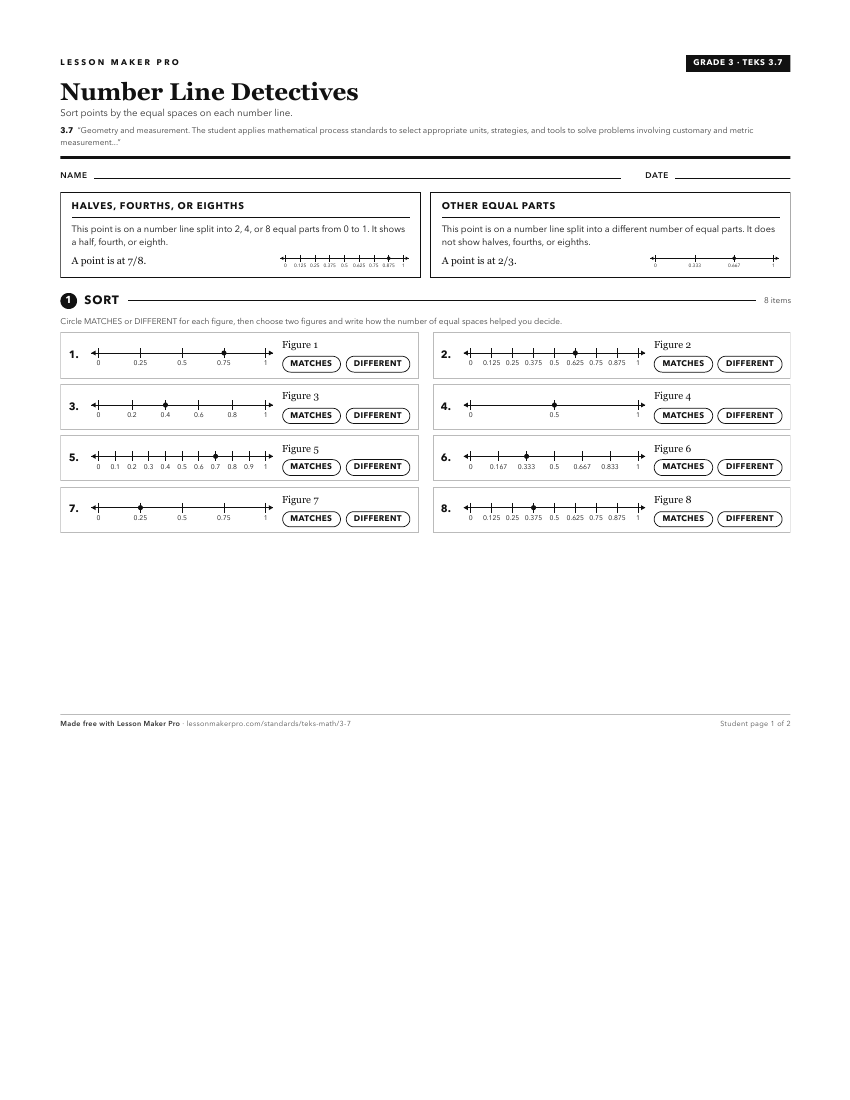
A ready-to-print activity worksheet aligned to 3.7, with an answer key for the teacher on its own page. No account needed.
PDF, US Letter, prints cleanly in black and white.
Download the worksheetKeep exploring
Related Standards
- 4.8
The student applies mathematical process standards to select appropriate customary and metric units, strategies, and tools to solve problems involving measureme...
- 5.7
The student applies mathematical process standards to select appropriate units, strategies, and tools to solve problems involving measurement. The student is ex...
- 1.7
The student applies mathematical process standards to select and use units to describe length and time
- 6.4
The student applies mathematical process standards to develop an understanding of proportional relationships in problem situations
Turn this cluster into a lesson
Grade, subject, topic, and the complete cluster are prefilled. Create one free, no account needed.
Also for this cluster:Make a WorksheetMake a QuizMake a Sub Lesson