TEKS Math 3.7.E
The Standard
determine liquid volume (capacity) or weight using appropriate units and tools
Texas Essential Knowledge and Skills for Mathematics
Teacher's field guide
What This Standard Means
What Students Need to Do
- Students measure how much liquid a container holds and how heavy an object is. They choose a suitable tool, read its markings, and report the measurement with units.
What Mastery Looks Like
- Students select a measuring cup or graduated container for liquids and a balance or scale for weight. They read the markings accurately and record each result with a reasonable unit.
Common Misconceptions
- Students may confuse capacity with weight or assume a larger container always holds more. They may choose the wrong tool, read a scale incorrectly, or leave units off answers.
How to Assess It
- Give each student a measuring cup, water, a scale, and a small object. Ask them to measure the water’s capacity and the object’s weight, including units.
Lesson moves
Ways to Teach It
Set up stations where students measure colored water with measuring cups and weigh classroom objects using a balance or digital scale.
Ask students to explain which tool and unit they would use for a water bottle, watermelon, soup pot, and paper clip.
Play a tool-and-unit matching game using cards labeled with objects, measuring tools, and units such as liters, milliliters, grams, and kilograms.
Use grocery packages and a simple drink recipe to compare labeled weights and measure the liquid needed for one batch.
Free download
Printable 3.7.E Worksheet
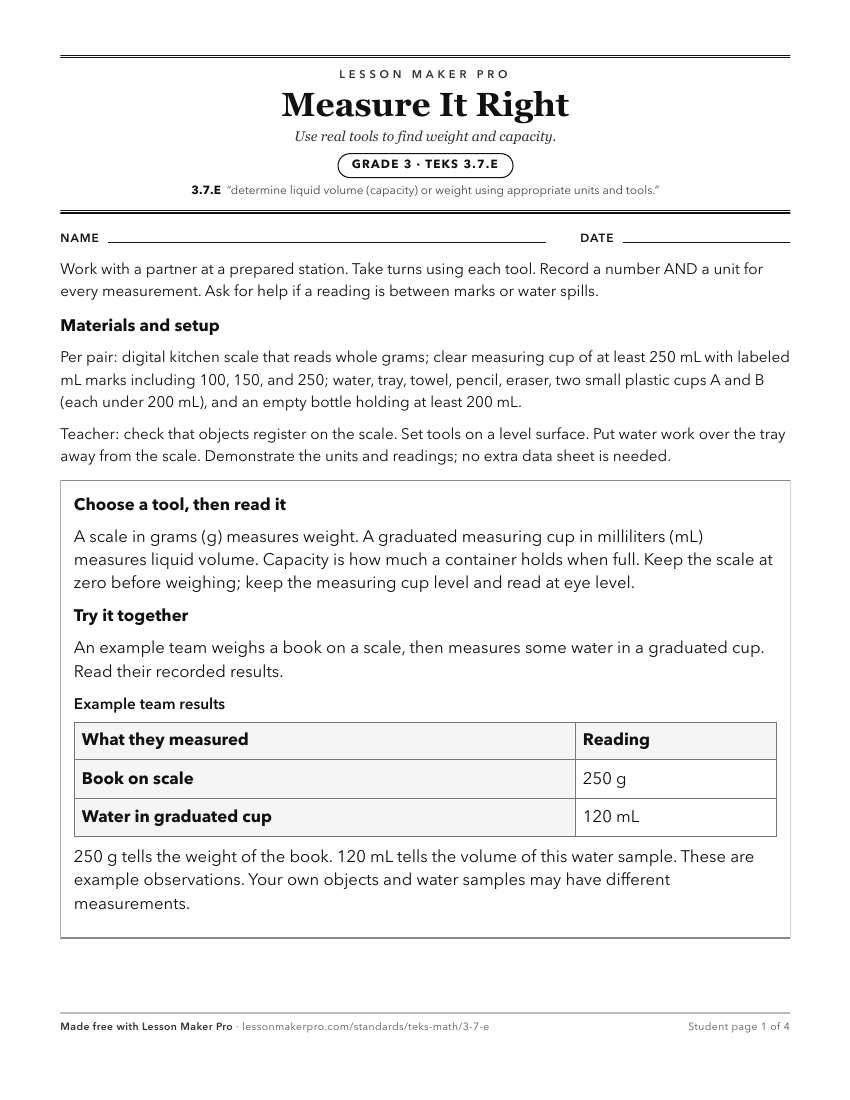
A ready-to-print activity worksheet aligned to 3.7.E, with an answer key for the teacher on its own page. No account needed.
PDF, US Letter, prints cleanly in black and white.
Download the worksheetKeep exploring
Related Standards
- 7.4.E
convert between measurement systems, including the use of proportions and the use of unit rates
- 3.7.D
determine when it is appropriate to use measurements of liquid volume (capacity) or weight
- 6.4.H
convert units within a measurement system, including the use of proportions and unit rates
- 4.8.C
solve problems that deal with measurements of length, intervals of time, liquid volumes, mass, and money using addition, subtraction, multiplication, or divisio...
Turn this exact standard into a lesson
Grade, subject, topic, and the complete standard are prefilled. Create one free, no account needed.
Also for this standard:Make a WorksheetMake a QuizMake a Sub Lesson