TEKS Math 3.7.D
The Standard
determine when it is appropriate to use measurements of liquid volume (capacity) or weight
Texas Essential Knowledge and Skills for Mathematics
Teacher's field guide
What This Standard Means
What Students Need to Do
- Students decide whether a situation is about how much liquid a container can hold or how heavy something is. They use context clues, tools, and units to explain their choice.
What Mastery Looks Like
- Students correctly choose capacity for how much liquid a container holds and weight for how heavy an item is. They can support each choice by naming a suitable tool or unit.
Common Misconceptions
- Students may assume large objects are always heavy or that small containers hold very little. They may also confuse how much a container can hold with how much liquid is currently inside it.
How to Assess It
- Give an exit ticket with two situations: the amount of juice a pitcher holds and the heaviness of a backpack. Students choose capacity or weight and explain each choice.
Lesson moves
Ways to Teach It
Set out cups, bottles, books, and bags; students place each beside a balance or measuring cup and explain the matching attribute.
Ask, “Would you describe a fish tank with capacity or weight, and when might each matter?” Students write two context-based answers.
Play a card sort with scenarios such as filling a pool or mailing a package, then have partners defend any disputed cards.
Examine labels on a milk jug and a bag of rice, then identify what each measurement tells a shopper.
Free download
Printable 3.7.D Worksheet
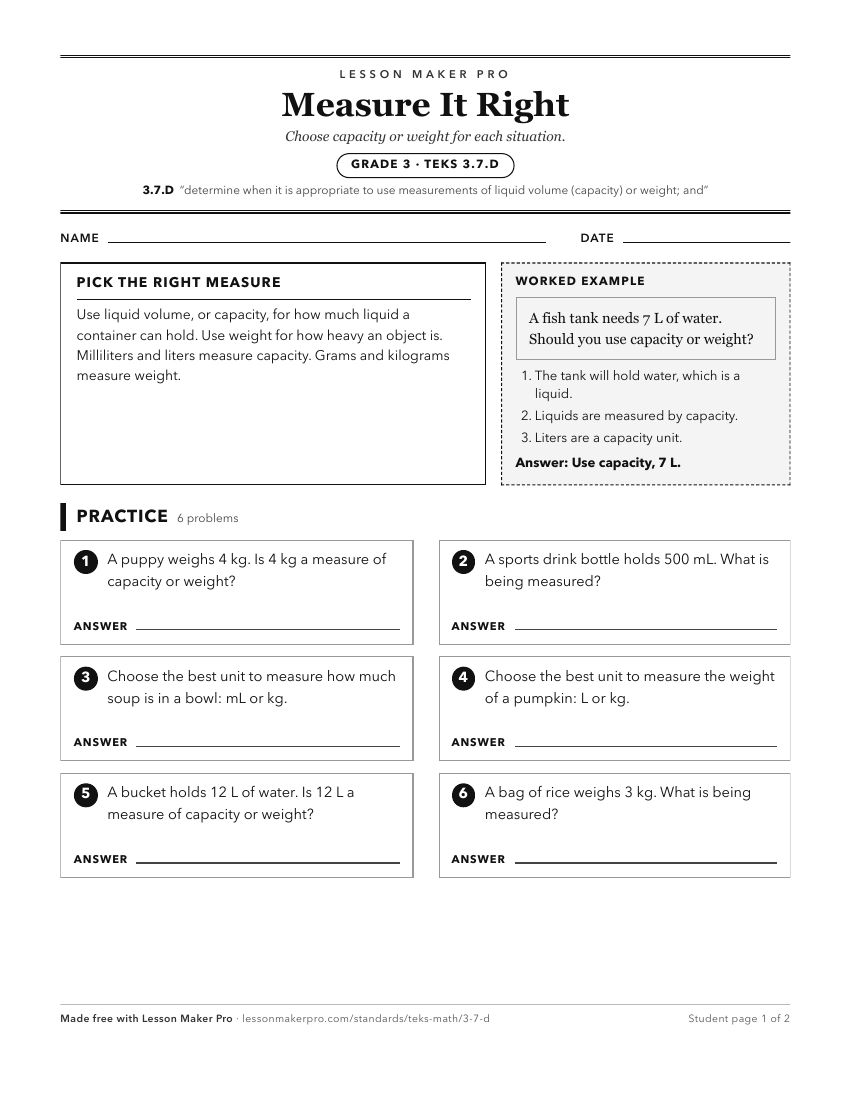
A ready-to-print activity worksheet aligned to 3.7.D, with an answer key for the teacher on its own page. No account needed.
PDF, US Letter, prints cleanly in black and white.
Download the worksheetKeep exploring
Related Standards
- 7.4.E
convert between measurement systems, including the use of proportions and the use of unit rates
- 4.8.C
solve problems that deal with measurements of length, intervals of time, liquid volumes, mass, and money using addition, subtraction, multiplication, or divisio...
- 3.7.E
determine liquid volume (capacity) or weight using appropriate units and tools
- K.7.A
give an example of a measurable attribute of a given object, including length, capacity, and weight
Turn this exact standard into a lesson
Grade, subject, topic, and the complete standard are prefilled. Create one free, no account needed.
Also for this standard:Make a WorksheetMake a QuizMake a Sub Lesson