TEKS Math K.7.A
The Standard
give an example of a measurable attribute of a given object, including length, capacity, and weight
Texas Essential Knowledge and Skills for Mathematics
Teacher's field guide
What This Standard Means
What Students Need to Do
- Students identify features of objects that can be measured. They give examples involving length, how much a container holds, or how heavy an object is.
What Mastery Looks Like
- A student names a sensible measurable feature for a given object. The student might describe a book’s length, a cup’s capacity, or a backpack’s weight.
Common Misconceptions
- Students may think a larger object is always heavier. They may confuse length with height or describe capacity for objects that cannot hold anything.
How to Assess It
- Show a water bottle and ask, “Name one thing about this bottle we could measure, and tell how we could measure it.”
Lesson moves
Ways to Teach It
Set out a book, cup, and toy truck, then have students match each object to length, capacity, or weight.
Ask, “What could we measure about a lunchbox?” and have students draw and label one measurable feature.
Play Attribute Sort by having students place object cards under length, capacity, or weight labels and explain each choice.
Examine classroom objects and discuss why a cook measures capacity, a builder measures length, and a grocer measures weight.
Free download
Printable K.7.A Worksheet
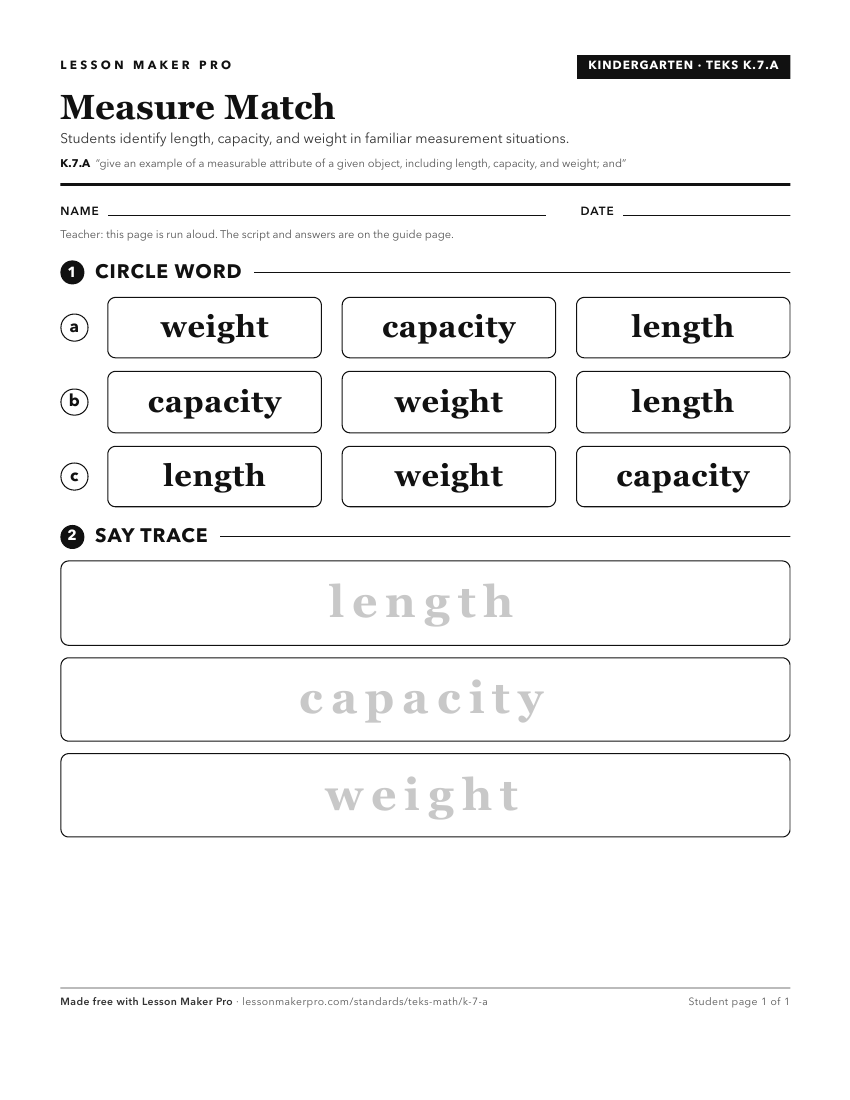
A ready-to-print activity worksheet aligned to K.7.A, with an answer key for the teacher on its own page. No account needed.
PDF, US Letter, prints cleanly in black and white.
Download the worksheetKeep exploring
Related Standards
- K.7.B
compare two objects with a common measurable attribute to see which object has more of/less of the attribute and describe the difference
- 1.7.A
use measuring tools to measure the length of objects to reinforce the continuous nature of linear measurement;
- 6.4.C
give examples of ratios as multiplicative comparisons of two quantities describing the same attribute
- 3.7.D
determine when it is appropriate to use measurements of liquid volume (capacity) or weight
Turn this exact standard into a lesson
Grade, subject, topic, and the complete standard are prefilled. Create one free, no account needed.
Also for this standard:Make a WorksheetMake a QuizMake a Sub Lesson