TEKS Math K.7.B
The Standard
compare two objects with a common measurable attribute to see which object has more of/less of the attribute and describe the difference
Texas Essential Knowledge and Skills for Mathematics
Teacher's field guide
What This Standard Means
What Students Need to Do
- Students focus on one shared feature, such as length, height, weight, or capacity. They compare two objects and say how one differs from the other.
What Mastery Looks Like
- Students compare two objects using the same feature and accurate comparison words. They can show their reasoning by aligning, lifting, filling, or placing the objects side by side.
Common Misconceptions
- Students may compare different features, such as one object's height with another object's weight. They may assume taller objects are always heavier or fail to align objects at the same starting point.
How to Assess It
- Give each student a pencil and a crayon. Ask, “Which is longer, and how can you show the difference?”
Lesson moves
Ways to Teach It
Give pairs two classroom objects to align, lift, and fill, then describe which is longer, heavier, or holds more.
Show a tall empty bottle and a short full bottle, then ask, “Which is heavier, and what evidence would prove it?”
Play Compare and Claim: partners choose two object cards, name one shared feature, and earn a counter for a correct comparison.
Compare two lunch containers with linking cubes, then choose which container would hold more food and explain why.
Free download
Printable K.7.B Worksheet
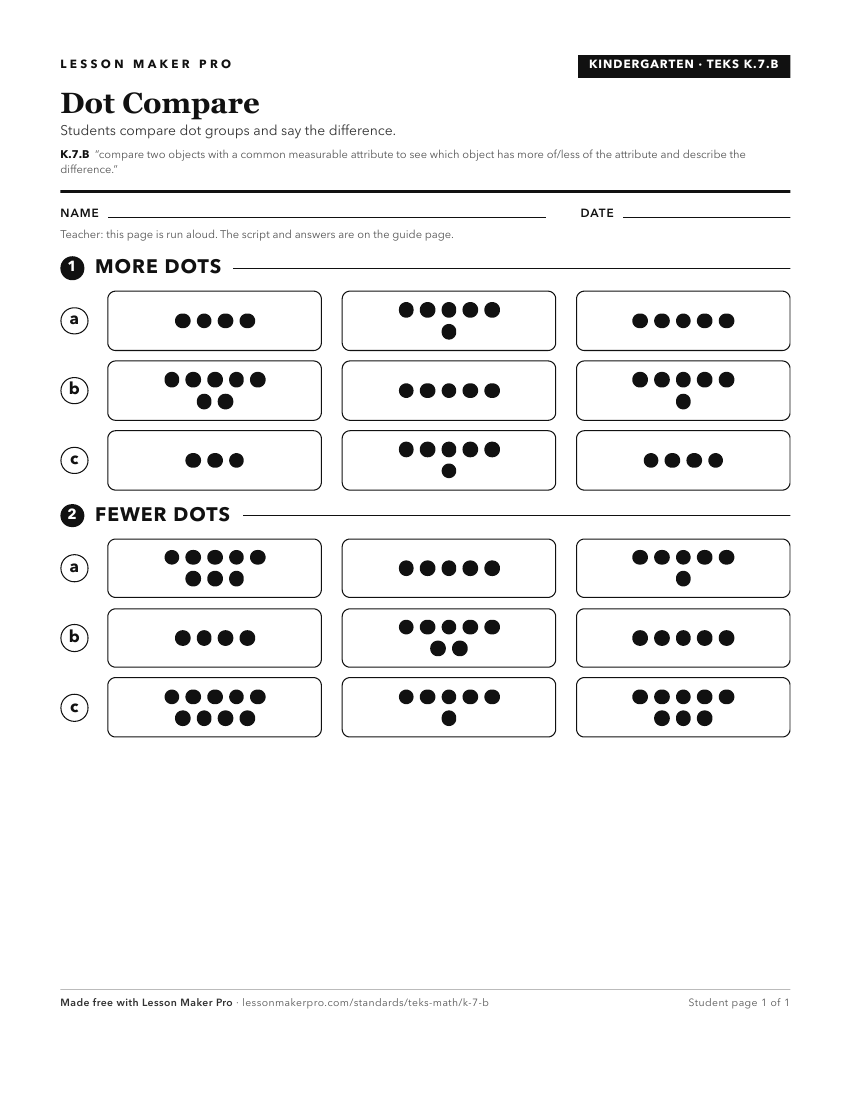
A ready-to-print activity worksheet aligned to K.7.B, with an answer key for the teacher on its own page. No account needed.
PDF, US Letter, prints cleanly in black and white.
Download the worksheetKeep exploring
Related Standards
- K.2.G
compare sets of objects up to at least 20 in each set using comparative language
- 6.4.C
give examples of ratios as multiplicative comparisons of two quantities describing the same attribute
- 1.7.C
measure the same object/distance with units of two different lengths and describe how and why the measurements differ
- K.7.A
give an example of a measurable attribute of a given object, including length, capacity, and weight
Turn this exact standard into a lesson
Grade, subject, topic, and the complete standard are prefilled. Create one free, no account needed.
Also for this standard:Make a WorksheetMake a QuizMake a Sub Lesson