TEKS Math 3.7.B
The Standard
determine the perimeter of a polygon or a missing length when given perimeter and remaining side lengths in problems
Texas Essential Knowledge and Skills for Mathematics
Teacher's field guide
What This Standard Means
What Students Need to Do
- Students add every side length to find the distance around a polygon. When one side is unknown, they subtract the known side lengths from the total perimeter.
What Mastery Looks Like
- Students include each side once, calculate accurately, and label answers with length units. They find a missing side and check it by adding all side lengths.
Common Misconceptions
- Students may confuse perimeter with area or add only the labeled sides. They may subtract one known side from the total instead of subtracting the sum of all known sides.
How to Assess It
- Use this exit ticket: A pentagon has sides of 3, 4, 5, 6, and 2 inches. Find its perimeter, then find a missing side if the perimeter is 25 inches and the other sides total 19 inches.
Lesson moves
Ways to Teach It
Tape a polygon on the floor, have students measure each side, add the lengths, then cover one measurement and find it from the total.
Ask students to explain why subtracting the sum of known sides finds a missing side, using a labeled polygon in their response.
Give pairs cards showing polygons, perimeters, and missing sides, then have them match each polygon with its correct solution card.
Plan the amount of fencing needed for a polygon-shaped garden, then calculate a missing side when the total fencing length is fixed.
Free download
Printable 3.7.B Worksheet
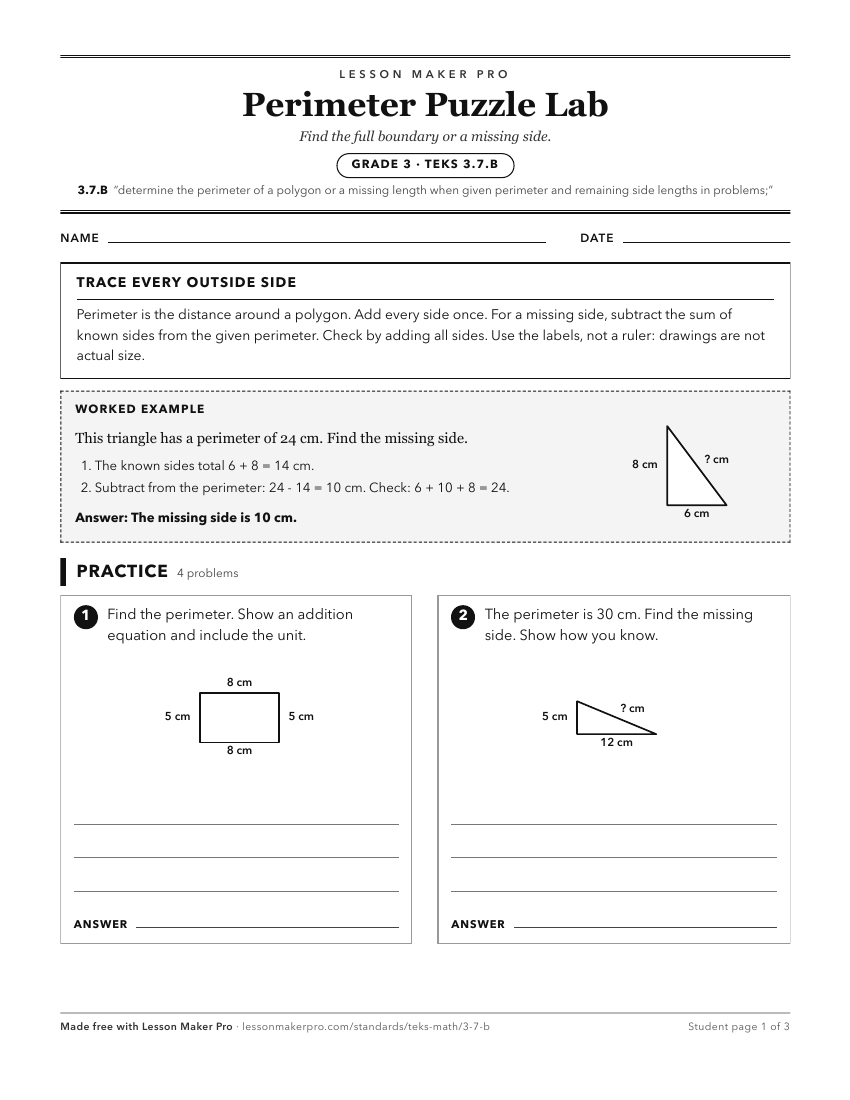
A ready-to-print activity worksheet aligned to 3.7.B, with an answer key for the teacher on its own page. No account needed.
PDF, US Letter, prints cleanly in black and white.
Download the worksheetKeep exploring
Related Standards
- 6.8.A
extend previous knowledge of triangles and their properties to include the sum of angles of a triangle, the relationship between the lengths of sides and measur...
- 5.4.H
represent and solve problems related to perimeter and/or area and related to volume
- 4.5.D
solve problems related to perimeter and area of rectangles where dimensions are whole numbers
- 2.9.E
determine a solution to a problem involving length, including estimating lengths
Turn this exact standard into a lesson
Grade, subject, topic, and the complete standard are prefilled. Create one free, no account needed.
Also for this standard:Make a WorksheetMake a QuizMake a Sub Lesson