TEKS Math 2.9.E
The Standard
determine a solution to a problem involving length, including estimating lengths
Texas Essential Knowledge and Skills for Mathematics
Teacher's field guide
What This Standard Means
What Students Need to Do
- Students decide whether to add, subtract, or compare measurements in a word problem. They estimate first, then use a drawing, number line, or equation to find and check an answer.
What Mastery Looks Like
- A student identifies the known and unknown lengths, chooses the correct operation, and shows an equation or drawing. The estimate is reasonable, and the exact answer includes the correct unit.
Common Misconceptions
- Students may treat an estimate as a random guess instead of using a nearby benchmark. They may mix centimeters and inches, choose addition when finding a difference, or leave units off the answer.
How to Assess It
- Exit ticket: A ribbon is 38 centimeters long. Mia cuts off 16 centimeters. Estimate the length left, then find the exact answer and label it.
Lesson moves
Ways to Teach It
Give pairs rulers and yarn. Students estimate each piece, measure it, then find how much longer one piece is.
Ask, "When would an estimate be enough, and when would you need an exact length?" Students write one example of each.
Play Length Problem Sort. Students match story cards to addition, subtraction, or comparison equations, then solve and label each answer.
Estimate and measure book widths, then calculate whether three chosen books will fit in a 30-centimeter shelf space.
Free download
Printable 2.9.E Worksheet
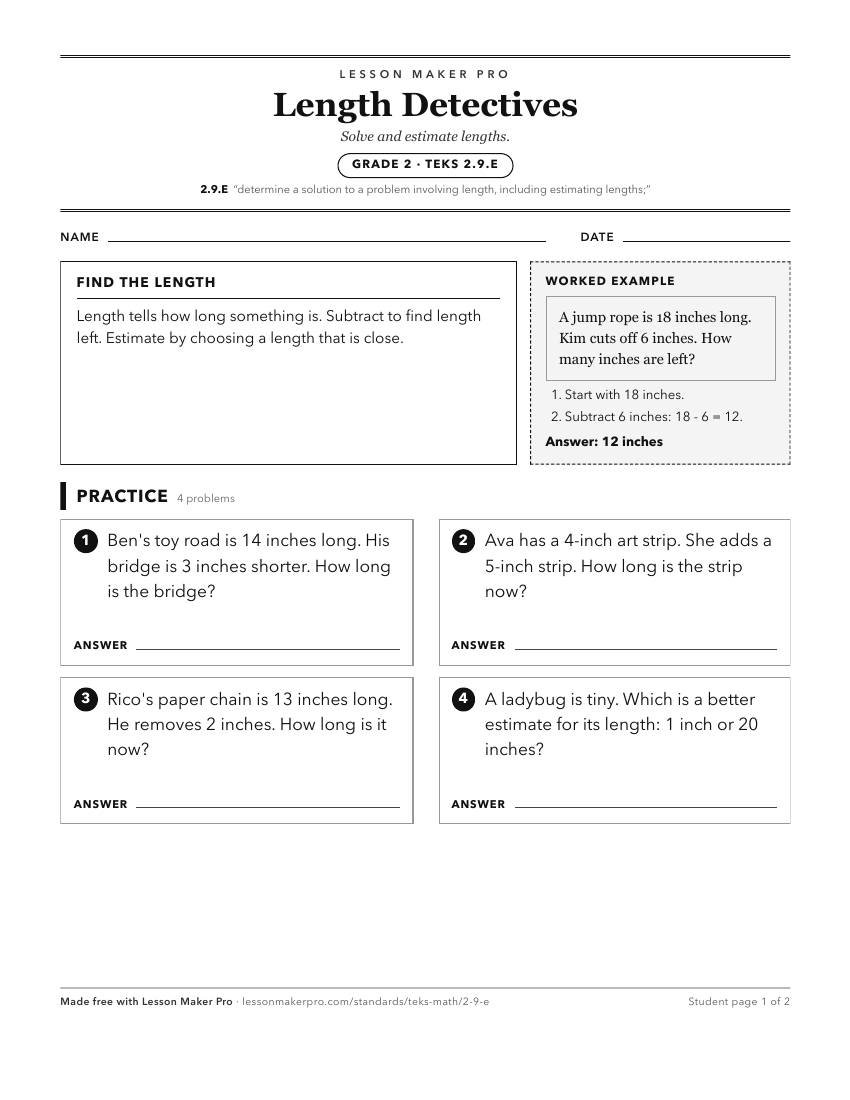
A ready-to-print activity worksheet aligned to 2.9.E, with an answer key for the teacher on its own page. No account needed.
PDF, US Letter, prints cleanly in black and white.
Download the worksheetKeep exploring
Related Standards
- 5.3.A
estimate to determine solutions to mathematical and real-world problems involving addition, subtraction, multiplication, or division
- 2.9.A
find the length of objects using concrete models for standard units of length
- 2.9.D
determine the length of an object to the nearest marked unit using rulers, yardsticks, meter sticks, or measuring tapes
- 4.8.C
solve problems that deal with measurements of length, intervals of time, liquid volumes, mass, and money using addition, subtraction, multiplication, or divisio...
Turn this exact standard into a lesson
Grade, subject, topic, and the complete standard are prefilled. Create one free, no account needed.
Also for this standard:Make a WorksheetMake a QuizMake a Sub Lesson