TEKS Math 4.8.A
The Standard
identify relative sizes of measurement units within the customary and metric systems
Texas Essential Knowledge and Skills for Mathematics
Teacher's field guide
What This Standard Means
What Students Need to Do
- Students compare common customary and metric units used for length, capacity, weight, and mass. They order units by size without needing to complete full conversions.
What Mastery Looks Like
- A student can order common length, capacity, weight, and mass units from smallest to largest. The student can explain comparisons using familiar benchmarks, such as a gallon being larger than a cup.
Common Misconceptions
- Students may think a longer unit name means a larger unit, or reverse the order of metric prefixes. They may also confuse ounces with fluid ounces or compare units that measure different attributes.
How to Assess It
- Exit ticket: Order inch, foot, yard, and mile, then circle the larger unit in each pair: liter/milliliter, gram/kilogram, cup/gallon.
Lesson moves
Ways to Teach It
Give groups rulers, measuring cups, containers, and mass labels to sort from smallest unit to largest unit within each measurement type.
Ask students to explain why meters and liters cannot be ordered together, even though both are metric units.
Play Unit War with cards showing measurement units, and have partners name which card represents the larger unit.
Use grocery packages and drink containers to compare pounds, ounces, liters, and milliliters found on real labels.
Free download
Printable 4.8.A Worksheet
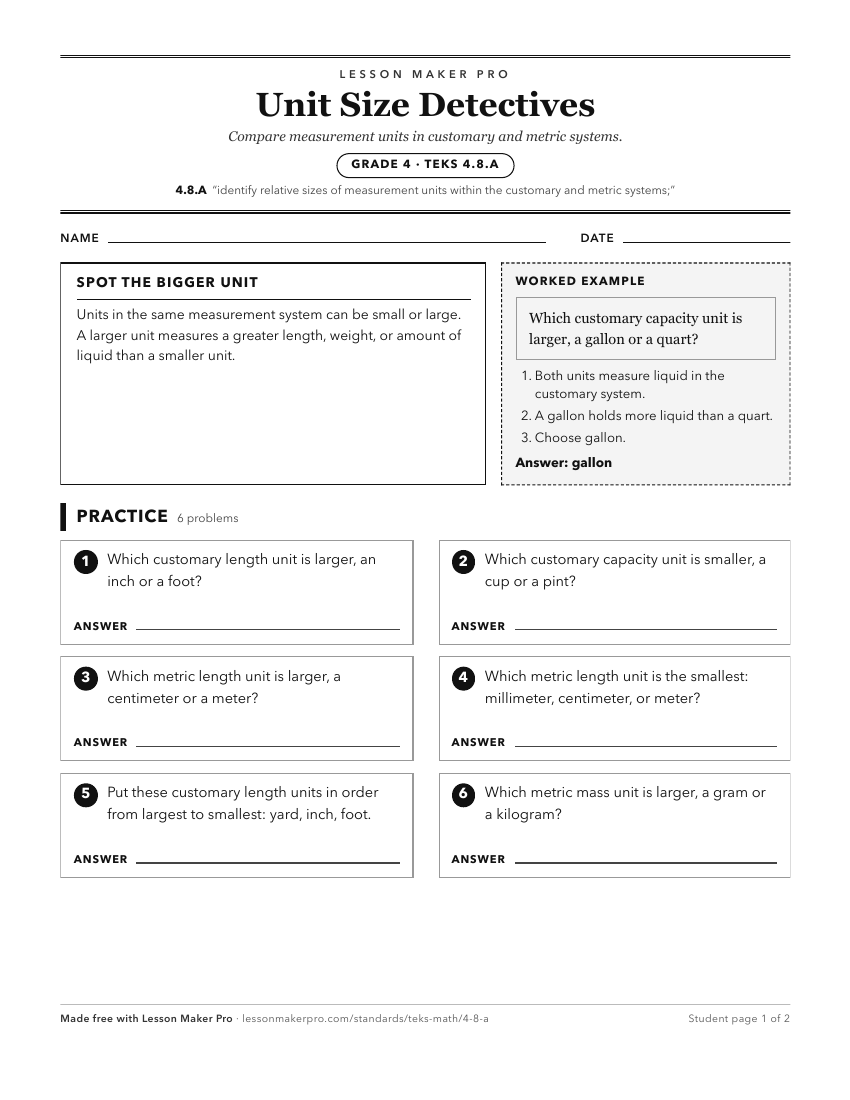
A ready-to-print activity worksheet aligned to 4.8.A, with an answer key for the teacher on its own page. No account needed.
PDF, US Letter, prints cleanly in black and white.
Download the worksheetKeep exploring
Related Standards
- 7.4.E
convert between measurement systems, including the use of proportions and the use of unit rates
- 6.4.H
convert units within a measurement system, including the use of proportions and unit rates
- 4.8.B
convert measurements within the same measurement system, customary or metric, from a smaller unit into a larger unit or a larger unit into a smaller unit when g...
- 1.7.C
measure the same object/distance with units of two different lengths and describe how and why the measurements differ
Turn this exact standard into a lesson
Grade, subject, topic, and the complete standard are prefilled. Create one free, no account needed.
Also for this standard:Make a WorksheetMake a QuizMake a Sub Lesson