TEKS Math 1.7.E
The Standard
tell time to the hour and half hour using analog and digital clocks
Texas Essential Knowledge and Skills for Mathematics
Teacher's field guide
What This Standard Means
What Students Need to Do
- Students read and show times that fall exactly on an hour or halfway between hours. They connect clock hands with matching number displays and time words.
What Mastery Looks Like
- Students read a clock face and write the matching digital time. They set both clock types correctly and use phrases such as “six o’clock” and “half past six.”
Common Misconceptions
- Students may switch the hour and minute hands or think the longer hand shows the hour. At half past, they may name the next hour because the short hand sits between numbers.
How to Assess It
- Show clocks reading 4:00 and 7:30. Ask students to write each digital time and explain what each hand shows.
Lesson moves
Ways to Teach It
Give students paper clocks with movable hands, then call out times for them to build and show.
Display 3:30 and ask, “Why is the short hand between 3 and 4?” Students explain with a partner.
Play clock match by pairing analog clock cards with digital time cards showing hours and half hours.
Use a class schedule to match familiar events, such as lunch or dismissal, with analog and digital clock displays.
Free download
Printable 1.7.E Worksheet
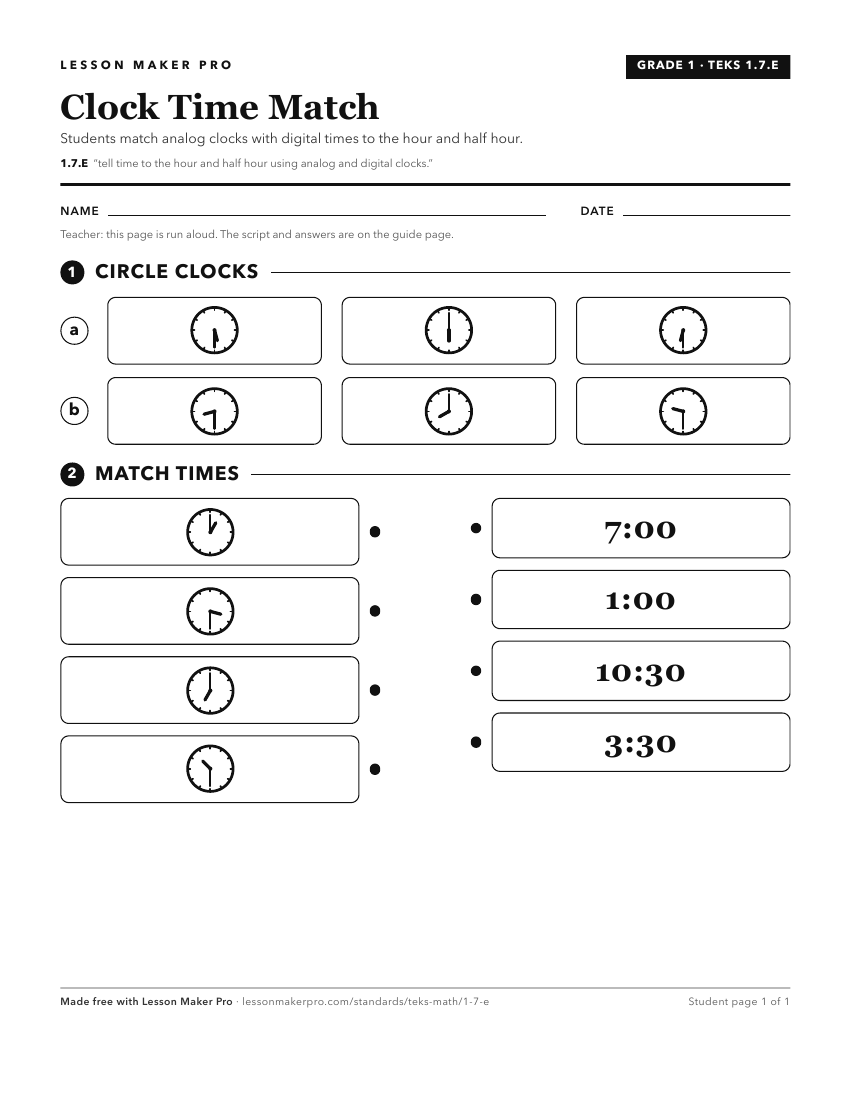
A ready-to-print activity worksheet aligned to 1.7.E, with an answer key for the teacher on its own page. No account needed.
PDF, US Letter, prints cleanly in black and white.
Download the worksheetKeep exploring
Related Standards
- 3.7.A
represent fractions of halves, fourths, and eighths as distances from zero on a number line
- 2.3.D
identify examples and non-examples of halves, fourths, and eighths
- 2.9.G
read and write time to the nearest one-minute increment using analog and digital clocks and distinguish between a.m. and p.m
- 3.7.C
determine the solutions to problems involving addition and subtraction of time intervals in minutes using pictorial models or tools such as a 15-minute event pl...
Turn this exact standard into a lesson
Grade, subject, topic, and the complete standard are prefilled. Create one free, no account needed.
Also for this standard:Make a WorksheetMake a QuizMake a Sub Lesson