TEKS Math 2.9.G
The Standard
read and write time to the nearest one-minute increment using analog and digital clocks and distinguish between a.m. and p.m
Texas Essential Knowledge and Skills for Mathematics
Teacher's field guide
What This Standard Means
What Students Need to Do
- Students use the hour hand, minute hand, and individual minute marks to determine an exact time. They record the time with digits and decide whether an event happens in the morning or later in the day.
What Mastery Looks Like
- A student can read an analog clock showing 7:43 and write 7:43 on a digital display. The student can draw clock hands for 3:54 and choose a.m. or p.m. for a stated event.
Common Misconceptions
- Students may confuse the hour and minute hands or count minute marks as hours. They may name the next hour when the hour hand is between numbers. They may also mix up noon and midnight when choosing a.m. or p.m.
How to Assess It
- Show an analog clock set to 8:27. Ask students to write the digital time and label it a.m. or p.m. for arriving at school.
Lesson moves
Ways to Teach It
Give pairs a geared clock, call out times such as 4:18, and have students set both hands accurately.
Ask students to explain how they know whether 6:35 for eating dinner should be labeled a.m. or p.m.
Play clock match by pairing analog clock cards, digital time cards, and event cards labeled a.m. or p.m.
Create a class daily schedule with exact times for arrival, lunch, recess, dismissal, bedtime, and waking up.
Free download
Printable 2.9.G Worksheet
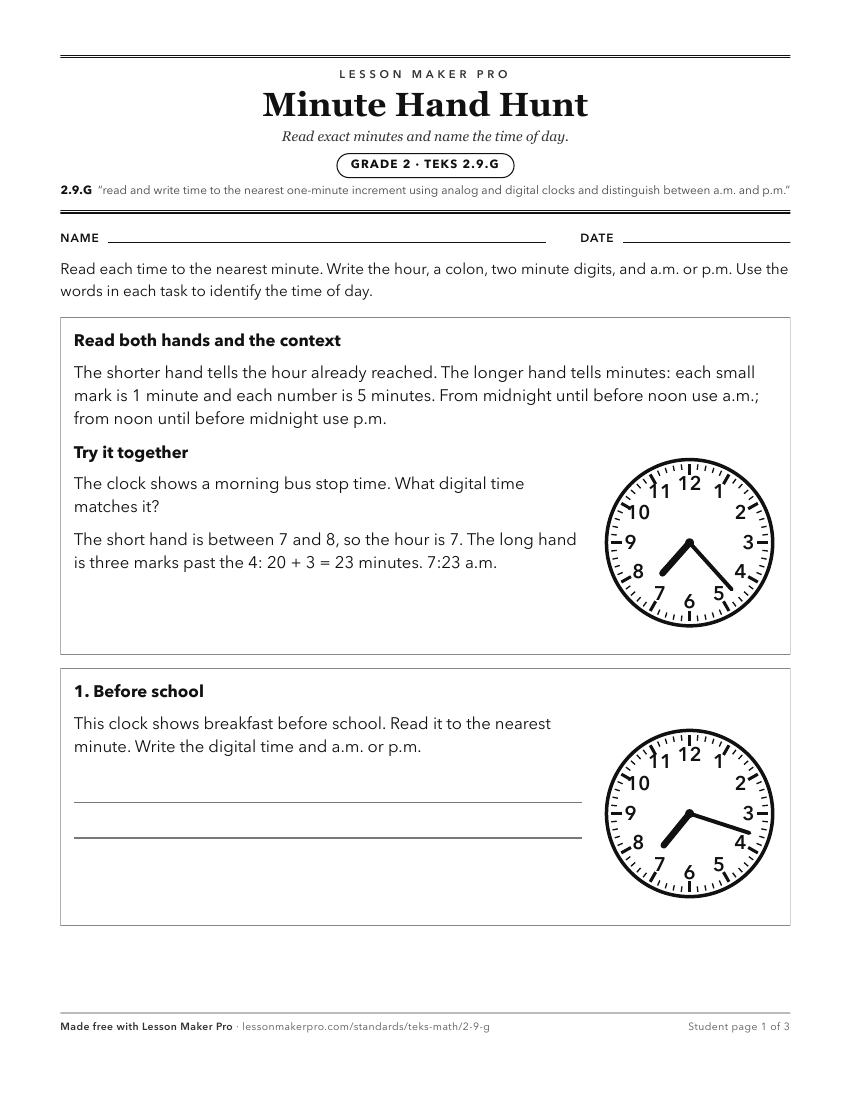
A ready-to-print activity worksheet aligned to 2.9.G, with an answer key for the teacher on its own page. No account needed.
PDF, US Letter, prints cleanly in black and white.
Download the worksheetKeep exploring
Related Standards
- 2.10.C
write and solve one-step word problems involving addition or subtraction using data represented within pictographs and bar graphs with intervals of one
- 1.7.E
tell time to the hour and half hour using analog and digital clocks
- K.2.B
read, write, and represent whole numbers from 0 to at least 20 with and without objects or pictures
- 3.7.C
determine the solutions to problems involving addition and subtraction of time intervals in minutes using pictorial models or tools such as a 15-minute event pl...
Turn this exact standard into a lesson
Grade, subject, topic, and the complete standard are prefilled. Create one free, no account needed.
Also for this standard:Make a WorksheetMake a QuizMake a Sub Lesson