TEKS ELAR K.8
Knowledge and Skills Statement (Standard Cluster)
The student recognizes and analyzes genre-specific characteristics, structures, and purposes within and across increasingly complex traditional, contemporary, classical, and diverse texts.
Texas Essential Knowledge and Skills for English Language Arts and Reading
Cluster contents
Student Expectations in This Statement
K.8 is a knowledge and skills statement. These are the student expectations under it.
- K.8.A
demonstrate knowledge of distinguishing characteristics of well-known children's literature such as folktales, fables, fairy tales, and nursery rhymes
- K.8.B
discuss rhyme and rhythm in nursery rhymes and a variety of poems
- K.8.C
discuss main characters in drama
- K.8.D.i
the central idea and supporting evidence with adult assistance
- K.8.D.ii
titles and simple graphics to gain information
- K.8.D.iii
the steps in a sequence with adult assistance
- K.8.E
recognize characteristics of persuasive text with adult assistance and state what the author is trying to persuade the reader to think or do
- K.8.F
recognize characteristics of multimodal and digital texts.
Teacher's field guide
What This Cluster Means
What Students Need to Do
- Students use text clues to identify folktales, fables, fairy tales, nursery rhymes, dramas, informational texts, and persuasive texts. They discuss rhyme, rhythm, main characters, central ideas, supporting evidence, titles, graphics, and sequence. With adult help, they explain the author’s persuasive goal and notice how words, pictures, sound, and video work together.
What Mastery Looks Like
- A student can sort familiar texts by genre and name a feature that supports each choice. They can identify rhyme and rhythm, name a drama’s main characters, and use titles, pictures, and numbered steps. With prompts, they can state a central idea, give supporting evidence, explain a persuasive goal, and identify digital features.
Common Misconceptions
- Students may sort texts by topic or cover art instead of genre features. They may call repeated words rhymes, confuse rhythm with rhyme, or name one detail as the central idea. They may think every text gives facts and miss when an author wants them to think or act.
How to Assess It
- Give each student a nursery rhyme, a simple informational page, and a picture advertisement. Ask them to name each type, circle one clue, and tell the rhyme, central idea, or persuasive message.
Lesson moves
Ways to Teach It
Place book covers and sample pages in genre baskets, then have pairs sort them and point to the feature that guided each choice.
Read a nursery rhyme aloud twice, then ask, “Which words rhyme, and where do you hear the beat?”
Play Genre Detective with clue cards such as talking animals, stage directions, facts, numbered steps, and a message asking readers to act.
Compare a weather app, a cereal advertisement, and a recipe, then name how pictures, sound, labels, and steps help each text.
Free download
Printable K.8 Worksheet
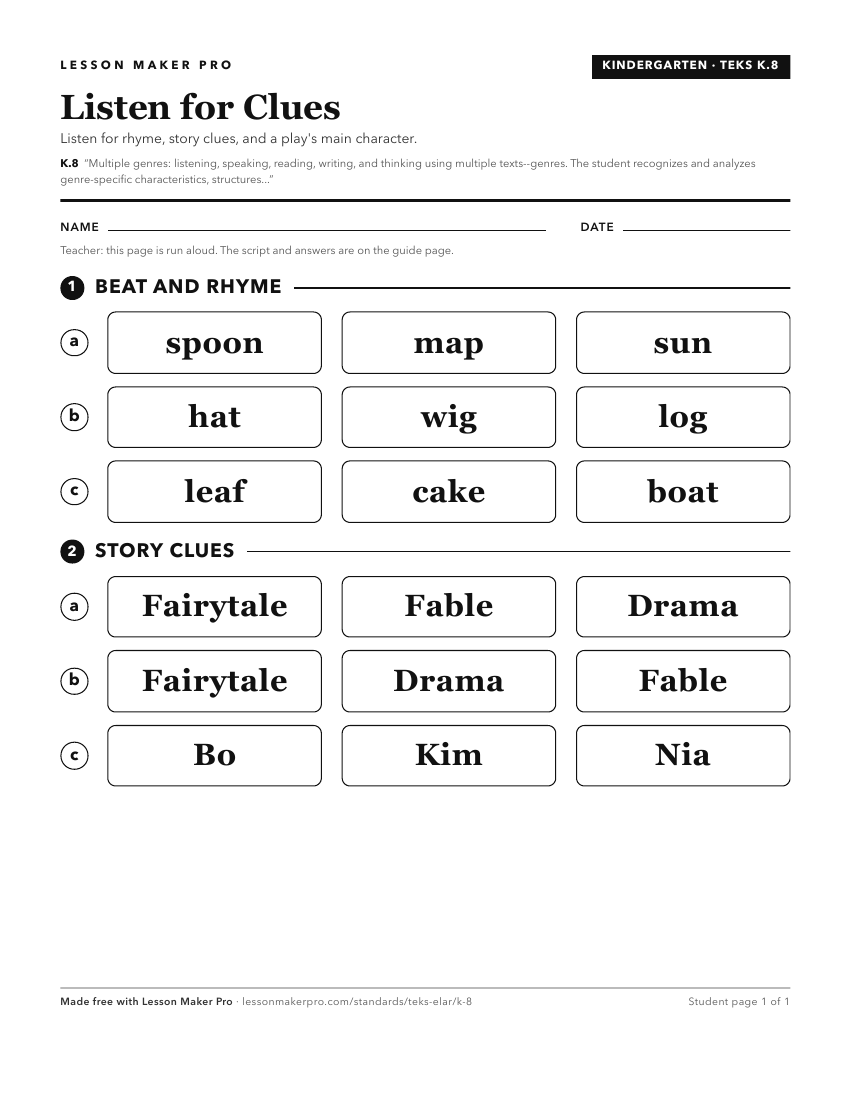
A ready-to-print activity worksheet aligned to K.8, with an answer key for the teacher on its own page. No account needed.
PDF, US Letter, prints cleanly in black and white.
Download the worksheetKeep exploring
Related Standards
Turn this cluster into a lesson
Grade, subject, topic, and the complete cluster are prefilled. Create one free, no account needed.
Also for this cluster:Make a WorksheetMake a QuizMake a Sub Lesson