TEKS ELAR 5.3
Knowledge and Skills Statement (Standard Cluster)
The student uses newly acquired vocabulary expressively.
Texas Essential Knowledge and Skills for English Language Arts and Reading
Cluster contents
Student Expectations in This Statement
5.3 is a knowledge and skills statement. These are the student expectations under it.
- 5.3.A
use print or digital resources to determine meaning, syllabication, pronunciation, and word origin
- 5.3.B
use context within and beyond a sentence to determine the relevant meaning of unfamiliar words or multiple-meaning words
- 5.3.C
identify the meaning of and use words with affixes such as trans-, super-, -ive, and -logy and roots such as geo and photo
- 5.3.D
identify, use, and explain the meaning of adages and puns.
Teacher's field guide
What This Cluster Means
What Students Need to Do
- Students use print and digital references to find a word’s meaning, syllables, pronunciation, and origin. They use context and word parts to understand words. They also explain and use adages, puns, and new vocabulary.
What Mastery Looks Like
- Students select the correct meaning of an unfamiliar or multiple-meaning word and point to context clues that support it. They use references accurately, analyze word parts, and explain and apply adages and puns.
Common Misconceptions
- Students often choose the first dictionary definition without checking the surrounding text. They may confuse roots with affixes, interpret adages literally, or label any joke as a pun.
How to Assess It
- Give students a paragraph containing “transcontinental” and an adage. Ask them to define the word using context and word parts, verify it with a dictionary, and explain the adage.
Lesson moves
Ways to Teach It
Give groups root and affix cards to build words, predict meanings, and verify each word with a print or digital dictionary.
Compare two sentences using “bright,” then have students explain each meaning and write a new sentence for both meanings.
Teams draw an adage or pun card, identify its type, explain its meaning, and use it in a new line.
Students find an unfamiliar word in a news headline, check its pronunciation and origin, then explain why its meaning fits the headline.
Free download
Printable 5.3 Worksheet
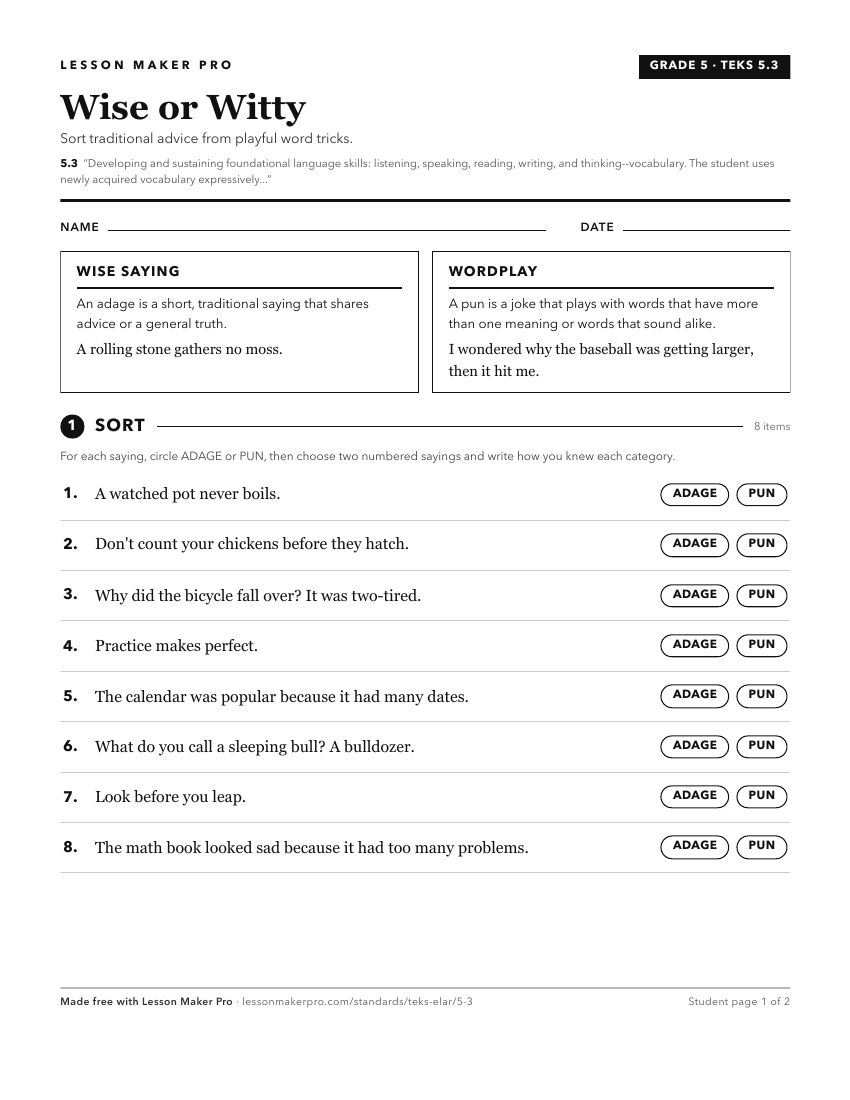
A ready-to-print activity worksheet aligned to 5.3, with an answer key for the teacher on its own page. No account needed.
PDF, US Letter, prints cleanly in black and white.
Download the worksheetKeep exploring
Related Standards
Turn this cluster into a lesson
Grade, subject, topic, and the complete cluster are prefilled. Create one free, no account needed.
Also for this cluster:Make a WorksheetMake a QuizMake a Sub Lesson