TEKS ELAR 5.3.C
The Standard
identify the meaning of and use words with affixes such as trans-, super-, -ive, and -logy and roots such as geo and photo
Texas Essential Knowledge and Skills for English Language Arts and Reading
Teacher's field guide
What This Standard Means
What Students Need to Do
- Students split unfamiliar words into meaningful parts and use those parts, along with context, to work out the whole meaning. They then use the new words accurately when speaking or writing.
What Mastery Looks Like
- A student can mark known word parts, propose a sensible meaning, and check it against context. The student can then use the word with correct meaning and grammar.
Common Misconceptions
- Students may define a whole word from one part and ignore the base word or context. They may think photo always means picture, treat -logy as an object, or use an -ive adjective as a noun.
How to Assess It
- Exit ticket: Underline useful word parts in transatlantic, superhuman, supportive, geology, and photograph. Define each word, then use two in sentences that make their meanings clear.
Lesson moves
Ways to Teach It
Give pairs prefix, root, suffix, and base-word cards to build and define transport, superhuman, creative, geology, geography, and photograph.
Students answer the prompt, “How do the parts of geography and photograph help reveal each word’s meaning?”
Play Affix Match, where students pair word cards with meaning cards and earn a point by using each matched word correctly.
Students photograph or copy five words from signs, labels, or science texts, then annotate the word parts and likely meanings.
Free download
Printable 5.3.C Worksheet
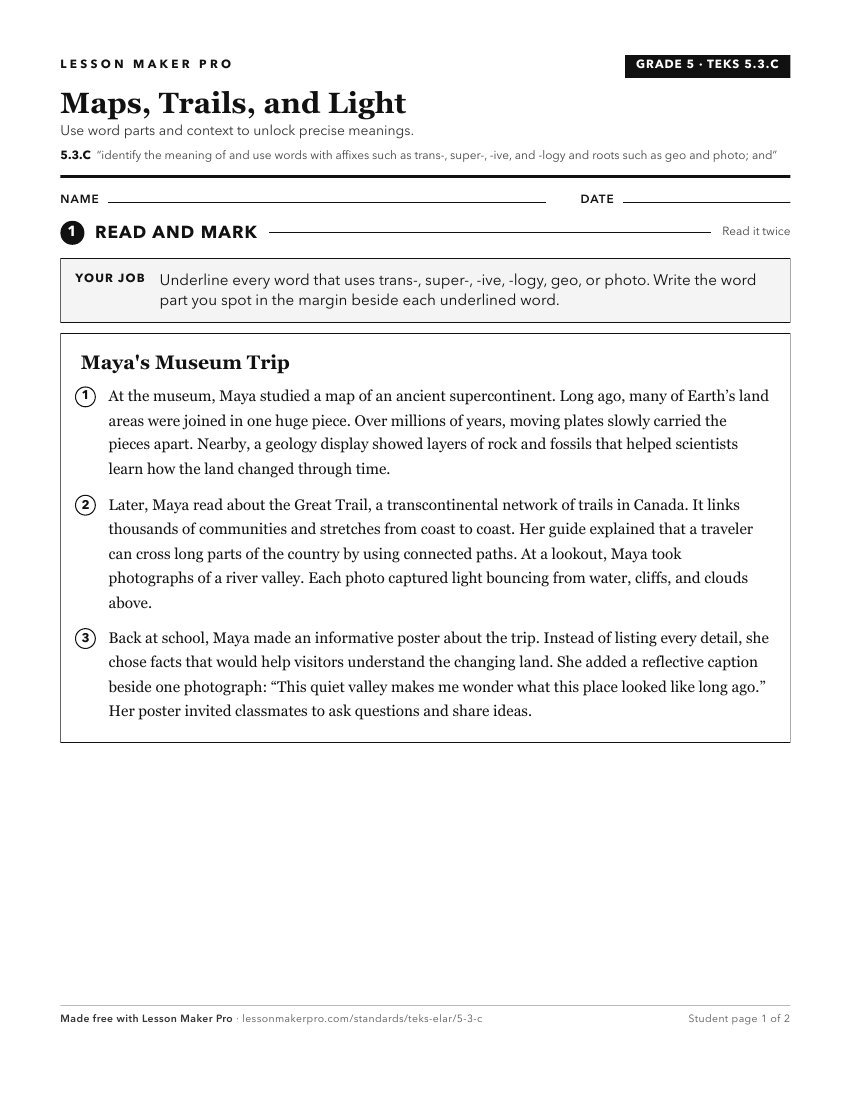
A ready-to-print activity worksheet aligned to 5.3.C, with an answer key for the teacher on its own page. No account needed.
PDF, US Letter, prints cleanly in black and white.
Download the worksheetKeep exploring
Related Standards
- 3.3.C
identify the meaning of and use words with affixes such as im- into, non-, dis-, in- not, non, pre-, -ness, -y, and -ful; and
- 2.3.C
identify the meaning of and use words with affixes un-, re-, -ly, -er, and -est comparative and superlative, and -ion/tion/sion; and
- 1.3.C
identify the meaning of words with the affixes -s, -ed, and -ing; and
- 4.3.C
determine the meaning of and use words with affixes such as mis-, sub-, -ment, and -ity/ty and roots such as auto, graph, and meter; and
Turn this exact standard into a lesson
Grade, subject, topic, and the complete standard are prefilled. Create one free, no account needed.
Also for this standard:Make a WorksheetMake a QuizMake a Sub Lesson