TEKS ELAR 2.3.C
The Standard
identify the meaning of and use words with affixes un-, re-, -ly, -er, and -est comparative and superlative, and -ion/tion/sion
Texas Essential Knowledge and Skills for English Language Arts and Reading
Teacher's field guide
What This Standard Means
What Students Need to Do
- Students identify a base word and the word part added before or after it. They explain the new meaning and use the completed word correctly when speaking or writing.
What Mastery Looks Like
- Students break an unfamiliar word into its base and added word part, then explain the word’s meaning. They correctly use words such as rewrite, slowly, taller, tallest, action, and decision in sentences.
Common Misconceptions
- Students may confuse un- with re- or use -est when comparing only two things. They may also add endings without needed spelling changes, as in happyer instead of happier.
How to Assess It
- Exit ticket: Underline the added word part in unhappy, replay, slowly, taller, tallest, action, and decision, then write each word’s meaning. Use any three words in complete sentences.
Lesson moves
Ways to Teach It
Give pairs base-word and affix cards to combine, read, define, and sort by how each added part changes meaning.
Ask students to compare three classroom objects in writing, using one word ending in -er and one ending in -est.
Play affix bingo by reading meanings aloud, then have students cover the matching word and use it in a sentence.
Have students find affixed words on classroom signs, book covers, or lunch menus, then explain each word to a partner.
Free download
Printable 2.3.C Worksheet
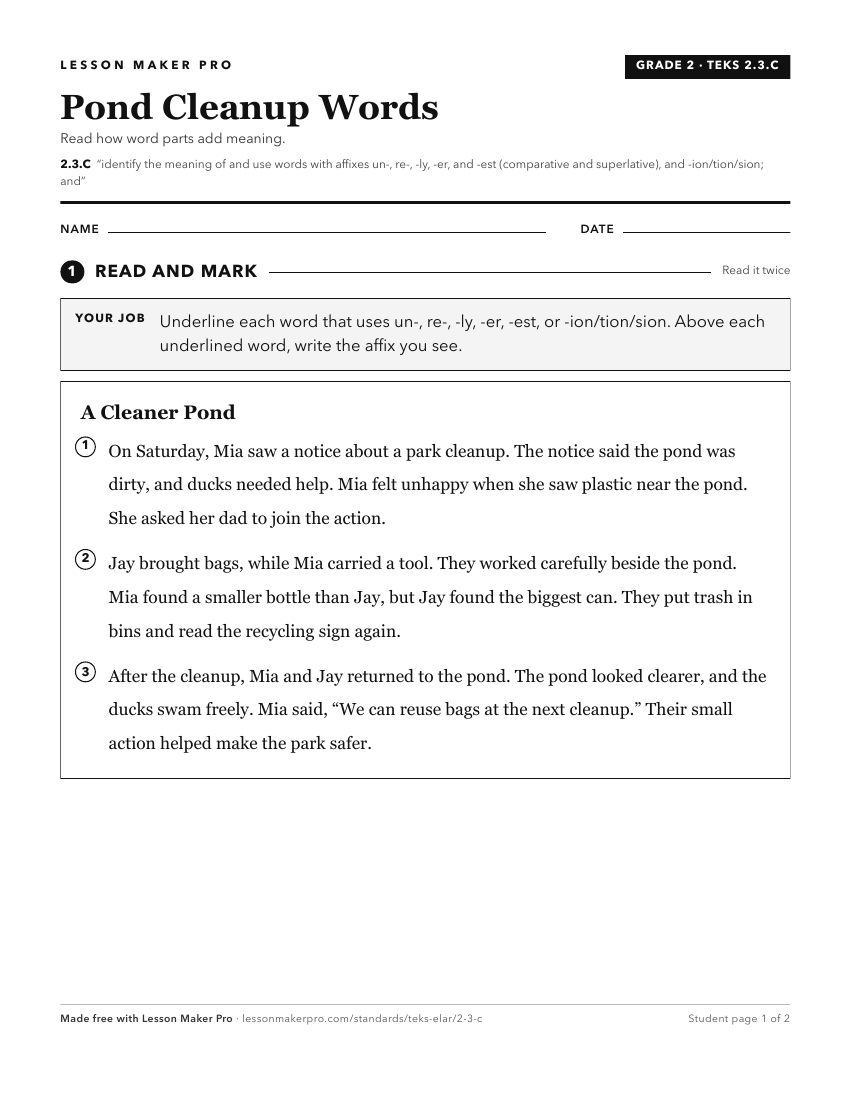
A ready-to-print activity worksheet aligned to 2.3.C, with an answer key for the teacher on its own page. No account needed.
PDF, US Letter, prints cleanly in black and white.
Download the worksheetKeep exploring
Related Standards
- 3.3.C
identify the meaning of and use words with affixes such as im- into, non-, dis-, in- not, non, pre-, -ness, -y, and -ful; and
- 5.3.C
identify the meaning of and use words with affixes such as trans-, super-, -ive, and -logy and roots such as geo and photo; and
- 1.3.C
identify the meaning of words with the affixes -s, -ed, and -ing; and
- 4.3.C
determine the meaning of and use words with affixes such as mis-, sub-, -ment, and -ity/ty and roots such as auto, graph, and meter; and
Turn this exact standard into a lesson
Grade, subject, topic, and the complete standard are prefilled. Create one free, no account needed.
Also for this standard:Make a WorksheetMake a QuizMake a Sub Lesson