TEKS ELAR 1.3.C
The Standard
identify the meaning of words with the affixes -s, -ed, and -ing
Texas Essential Knowledge and Skills for English Language Arts and Reading
Teacher's field guide
What This Standard Means
What Students Need to Do
- Students use word endings to work out meaning. They tell whether a word names more than one, an action that already happened, or an action happening now.
What Mastery Looks Like
- Given jump, jumped, and jumping, students explain when each action happens. They recognize that cats means more than one cat and runs names a present action.
Common Misconceptions
- Students may think every final s means more than one, even in a verb like runs. They may confuse -ed with happening now or -ing with an action that already ended.
How to Assess It
- Exit ticket: Draw or write what each word means: cat, cats, jumped, and jumping. Underline the ending that changes each base word.
Lesson moves
Ways to Teach It
Have students sort word cards under three labels: more than one, already happened, and happening now.
Ask students to explain how adding -s, -ed, or -ing changes the meaning of play.
Play ending charades: one student acts out walked or walking while classmates choose the matching word card.
Use classroom routines to compare sentences such as Ava walks, Ava walked, and Ava is walking.
Free download
Printable 1.3.C Worksheet
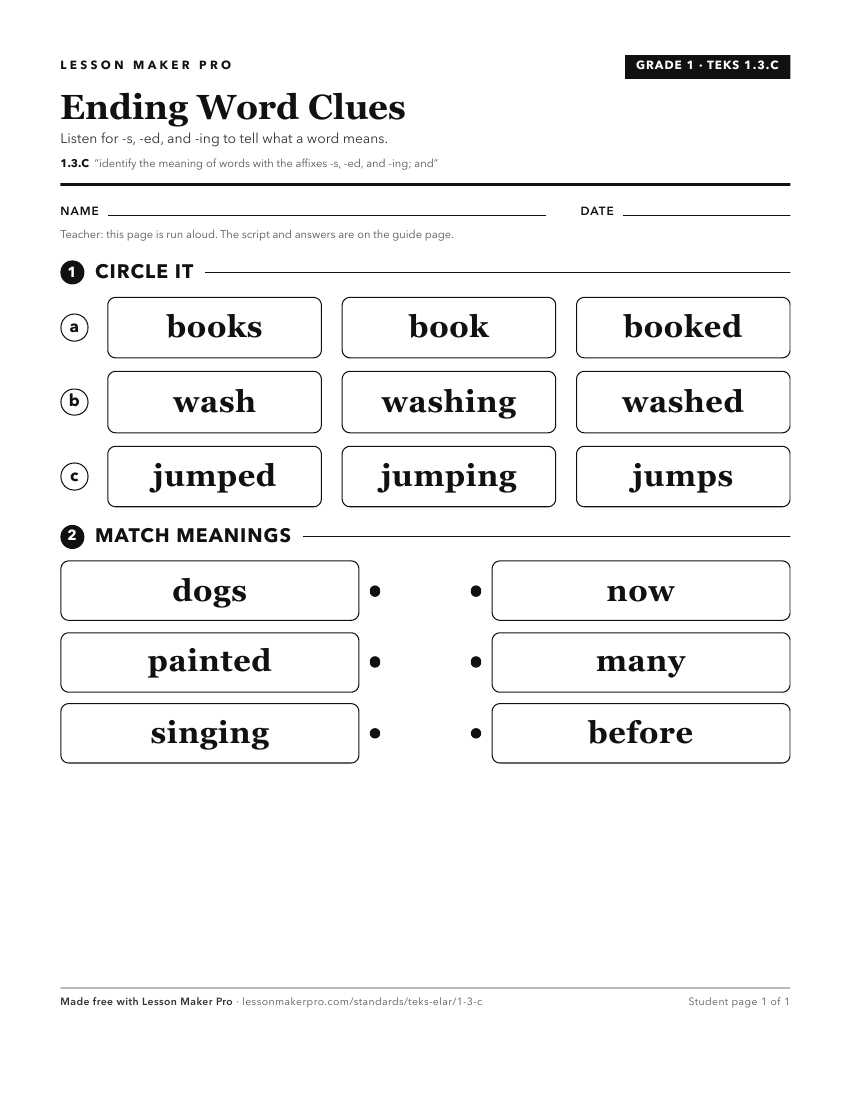
A ready-to-print activity worksheet aligned to 1.3.C, with an answer key for the teacher on its own page. No account needed.
PDF, US Letter, prints cleanly in black and white.
Download the worksheetKeep exploring
Related Standards
- 3.3.C
identify the meaning of and use words with affixes such as im- into, non-, dis-, in- not, non, pre-, -ness, -y, and -ful; and
- 2.3.C
identify the meaning of and use words with affixes un-, re-, -ly, -er, and -est comparative and superlative, and -ion/tion/sion; and
- 1.2.B.v
decoding words with inflectional endings, including -ed, -s, and -es; and
- 2.2.B.vi
decoding words with prefixes, including un-, re-, and dis-, and inflectional endings, including -s, -es, -ed, -ing, -er, and -est; and
Turn this exact standard into a lesson
Grade, subject, topic, and the complete standard are prefilled. Create one free, no account needed.
Also for this standard:Make a WorksheetMake a QuizMake a Sub Lesson