TEKS ELAR 3.3
Knowledge and Skills Statement (Standard Cluster)
The student uses newly acquired vocabulary expressively.
Texas Essential Knowledge and Skills for English Language Arts and Reading
Cluster contents
Student Expectations in This Statement
3.3 is a knowledge and skills statement. These are the student expectations under it.
- 3.3.A
use print or digital resources to determine meaning, syllabication, and pronunciation
- 3.3.B
use context within and beyond a sentence to determine the meaning of unfamiliar words and multiple-meaning words
- 3.3.C
identify the meaning of and use words with affixes such as im- into, non-, dis-, in- not, non, pre-, -ness, -y, and -ful
- 3.3.D
identify, use, and explain the meaning of antonyms, synonyms, idioms, homophones, and homographs in a text.
Teacher's field guide
What This Cluster Means
What Students Need to Do
- Students use print and digital references to check a word’s meaning, syllable breaks, and pronunciation. They use context and word parts to work out unfamiliar or multiple-meaning words. They recognize word relationships and use new vocabulary clearly in speech and writing.
What Mastery Looks Like
- Students select a meaning that fits the passage and point to words that support their choice. They explain how an affix changes a word and accurately use the new word in speaking or writing. They can distinguish and explain common word relationships and figurative phrases.
Common Misconceptions
- Students may choose the first dictionary meaning without checking the sentence. They may treat prefixes and suffixes as whole words or assume similar-looking words are synonyms. Homophones, homographs, and idioms are often interpreted literally or confused with one another.
How to Assess It
- Give students: “Before the game, the pitcher filled a pitcher with water,” plus the word “hopeful.” Ask them to explain both meanings of pitcher, cite context clues, break hopeful into parts, and use a dictionary to record its syllables and pronunciation.
Lesson moves
Ways to Teach It
Give pairs word cards, affix tiles, and dictionaries to build words such as dislike, preview, joyful, and kindness, then verify each meaning.
Ask students to explain how the meaning of “The test was a piece of cake” differs from its literal meaning.
Play vocabulary bingo using clues for synonyms, antonyms, homophones, homographs, idioms, affixed words, and multiple-meaning words.
Have students collect five unfamiliar words from menus, signs, or directions, then use context and a digital dictionary to explain each word.
Free download
Printable 3.3 Worksheet
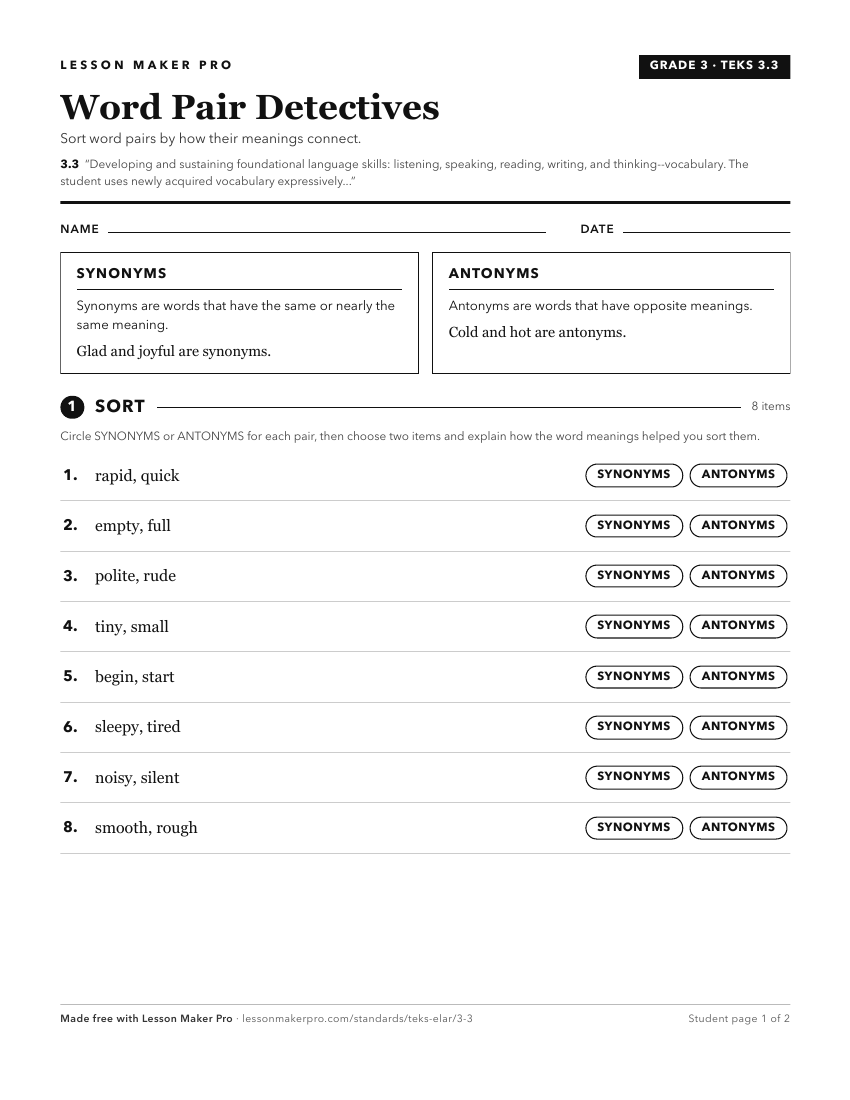
A ready-to-print activity worksheet aligned to 3.3, with an answer key for the teacher on its own page. No account needed.
PDF, US Letter, prints cleanly in black and white.
Download the worksheetKeep exploring
Related Standards
Turn this cluster into a lesson
Grade, subject, topic, and the complete cluster are prefilled. Create one free, no account needed.
Also for this cluster:Make a WorksheetMake a QuizMake a Sub Lesson