TEKS ELAR 2.3
Knowledge and Skills Statement (Standard Cluster)
The student uses newly acquired vocabulary expressively.
Texas Essential Knowledge and Skills for English Language Arts and Reading
Cluster contents
Student Expectations in This Statement
2.3 is a knowledge and skills statement. These are the student expectations under it.
- 2.3.A
use print or digital resources to determine meaning and pronunciation of unknown words
- 2.3.B
use context within and beyond a sentence to determine the meaning of unfamiliar words
- 2.3.C
identify the meaning of and use words with affixes un-, re-, -ly, -er, and -est comparative and superlative, and -ion/tion/sion
- 2.3.D
identify, use, and explain the meaning of antonyms, synonyms, idioms, and homographs in context.
Teacher's field guide
What This Cluster Means
What Students Need to Do
- Students figure out unfamiliar words by using dictionaries, pronunciation tools, and clues from nearby sentences. They explain how common prefixes and suffixes change meaning. They use new words and recognize synonyms, antonyms, idioms, and homographs in context.
What Mastery Looks Like
- Students choose useful context clues and confirm a word’s meaning and pronunciation with a dictionary. They explain how an affix changes a base word. They correctly use new words, synonyms, antonyms, idioms, and homographs in speech or writing.
Common Misconceptions
- Students may rely on one nearby word instead of reading the surrounding sentences for clues. They may think synonyms are always interchangeable or read idioms literally. They may also confuse comparative endings with word endings that name a person, such as the er in teacher.
How to Assess It
- Give a four-part exit ticket: use a child dictionary to pronounce “drowsy,” define it from “Mia yawned through breakfast. She felt drowsy,” use “replay” in a sentence, and explain “under the weather.”
Lesson moves
Ways to Teach It
Give pairs base word cards and affix tiles to build words, state each meaning, and use each new word in a sentence.
Read a short paragraph with one bold word, then ask, “Which clues reveal its meaning, and which sentence gives the strongest clue?”
Play four corners: students move to synonym, antonym, idiom, or homograph, then explain the word or phrase on each card.
Have students use a grocery ad or weather report to find unfamiliar words, check a dictionary, and teach one word to a partner.
Free download
Printable 2.3 Worksheet
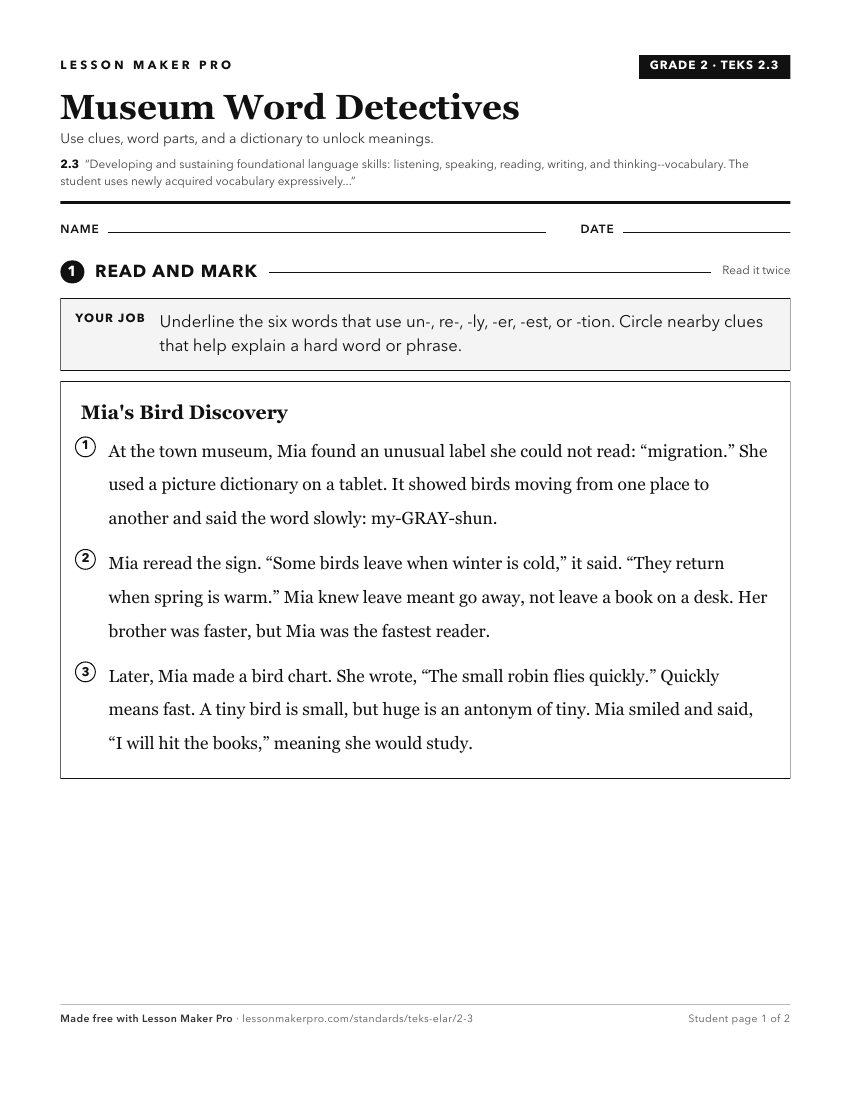
A ready-to-print activity worksheet aligned to 2.3, with an answer key for the teacher on its own page. No account needed.
PDF, US Letter, prints cleanly in black and white.
Download the worksheetKeep exploring
Related Standards
Turn this cluster into a lesson
Grade, subject, topic, and the complete cluster are prefilled. Create one free, no account needed.
Also for this cluster:Make a WorksheetMake a QuizMake a Sub Lesson