TEKS ELAR 2.3.A
The Standard
use print or digital resources to determine meaning and pronunciation of unknown words
Texas Essential Knowledge and Skills for English Language Arts and Reading
Teacher's field guide
What This Standard Means
What Students Need to Do
- Students notice a word they do not know and look it up in a child-friendly dictionary, glossary, or website. They use the entry and audio tools to explain the word and say it correctly.
What Mastery Looks Like
- Given an unfamiliar word in a short passage, a student selects a useful resource and finds the correct entry. The student gives a meaning that fits the sentence and pronounces the word accurately.
Common Misconceptions
- Students may choose the first definition even when it does not fit the sentence. They may misread syllable breaks, ignore audio pronunciation, or search with the wrong spelling.
How to Assess It
- Give students this sentence: “The tiny seedling emerged from the soil.” Have them look up emerged, write its meaning in the sentence, and say it aloud.
Lesson moves
Ways to Teach It
Place word cards and child dictionaries at tables, then have pairs find each entry, record the fitting meaning, and practice saying the word.
Read a sentence with “bark,” then ask, “Which dictionary meaning fits here, and what clue in the sentence proves it?”
Play Dictionary Relay: teams alphabetize word cards, locate each word, and earn a point for a fitting definition and clear pronunciation.
Use a school lunch menu to find one unfamiliar food word, look it up online, listen to the audio, and explain it to a partner.
Free download
Printable 2.3.A Worksheet
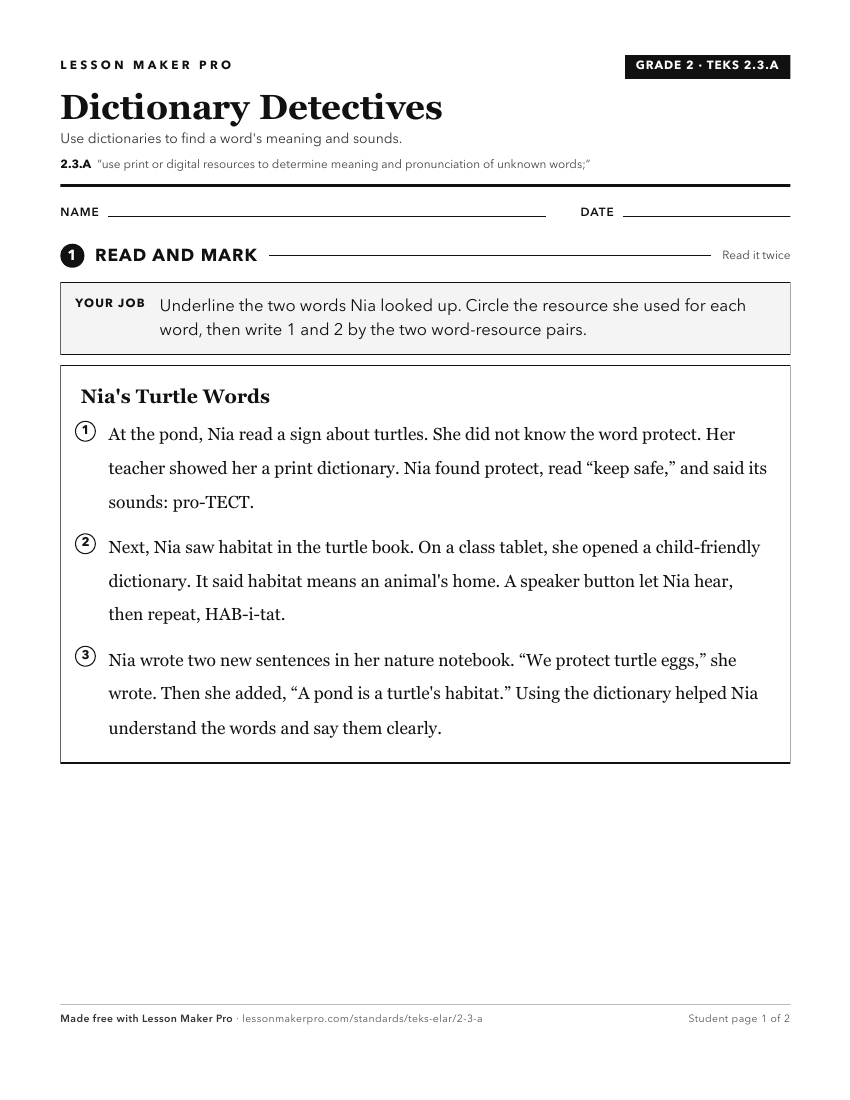
A ready-to-print activity worksheet aligned to 2.3.A, with an answer key for the teacher on its own page. No account needed.
PDF, US Letter, prints cleanly in black and white.
Download the worksheetKeep exploring
Related Standards
- 4.3.A
use print or digital resources to determine meaning, syllabication, and pronunciation;
- 5.3.A
use print or digital resources to determine meaning, syllabication, pronunciation, and word origin;
- 6.2.A
use print or digital resources to determine the meaning, syllabication, pronunciation, word origin, and part of speech;
- 3.3.A
use print or digital resources to determine meaning, syllabication, and pronunciation;
Turn this exact standard into a lesson
Grade, subject, topic, and the complete standard are prefilled. Create one free, no account needed.
Also for this standard:Make a WorksheetMake a QuizMake a Sub Lesson