TEKS ELAR 5.3.D
The Standard
identify, use, and explain the meaning of adages and puns.
Texas Essential Knowledge and Skills for English Language Arts and Reading
Teacher's field guide
What This Standard Means
What Students Need to Do
- Students identify adages and puns in speech and writing. They explain the lesson behind an adage and the wordplay in a pun. They also use both in fitting contexts.
What Mastery Looks Like
- Students correctly label an expression as an adage or pun and explain how they know. They use an adage to fit a situation and create a pun with clear wordplay.
Common Misconceptions
- Students may treat every familiar saying as an adage, even when it does not offer advice or a general truth. They may spot a funny line but miss the double meaning or sound-alike word that creates a pun.
How to Assess It
- Give students these lines: “Actions speak louder than words” and “The math book had too many problems.” Ask them to label each, explain its meaning, and identify the wordplay.
Lesson moves
Ways to Teach It
Have pairs sort sentence cards into adages, puns, and neither, then underline the clue that supports each choice.
Ask students to explain when “Two heads are better than one” would be useful advice and write a matching situation.
Play Pun Match by pairing setup cards with punchlines based on double meanings or sound-alike words.
Collect adages and puns from advertisements, cartoons, signs, and family conversations, then explain each one in a class display.
Free download
Printable 5.3.D Worksheet
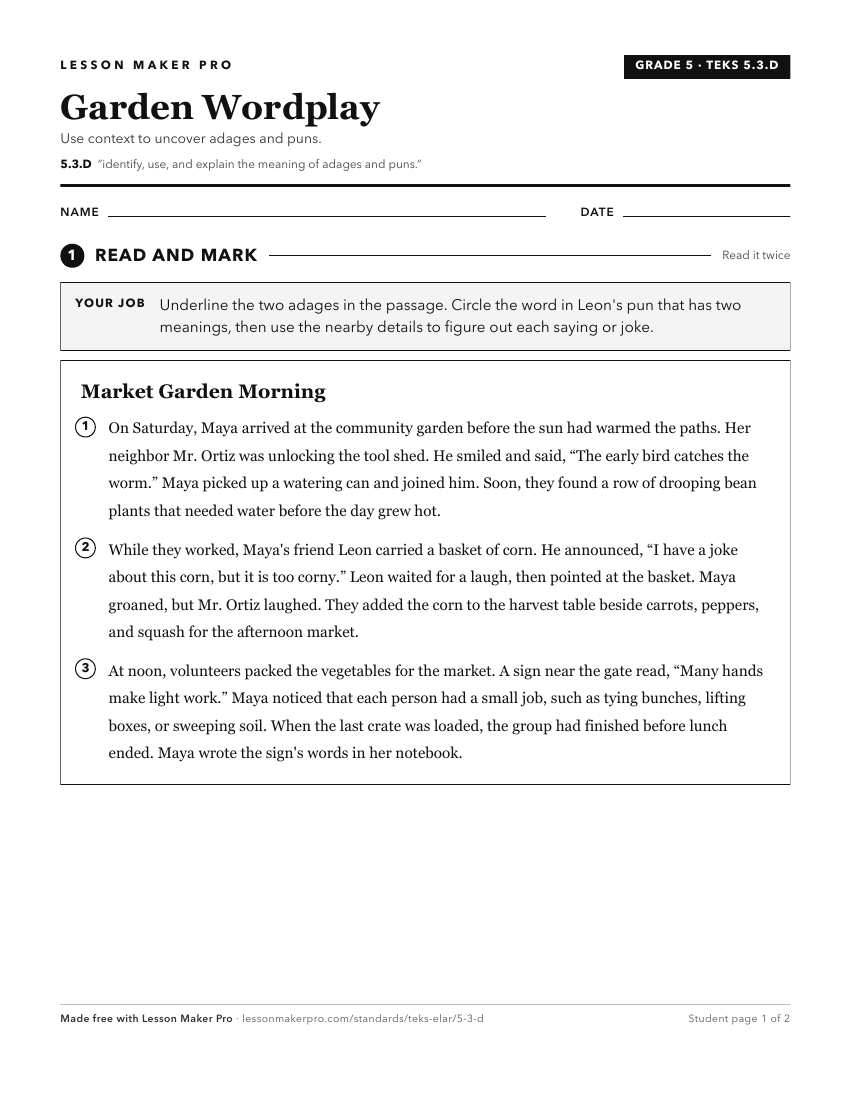
A ready-to-print activity worksheet aligned to 5.3.D, with an answer key for the teacher on its own page. No account needed.
PDF, US Letter, prints cleanly in black and white.
Download the worksheetKeep exploring
Related Standards
- 2.3.D
identify, use, and explain the meaning of antonyms, synonyms, idioms, and homographs in context.
- 6.2.B
use context such as definition, analogy, and examples to clarify the meaning of words; and
- 4.10.G
identify and explain the use of anecdote.
- 3.3.D
identify, use, and explain the meaning of antonyms, synonyms, idioms, homophones, and homographs in a text.
Turn this exact standard into a lesson
Grade, subject, topic, and the complete standard are prefilled. Create one free, no account needed.
Also for this standard:Make a WorksheetMake a QuizMake a Sub Lesson