Oklahoma Social Studies 8.C.1
Standard Cluster
Analyze the foundations of the United States of America by examining the causes, events, and ideologies which led to the American Revolution. Analyze the political and economic climate in the British colonies on the eve of the French and Indian War. Examine how the unofficial British policy of salutary neglect created an environment suited to self-determination in the colonies. Explain how the British policy of mercantilism sought to increase England’s prosperity through restrictive trade practices, such as the Navigation Acts. Examine how British colonial ideas and practices of self-government (e.g., town meetings and colonial legislatures) influenced American political thought. Describe the influence of the First Great Awakening on concepts related to individual equality and self-rule, including its role in promoting a revolutionary fervor. Examine the goals of the Albany Plan of Union and how it reflected colonial reactions to changing imperial economic policies. Compare the Haudenosaunee (Iroquois) Confederacy with early attempts to unite the colonies. Summarize the political and economic consequences of the French and Indian War. Explain Parliament’s rationale for levying new forms of taxation. Describe how the Proclamation of 1763 and its restriction on migration into American Indian sovereign territories fed discontent among the colonies. Examine growing tensions between the North American colonies and Britain. Analyze the primary cause of the American Revolution as it relates to violations of rights as Englishmen, exemplified in the lack of colonial representation in Parliament. Describe the effect on colonial economics and local self-government created by the series of trade restrictions and imposed taxes, such as the Sugar Act, Stamp Act, Townshend Acts, and Quartering Act. Explain the strategies utilized by colonists to oppose imperial policies, including the issuance of the Stamp Act Resolves and the use of propaganda, exemplified by the work of the Committees of Correspondence, the Sons of Liberty, and the boycott of British goods. Describe escalating tensions, exemplified by the Boston Massacre and the Boston Tea Party. Explain continued attempts by Parliament to exert its authority through the Coercive Acts (Intolerable Acts), prompting the formation of the First Continental Congress and its Declaration of Resolves, stating that colonists possess the same rights as Englishmen. Explain why the Battles of Lexington and Concord were perceived as major military victories, known as the “shot heard ‘round the world.” Analyze how the Second Continental Congress functioned as the de facto national government, uniting colonial response. Describe how the congress successfully formed the Continental Army, directed military strategy, established a national currency, and negotiated a foreign alliance with France. Explain the purpose and outcome of the Olive Branch Petition as the colonists’ final attempt to avoid war by affirming loyalty yet seeking the king’s intervention. Summarize the decision to appoint a committee to draft a declaration of independence. Analyze the significance of the Declaration of Independence as a founding statement of American thought on the constitutional republic and the purpose of government. Read and discuss the Declaration of Independence as drafted by Thomas Jefferson, influenced by the Committee of Five, and adopted July 4, 1776. Describe the intellectual origins of American political thought as proposed by such Enlightenment philosophers as John Locke and his theory on natural rights. Identify the purpose of government as the protection of unalienable individual rights and liberties. Explain how a social contract exists between citizens and their government, requiring the consent of the governed, as well as the right of citizens to alter their governments when abusive. Evaluate the diverse political, economic, and religious influences that shaped colonial arguments for independence. Identify specific economic and political grievances against British policies used by the colonists to justify independence.
Oklahoma Academic Standards for Social Studies (2026)
Cluster contents
Standards in This Cluster
8.C.1 is a cluster heading. These are the individual standards under it.
- 8.C.1.1
Analyze the political and economic climate in the British colonies on the eve of the French and Indian War.
- 8.C.1.1.A
Examine how the unofficial British policy of salutary neglect created an environment suited to self-determination in the colonies.
- 8.C.1.1.B
Explain how the British policy of mercantilism sought to increase England’s prosperity through restrictive trade practices, such as the Navigation Acts.
- 8.C.1.1.C
Examine how British colonial ideas and practices of self-government (e.g., town meetings and colonial legislatures) influenced American political thought.
- 8.C.1.1.D
Describe the influence of the First Great Awakening on concepts related to individual equality and self-rule, including its role in promoting a revolutionary fe...
- 8.C.1.1.E
Examine the goals of the Albany Plan of Union and how it reflected colonial reactions to changing imperial economic policies.
- 8.C.1.1.F
Compare the Haudenosaunee (Iroquois) Confederacy with early attempts to unite the colonies.
- 8.C.1.2
Summarize the political and economic consequences of the French and Indian War.
- 8.C.1.2.A
Explain Parliament’s rationale for levying new forms of taxation.
- 8.C.1.2.B
Describe how the Proclamation of 1763 and its restriction on migration into American Indian sovereign territories fed discontent among the colonies.
- 8.C.1.3
Examine growing tensions between the North American colonies and Britain.
- 8.C.1.3.A
Analyze the primary cause of the American Revolution as it relates to violations of rights as Englishmen, exemplified in the lack of colonial representation in ...
- 8.C.1.3.B
Describe the effect on colonial economics and local self-government created by the series of trade restrictions and imposed taxes, such as the Sugar Act, Stamp ...
- 8.C.1.3.C
Explain the strategies utilized by colonists to oppose imperial policies, including the issuance of the Stamp Act Resolves and the use of propaganda, exemplifie...
- 8.C.1.3.D
Describe escalating tensions, exemplified by the Boston Massacre and the Boston Tea Party.
- 8.C.1.3.E
Explain continued attempts by Parliament to exert its authority through the Coercive Acts (Intolerable Acts), prompting the formation of the First Continental C...
- 8.C.1.3.F
Explain why the Battles of Lexington and Concord were perceived as major military victories, known as the “shot heard ‘round the world.”
- 8.C.1.4
Analyze how the Second Continental Congress functioned as the de facto national government, uniting colonial response.
- 8.C.1.4.A
Describe how the congress successfully formed the Continental Army, directed military strategy, established a national currency, and negotiated a foreign allian...
- 8.C.1.4.B
Explain the purpose and outcome of the Olive Branch Petition as the colonists’ final attempt to avoid war by affirming loyalty yet seeking the king’s interventi...
- 8.C.1.4.C
Summarize the decision to appoint a committee to draft a declaration of independence.
- 8.C.1.5
Analyze the significance of the Declaration of Independence as a founding statement of American thought on the constitutional republic and the purpose of govern...
- 8.C.1.5.A
Read and discuss the Declaration of Independence as drafted by Thomas Jefferson, influenced by the Committee of Five, and adopted July 4, 1776.
- 8.C.1.5.B
Describe the intellectual origins of American political thought as proposed by such Enlightenment philosophers as John Locke and his theory on natural rights.
- 8.C.1.5.C
Identify the purpose of government as the protection of unalienable individual rights and liberties.
- 8.C.1.5.D
Explain how a social contract exists between citizens and their government, requiring the consent of the governed, as well as the right of citizens to alter the...
- 8.C.1.5.E
Evaluate the diverse political, economic, and religious influences that shaped colonial arguments for independence.
- 8.C.1.5.F
Identify specific economic and political grievances against British policies used by the colonists to justify independence.
Teacher's field guide
What This Cluster Means
What Students Need to Do
- Students explain how colonial self-government, religious revival, British trade rules, and the French and Indian War shaped colonial thinking. They trace how taxes and protests led to war and independence. They connect the Declaration of Independence to natural rights and consent.
What Mastery Looks Like
- Students can compare the Haudenosaunee Confederacy, the proposed Albany union, and colonial legislatures without treating them as identical. They can put a British tax, a colonial protest, and a battle in order and explain the links. They can explain why Congress took charge of the war and use a grievance from the Declaration to support an argument about rights.
Common Misconceptions
- Students may think Britain imposed taxes only to punish colonists, missing its war debt and defense costs. They may think all colonists wanted independence from the start, despite petitions to the king. They may assume the Declaration immediately gave equal rights to everyone.
How to Assess It
- Exit ticket: Why did Parliament impose the Stamp Act, and why did colonists object? Name one form of protest and explain the right colonists said was at stake.
Lesson moves
Ways to Teach It
Pairs sort five event cards: French and Indian War, Stamp Act, Boston Tea Party, Lexington and Concord, Declaration; then write one cause per card.
Give students brief descriptions of the Haudenosaunee Confederacy and Albany Plan; ask what each united and how leaders would make decisions.
Match Navigation Acts, Stamp Act, and Coercive Acts cards to trade limits, paper taxes, and Boston port closure; explain each match.
Hand students a sample school council budget ballot; ask who votes, then compare the rule with colonists' objection to Parliament's taxes.
Free download
Printable 8.C.1 Worksheet
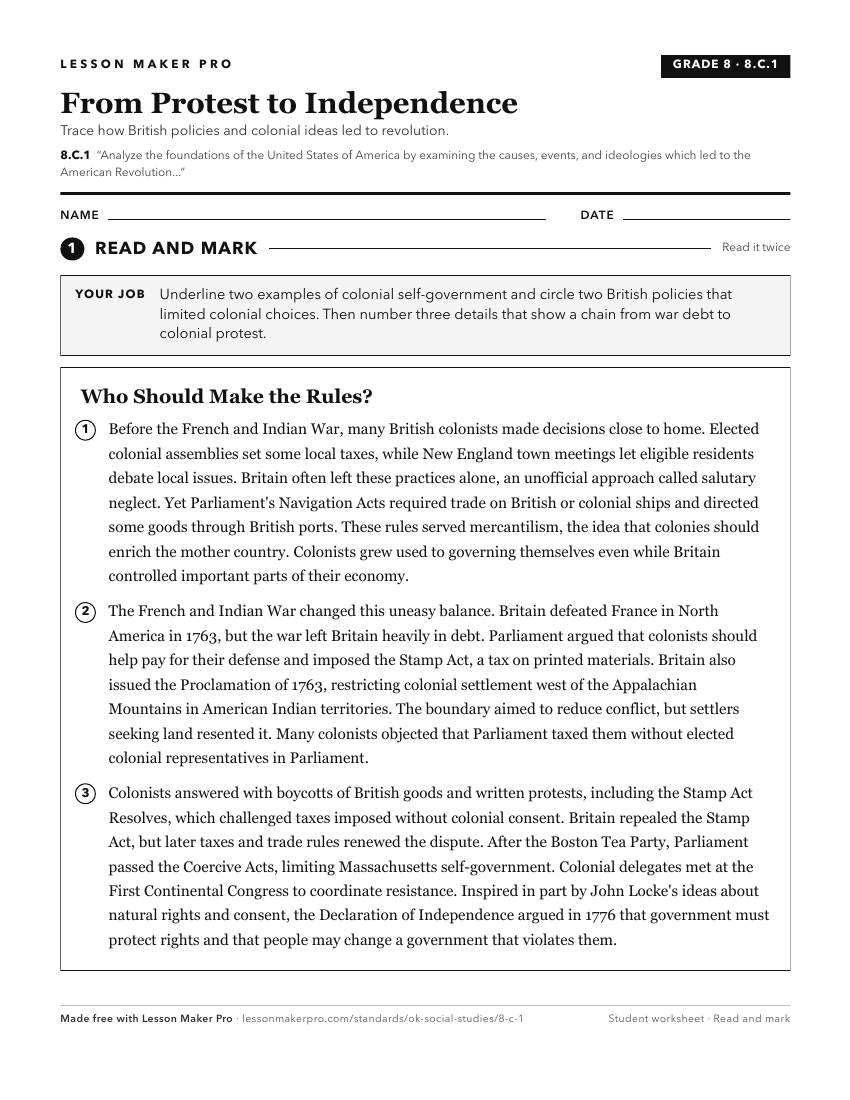
A ready-to-print activity worksheet aligned to 8.C.1, with an answer key for the teacher on its own page. No account needed.
PDF, US Letter, prints cleanly in black and white.
Download the worksheetKeep exploring
Related Standards
- USG.C.3
Analyze the fundamental principles of the American republic, as established in the Constitution of the United States of America.
- 5.C.5
Examine the formation of the United States of America’s system of government following the American Revolution.
- 8.C.3
Examine the formation of the United States of America’s system of government following the Revolutionary War and the creation of the Constitution of the United ...
Turn this cluster into a lesson
Grade, subject, topic, and the complete cluster are prefilled. Create one free, no account needed.
Also for this cluster:Make a WorksheetMake a QuizMake a Sub Lesson