Oklahoma Social Studies 5.C.5
Standard Cluster
Examine the formation of the United States of America’s system of government following the American Revolution. Evaluate the major issues that led to the Constitutional Convention, including the public alarm raised from Shays’ Rebellion and challenges faced by a national government too weak to conduct its affairs. Identify the role of leaders of the Constitutional Convention, including its president George Washington and the influence of James Madison, known as the “Father of the Constitution.” Read, discuss, and explain the Declaration of Independence and how it has shaped the United States of America. Explain the key debates and compromises of the Constitutional Convention, including the goals of a stronger union with respect to commerce and political stability state representation in Congress, presented by opposing Virginia and New Jersey Plans, and resolved by the Great Compromise, creating a bicameral legislature congressional representation resolved by the Three-Fifths Compromise and the potential for a future ban of the international slave trade. Describe the public debates over the Constitution’s ratification, comparing the viewpoints of the Federalists, led by James Madison and Alexander Hamilton, and Anti-Federalists, led by George Mason, regarding the powers of central government and the necessity for a national Bill of Rights.
Oklahoma Academic Standards for Social Studies (2026)
Cluster contents
Standards in This Cluster
5.C.5 is a cluster heading. These are the individual standards under it.
- 5.C.5.1
Evaluate the major issues that led to the Constitutional Convention, including the public alarm raised from Shays’ Rebellion and challenges faced by a national ...
- 5.C.5.2
Identify the role of leaders of the Constitutional Convention, including its president George Washington and the influence of James Madison, known as the “Fathe...
- 5.C.5.3
Read, discuss, and explain the Declaration of Independence and how it has shaped the United States of America. Explain the key debates and compromises of the Co...
- 5.C.5.3.A
the goals of a stronger union with respect to commerce and political stability
- 5.C.5.3.B
state representation in Congress, presented by opposing Virginia and New Jersey Plans, and resolved by the Great Compromise, creating a bicameral legislature
- 5.C.5.3.C
congressional representation resolved by the Three-Fifths Compromise and the potential for a future ban of the international slave trade.
- 5.C.5.4
Describe the public debates over the Constitution’s ratification, comparing the viewpoints of the Federalists, led by James Madison and Alexander Hamilton, and ...
Teacher's field guide
What This Cluster Means
What Students Need to Do
- Students explain why Shays' Rebellion and problems with the weak national government led leaders to meet. They connect the Declaration's ideas about rights and consent to debates about government. They explain key compromises and compare arguments for and against ratification.
What Mastery Looks Like
- A student can explain why the national government struggled to collect taxes and regulate trade. They can name Washington's role, Madison's influence, and how the Virginia and New Jersey Plans led to a two-house Congress. They can explain how the Three-Fifths Compromise increased slave states' power, why Congress could not ban the overseas slave trade before 1808, and why Anti-Federalists wanted a bill of rights.
Common Misconceptions
- Some students think the Declaration created Congress, rather than making a case for independence. Others think the Great Compromise gave every state equal House seats, or that counting enslaved people gave them a vote. Some mix up Federalists, who backed ratification, with Anti-Federalists, who feared central power without a bill of rights.
How to Assess It
- Ask students to write three sentences: Why did Shays' Rebellion alarm leaders? How did the Great Compromise settle the representation debate? Why did Anti-Federalists want a bill of rights?
Lesson moves
Ways to Teach It
Give pairs cards showing each plan's representation rule and counters for three states; have them build the Great Compromise's two houses.
Read short Declaration excerpts on rights and consent; ask, 'Which ideas shaped later debates, and who was denied those rights?'
Play a ratification sort with argument cards about federal power and rights; students label each Federalist or Anti-Federalist and explain why.
Show a current House and Senate seat chart; have students compare state representation and find the Great Compromise's two-house design.
Free download
Printable 5.C.5 Worksheet
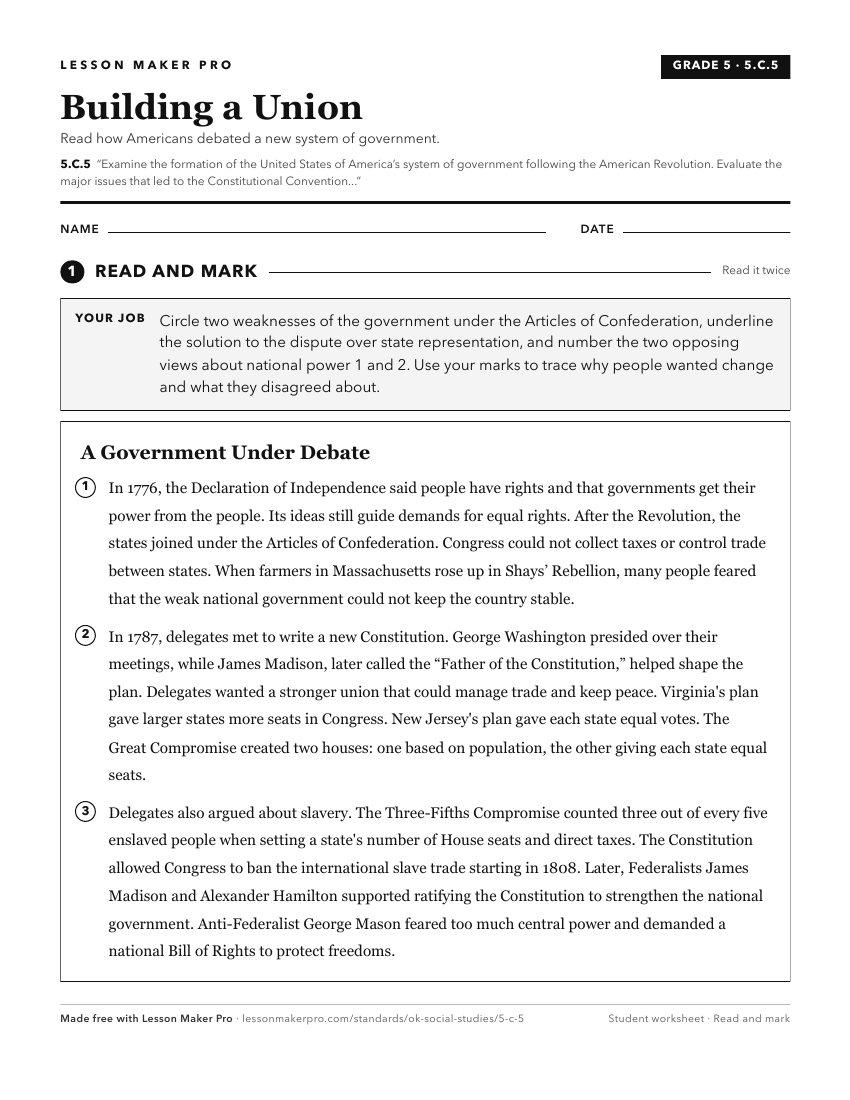
A ready-to-print activity worksheet aligned to 5.C.5, with an answer key for the teacher on its own page. No account needed.
PDF, US Letter, prints cleanly in black and white.
Download the worksheetKeep exploring
Related Standards
- 5.C.6.3
Analyze the structure and operations of government established in the Constitution of the United States of America.
- USG.C.1.3
Examine the founding principles of the United States of America’s constitutional republic.
- 8.C.3
Examine the formation of the United States of America’s system of government following the Revolutionary War and the creation of the Constitution of the United ...
- 8.C.4
Examine the key principles and structure of the United States of America’s government as established by the Constitution of the United States of America.
Turn this cluster into a lesson
Grade, subject, topic, and the complete cluster are prefilled. Create one free, no account needed.
Also for this cluster:Make a WorksheetMake a QuizMake a Sub Lesson