Oklahoma Social Studies 8.C.1.5
Standard Cluster
- 8.C.1
- Analyze the foundations of the United States of America by examining the causes, events, and ideologies which led to the American Revolution.
Analyze the significance of the Declaration of Independence as a founding statement of American thought on the constitutional republic and the purpose of government. Read and discuss the Declaration of Independence as drafted by Thomas Jefferson, influenced by the Committee of Five, and adopted July 4, 1776. Describe the intellectual origins of American political thought as proposed by such Enlightenment philosophers as John Locke and his theory on natural rights. Identify the purpose of government as the protection of unalienable individual rights and liberties. Explain how a social contract exists between citizens and their government, requiring the consent of the governed, as well as the right of citizens to alter their governments when abusive. Evaluate the diverse political, economic, and religious influences that shaped colonial arguments for independence. Identify specific economic and political grievances against British policies used by the colonists to justify independence.
Oklahoma Academic Standards for Social Studies (2026) · 8.C.1
Cluster contents
Standards in This Cluster
8.C.1.5 is a cluster heading. These are the individual standards under it.
- 8.C.1.5.A
Read and discuss the Declaration of Independence as drafted by Thomas Jefferson, influenced by the Committee of Five, and adopted July 4, 1776.
- 8.C.1.5.B
Describe the intellectual origins of American political thought as proposed by such Enlightenment philosophers as John Locke and his theory on natural rights.
- 8.C.1.5.C
Identify the purpose of government as the protection of unalienable individual rights and liberties.
- 8.C.1.5.D
Explain how a social contract exists between citizens and their government, requiring the consent of the governed, as well as the right of citizens to alter the...
- 8.C.1.5.E
Evaluate the diverse political, economic, and religious influences that shaped colonial arguments for independence.
- 8.C.1.5.F
Identify specific economic and political grievances against British policies used by the colonists to justify independence.
Teacher's field guide
What This Cluster Means
What Students Need to Do
- Students read how Jefferson's draft became a document Congress adopted on July 4, 1776, after input from the Committee of Five. They connect Locke's ideas about rights and government by consent to the case for independence and limited government. They examine British taxes, restrictions on colonial assemblies, and religious concerns behind colonial arguments.
What Mastery Looks Like
- A student can explain why the Declaration says people may replace a government that fails to protect their rights. They can link that argument to Locke and to limits on power in a constitutional republic. They can name a British policy, explain why colonists objected, and distinguish Jefferson's draft from the adopted document.
Common Misconceptions
- Students may credit Jefferson alone for the final wording or confuse the July 2 independence vote with the July 4 adoption. Some think government grants people their rights, or that colonists opposed every tax rather than taxes imposed without their elected representatives' approval. Others miss how Protestant sermons shaped some arguments for independence.
How to Assess It
- On an exit ticket, ask: "Why did colonists cite taxes imposed without their elected representatives' approval as a reason for independence? Connect your answer to Locke's ideas about rights and government authority."
Lesson moves
Ways to Teach It
Give pairs a one-page set of excerpts from Jefferson's draft, committee edits, and final text; have them mark one change.
Ask: "When may people replace their government? Use one complaint in the Declaration and one idea from Locke to defend your answer."
Put the Stamp Act, dissolved colonial assemblies, and Quebec Act on cards; teams sort them as economic, political, or religious concerns and defend overlaps.
Use a city council election notice and a public budget; ask students how voters can challenge a tax they oppose without seeking independence.
Free download
Printable 8.C.1.5 Worksheet
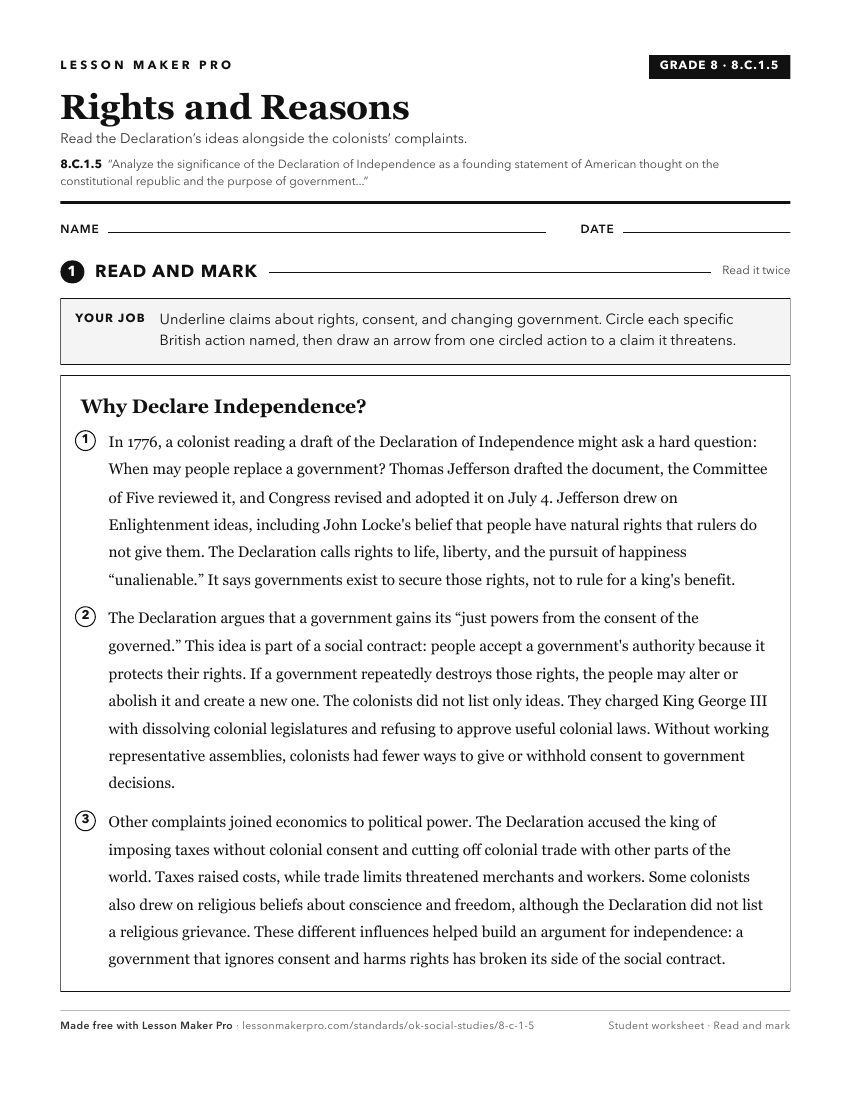
A ready-to-print activity worksheet aligned to 8.C.1.5, with an answer key for the teacher on its own page. No account needed.
PDF, US Letter, prints cleanly in black and white.
Download the worksheetKeep exploring
Related Standards
- USG.C.3
Analyze the fundamental principles of the American republic, as established in the Constitution of the United States of America.
- 5.C.5.3
Read, discuss, and explain the Declaration of Independence and how it has shaped the United States of America. Explain the key debates and compromises of the Co...
- 8.C.3.2.A
Identify the relationship between the principles established in the Declaration of Independence and the government created by the Constitution of the United Sta...
- USG.C.1.3
Examine the founding principles of the United States of America’s constitutional republic.
Turn this cluster into a lesson
Grade, subject, topic, and the complete cluster are prefilled. Create one free, no account needed.
Also for this cluster:Make a WorksheetMake a QuizMake a Sub Lesson