Oklahoma Social Studies 5.C.2
Standard Cluster
Compare the developments of the New England Colonies, the Middle Colonies, and the Southern Colonies. Explain how settlements in other colonies were influenced by a desire for religious freedom, economic opportunity, and self-government, including Roger Williams’ advocacy for religious freedom and his founding of the Providence Plantation Anne Hutchinson’s opposition to Puritan restrictions on religious freedom C William Penn’s establishment of a haven for Quakers and diverse faiths in Pennsylvania Thomas Hooker’s influence in formulating the Fundamental Orders of Connecticut George Calvert’s (First Baron of Baltimore) creation of a refuge for persecuted Catholics in Maryland James Oglethorpe’s recruitment of England’s impoverished and religious minorities to Georgia. Compare the economic development of the three colonial regions including agricultural exports as affected by climate, physical features, and natural resources a labor system utilizing indentured servants in various occupations a growing reliance on enslaved labor considered essential to the plantation system. Explain the economic and cultural interactions resulting from the triangular trade routes, including the forced migration of Africans through the Transatlantic slave trade and experiences of the Middle Passage. Analyze the forms of self-government in the colonies. Explain how English traditions of limited government (Parliament’s relationship to the monarchy) and ethical traditions reflected in colonial covenants and political writings which shaped the colonial experience in self-government. Describe how representative government was established through various institutions (e.g., New England town hall meetings, colonial legislatures, colonial charters). Examine early discussions on intercolonial cooperation exemplified by the Albany Plan of Union and Benjamin Franklin's “Join or Die” political cartoon. Evaluate the influence of the Haudenosaunee (Iroquois) Confederacy on colonial attempts to unite. Analyze the evolving relationship between American Indians and the British colonists by describing how although colonists and American Indians benefited from trade, disputes erupted over territorial claims. armed conflicts devastated both British settlements and Tribal communities. Compare the experiences of both free and enslaved persons in the British colonies, including resistance efforts by enslaved peoples and attempts to preserve aspects of African culture.
Oklahoma Academic Standards for Social Studies (2026)
Cluster contents
Standards in This Cluster
5.C.2 is a cluster heading. These are the individual standards under it.
- 5.C.2.1
Explain how settlements in other colonies were influenced by a desire for religious freedom, economic opportunity, and self-government, including
- 5.C.2.1.A
Roger Williams’ advocacy for religious freedom and his founding of the Providence Plantation
- 5.C.2.1.B
Anne Hutchinson’s opposition to Puritan restrictions on religious freedom C William Penn’s establishment of a haven for Quakers and diverse faiths in Pennsylvan...
- 5.C.2.1.D
Thomas Hooker’s influence in formulating the Fundamental Orders of Connecticut
- 5.C.2.1.E
George Calvert’s (First Baron of Baltimore) creation of a refuge for persecuted Catholics in Maryland
- 5.C.2.1.F
James Oglethorpe’s recruitment of England’s impoverished and religious minorities to Georgia.
- 5.C.2.2
Compare the economic development of the three colonial regions including
- 5.C.2.2.A
agricultural exports as affected by climate, physical features, and natural resources
- 5.C.2.2.B
a labor system utilizing indentured servants in various occupations
- 5.C.2.2.C
a growing reliance on enslaved labor considered essential to the plantation system.
- 5.C.2.3
Explain the economic and cultural interactions resulting from the triangular trade routes, including the forced migration of Africans through the Transatlantic ...
- 5.C.2.4
Analyze the forms of self-government in the colonies.
- 5.C.2.4.A
Explain how English traditions of limited government (Parliament’s relationship to the monarchy) and ethical traditions reflected in colonial covenants and poli...
- 5.C.2.4.B
Describe how representative government was established through various institutions (e.g., New England town hall meetings, colonial legislatures, colonial chart...
- 5.C.2.4.C
Examine early discussions on intercolonial cooperation exemplified by the Albany Plan of Union and Benjamin Franklin's “Join or Die” political cartoon.
- 5.C.2.4.D
Evaluate the influence of the Haudenosaunee (Iroquois) Confederacy on colonial attempts to unite.
- 5.C.2.5
Analyze the evolving relationship between American Indians and the British colonists by describing how
- 5.C.2.5.A
although colonists and American Indians benefited from trade, disputes erupted over territorial claims.
- 5.C.2.5.B
armed conflicts devastated both British settlements and Tribal communities.
- 5.C.2.6
Compare the experiences of both free and enslaved persons in the British colonies, including resistance efforts by enslaved peoples and attempts to preserve asp...
Teacher's field guide
What This Cluster Means
What Students Need to Do
- Students compare how geography, religion, farming, and labor shaped the three colonial regions. They explain colonial self-government and plans for union, along with how trade and land claims affected Tribal nations. They trace the forced migration of Africans and compare free and enslaved lives, including resistance and efforts to keep African traditions.
What Mastery Looks Like
- Students link New England's short growing season to small farms, Middle Colony grain farming to fertile soil, and Southern plantations to enslaved labor. They explain why Penn welcomed Quakers and compare a colonial union plan with Haudenosaunee governance using evidence. They describe the Middle Passage as forced transport and explain how land disputes harmed Tribal communities.
Common Misconceptions
- Students may think all colonies grew the same crops and allowed the same religious practices. They may confuse indentured service with enslavement or describe the Middle Passage as voluntary migration. Some assume town meetings included everyone or that trade prevented conflict over land.
How to Assess It
- Exit ticket: Ask, “How did geography shape work in two colonial regions? Name one group excluded from colonial self-government, and explain why Africans crossed the Middle Passage.”
Lesson moves
Ways to Teach It
Give pairs a blank colonial map and crop, climate, labor, and trade-route cards; have them place the cards and justify three links.
Show Franklin's “Join or Die” cartoon, the Albany Plan, and a Haudenosaunee source; ask, “What evidence connects these ideas about union?”
Run a card match linking Williams, Hutchinson, Penn, Hooker, Calvert, and Oglethorpe to their actions and settlement goals.
Compare a local town council agenda with a colonial town meeting notice; mark who could take part and who was excluded.
Free download
Printable 5.C.2 Worksheet
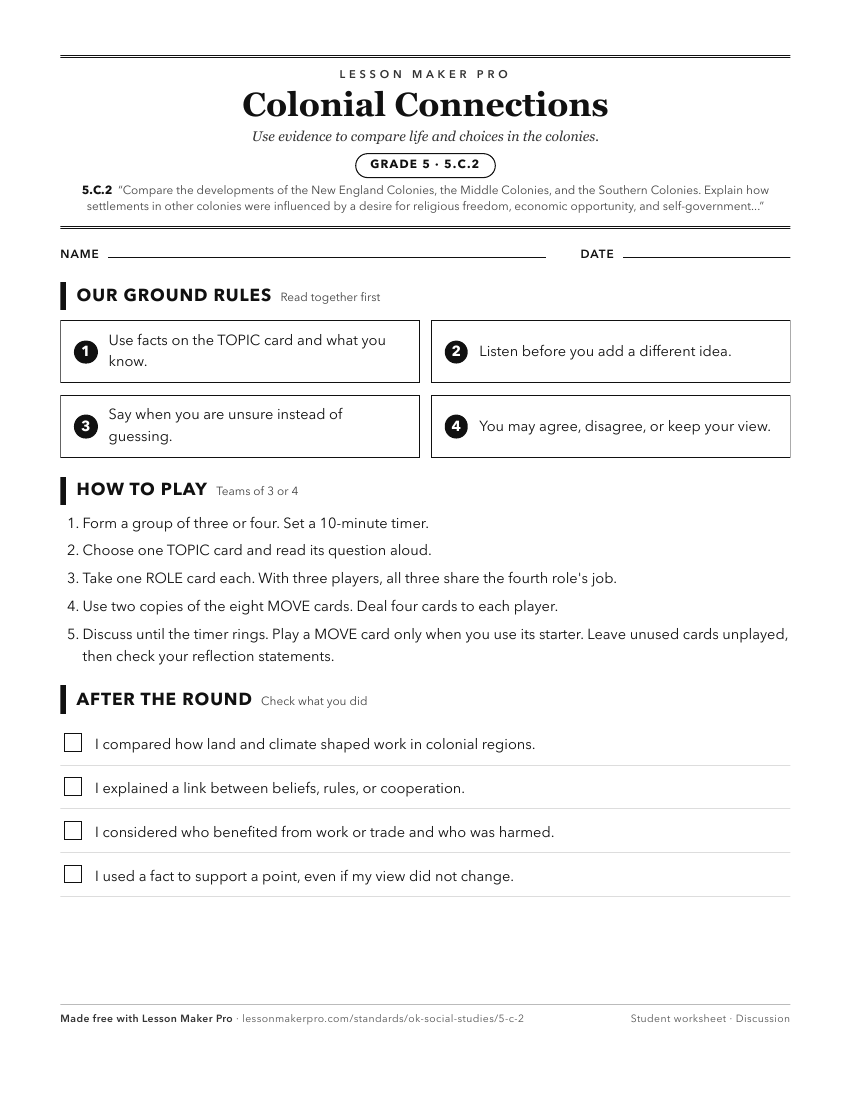
A ready-to-print activity worksheet aligned to 5.C.2, with an answer key for the teacher on its own page. No account needed.
PDF, US Letter, prints cleanly in black and white.
Download the worksheetKeep exploring
Related Standards
Turn this cluster into a lesson
Grade, subject, topic, and the complete cluster are prefilled. Create one free, no account needed.
Also for this cluster:Make a WorksheetMake a QuizMake a Sub Lesson