Oklahoma Social Studies 5.C.2.4
Standard Cluster
- 5.C.2
- Compare the developments of the New England Colonies, the Middle Colonies, and the Southern Colonies.
Analyze the forms of self-government in the colonies. Explain how English traditions of limited government (Parliament’s relationship to the monarchy) and ethical traditions reflected in colonial covenants and political writings which shaped the colonial experience in self-government. Describe how representative government was established through various institutions (e.g., New England town hall meetings, colonial legislatures, colonial charters). Examine early discussions on intercolonial cooperation exemplified by the Albany Plan of Union and Benjamin Franklin's “Join or Die” political cartoon. Evaluate the influence of the Haudenosaunee (Iroquois) Confederacy on colonial attempts to unite.
Oklahoma Academic Standards for Social Studies (2026) · 5.C.2
Cluster contents
Standards in This Cluster
5.C.2.4 is a cluster heading. These are the individual standards under it.
- 5.C.2.4.A
Explain how English traditions of limited government (Parliament’s relationship to the monarchy) and ethical traditions reflected in colonial covenants and poli...
- 5.C.2.4.B
Describe how representative government was established through various institutions (e.g., New England town hall meetings, colonial legislatures, colonial chart...
- 5.C.2.4.C
Examine early discussions on intercolonial cooperation exemplified by the Albany Plan of Union and Benjamin Franklin's “Join or Die” political cartoon.
- 5.C.2.4.D
Evaluate the influence of the Haudenosaunee (Iroquois) Confederacy on colonial attempts to unite.
Teacher's field guide
What This Cluster Means
What Students Need to Do
- Students explain how Parliament limited the king and how written agreements set rules for colonial government. They compare town meetings, elected assemblies, and colonial charters. They examine Franklin’s cartoon, the Albany Plan, and evidence of Haudenosaunee influence on plans for union.
What Mastery Looks Like
- A student can explain how Parliament limited the king and how a covenant set rules by agreement. They can distinguish a charter from a town meeting or assembly. They can explain the Albany Plan and weigh evidence of Haudenosaunee influence without claiming colonists copied its system exactly.
Common Misconceptions
- Students may think kings could ignore Parliament, or that everyone could vote in colonial meetings. A charter was a written grant, not an elected assembly. The Albany Plan was proposed, not adopted, and evidence of Haudenosaunee influence does not prove exact copying.
How to Assess It
- Exit ticket: Why does Franklin’s snake cartoon call for colonial union, and how is that idea like a town meeting or assembly? Name one piece of evidence you would need to test a claim of Haudenosaunee influence.
Lesson moves
Ways to Teach It
Stage a town meeting with role cards for eligible voters and excluded residents; vote on a road repair and tally whose voices counted.
Read a short, contextualized excerpt from Franklin’s 1751 letter about Haudenosaunee unity; ask, “Does this prove colonists copied their government?”
Play a matching game: pair Parliament, king, Mayflower Compact, charter, and assembly cards with short descriptions of their powers or rules.
Compare the Albany Plan’s proposed council with a school council; have students list one shared problem and who would get a vote.
Free download
Printable 5.C.2.4 Worksheet
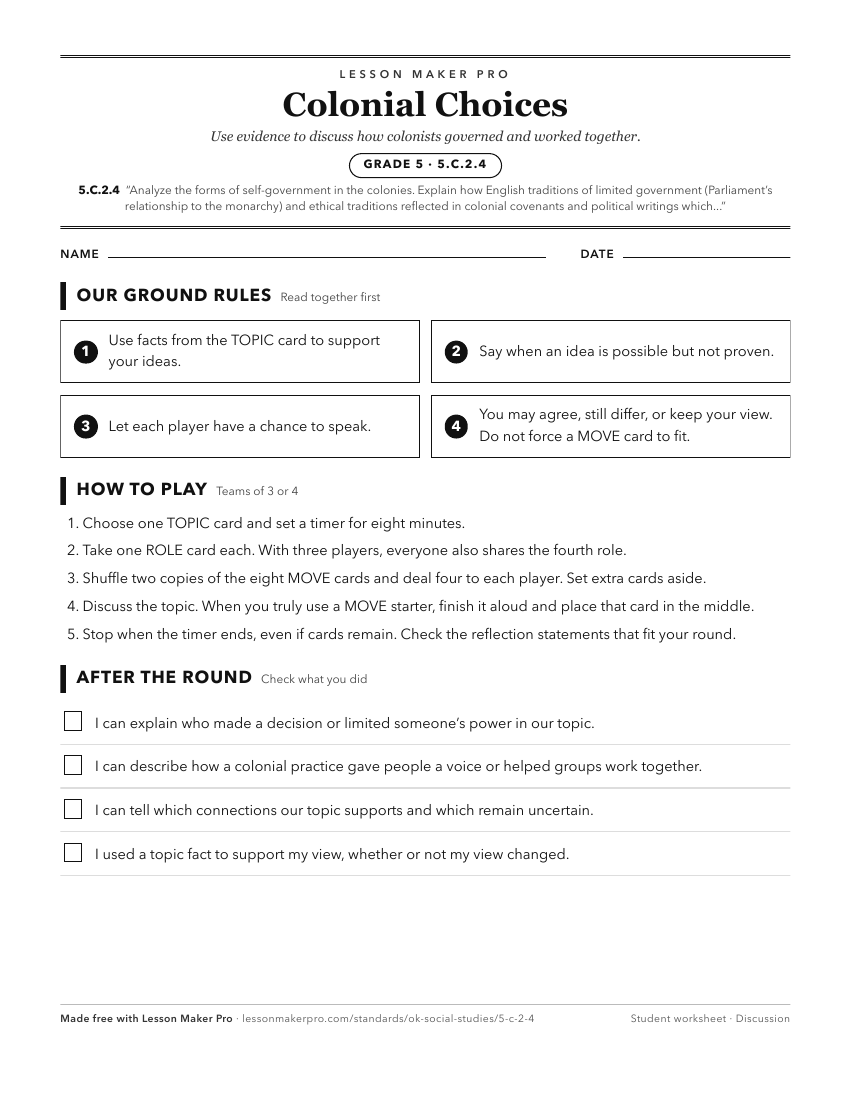
A ready-to-print activity worksheet aligned to 5.C.2.4, with an answer key for the teacher on its own page. No account needed.
PDF, US Letter, prints cleanly in black and white.
Download the worksheetKeep exploring
Related Standards
- 8.C.1.5.E
Evaluate the diverse political, economic, and religious influences that shaped colonial arguments for independence.
- 8.C.1.1.C
Examine how British colonial ideas and practices of self-government (e.g., town meetings and colonial legislatures) influenced American political thought.
- USG.C.2.1.C
Analyze colonial ideas on liberty, the practice of self-government, and the influence of religious thought on foundational documents (e.g., Massachusetts Body o...
Turn this cluster into a lesson
Grade, subject, topic, and the complete cluster are prefilled. Create one free, no account needed.
Also for this cluster:Make a WorksheetMake a QuizMake a Sub Lesson