Oklahoma Social Studies 5.C.2.1
Standard Cluster
- 5.C.2
- Compare the developments of the New England Colonies, the Middle Colonies, and the Southern Colonies.
Explain how settlements in other colonies were influenced by a desire for religious freedom, economic opportunity, and self-government, including Roger Williams’ advocacy for religious freedom and his founding of the Providence Plantation Anne Hutchinson’s opposition to Puritan restrictions on religious freedom C William Penn’s establishment of a haven for Quakers and diverse faiths in Pennsylvania Thomas Hooker’s influence in formulating the Fundamental Orders of Connecticut George Calvert’s (First Baron of Baltimore) creation of a refuge for persecuted Catholics in Maryland James Oglethorpe’s recruitment of England’s impoverished and religious minorities to Georgia.
Oklahoma Academic Standards for Social Studies (2026) · 5.C.2
Cluster contents
Standards in This Cluster
5.C.2.1 is a cluster heading. These are the individual standards under it.
- 5.C.2.1.A
Roger Williams’ advocacy for religious freedom and his founding of the Providence Plantation
- 5.C.2.1.B
Anne Hutchinson’s opposition to Puritan restrictions on religious freedom C William Penn’s establishment of a haven for Quakers and diverse faiths in Pennsylvan...
- 5.C.2.1.D
Thomas Hooker’s influence in formulating the Fundamental Orders of Connecticut
- 5.C.2.1.E
George Calvert’s (First Baron of Baltimore) creation of a refuge for persecuted Catholics in Maryland
- 5.C.2.1.F
James Oglethorpe’s recruitment of England’s impoverished and religious minorities to Georgia.
Teacher's field guide
What This Cluster Means
What Students Need to Do
- Students connect six colonial figures to the places they shaped. They explain how the search for religious freedom, economic opportunity, or self-government influenced those settlements.
What Mastery Looks Like
- Students connect Williams and Hutchinson to Rhode Island, Penn to Pennsylvania, and Calvert to Maryland. They link Hooker to Connecticut and Oglethorpe to Georgia. They can explain the reason behind each connection.
Common Misconceptions
- Students may credit Hutchinson with founding Providence instead of Williams. They may mistake Hooker’s plan for colonial government for church rules. They may overlook poverty as a reason people moved to Georgia.
How to Assess It
- On an exit ticket, ask: For Penn, Hooker, and Oglethorpe, name the colony linked to each person and give one reason people settled there.
Lesson moves
Ways to Teach It
Give pairs a blank map and six name cards. Have them place each person by the colony they shaped and add a reason for settlement.
Ask students to write: How did Williams and Hutchinson each challenge Puritan restrictions on religion?
Play a matching game with cards for the six people, their colonies, and their reasons for settlement.
Show a local job posting and town council agenda. Ask which colonial reasons for settling each resembles, and where the comparison falls short.
Free download
Printable 5.C.2.1 Worksheet
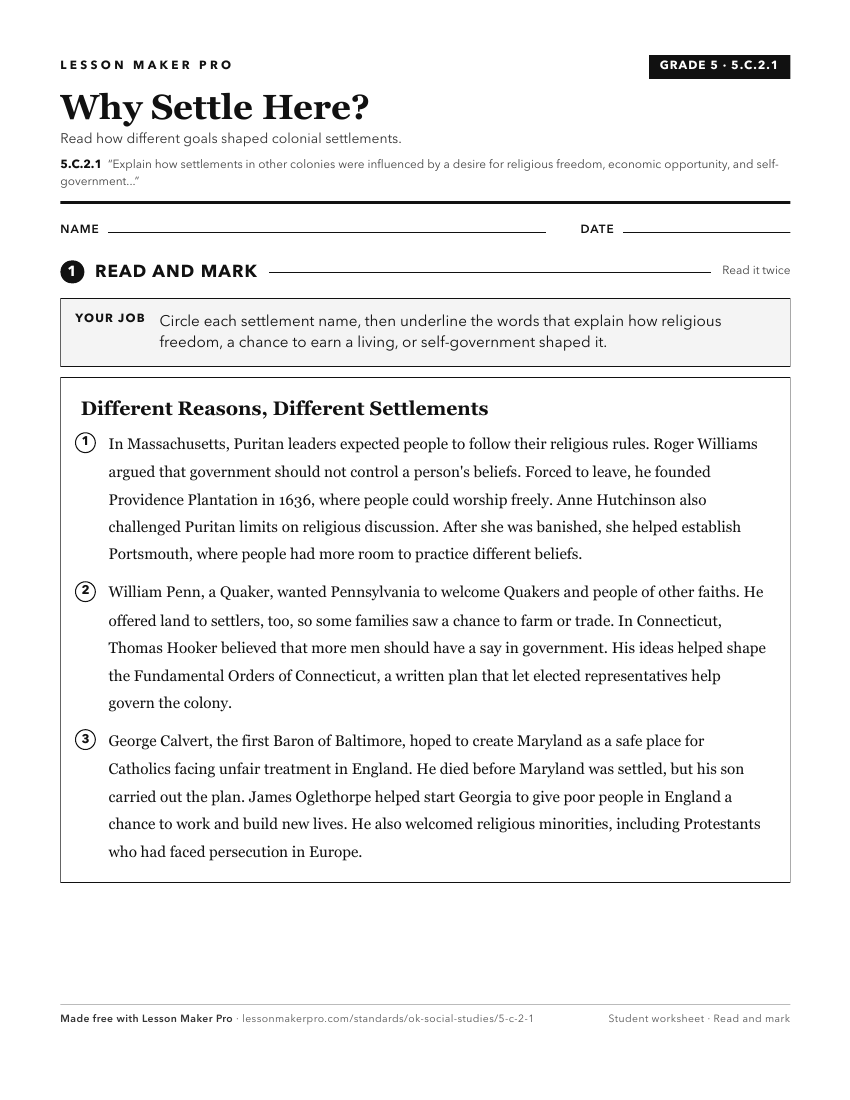
A ready-to-print activity worksheet aligned to 5.C.2.1, with an answer key for the teacher on its own page. No account needed.
PDF, US Letter, prints cleanly in black and white.
Download the worksheetKeep exploring
Related Standards
- 5.C.2.4
Analyze the forms of self-government in the colonies.
- 8.C.1.5.E
Evaluate the diverse political, economic, and religious influences that shaped colonial arguments for independence.
- 5.C.2.4.A
Explain how English traditions of limited government (Parliament’s relationship to the monarchy) and ethical traditions reflected in colonial covenants and poli...
- USG.C.2.1.C
Analyze colonial ideas on liberty, the practice of self-government, and the influence of religious thought on foundational documents (e.g., Massachusetts Body o...
Turn this cluster into a lesson
Grade, subject, topic, and the complete cluster are prefilled. Create one free, no account needed.
Also for this cluster:Make a WorksheetMake a QuizMake a Sub Lesson