Mississippi Science MAQ.1
Standard Cluster
Students will develop an understanding of the unique physical and chemical properties of water and how those properties shape life on Earth. Characterize the physical and chemical properties of water, including specific heat, surface temperature, universal solvent, and hydrogen bonding between water molecules (i.e., cohesion/adhesion/capillary action). Describe the role of water within biological systems (e.g., provides the medium necessary to allow for life processes such as protein synthesis, enzymatic reactions, and passive transport). Diagram, utilizing digital or physical models, the water cycle and how it relates to the total amount of fresh water available to living things at any given time. Collect, analyze, and communicate quantitative data that includes dissolved oxygen, pH, temperature, salinity, mineral content, nitrogen compounds, and turbidity from an aquatic environment (i.e., hydrometer, refractometer, Secchi disk, and chemical test kits). Research, analyze, and communicate current technology and career opportunities available to collect this data on a global scale using CTD, buoy data, or satellites. Enrichment: Use an engineering design process to reduce the effects of pollution in aquatic ecosystems (e.g., microplastics, garbage patches, oil spills, and eutrophication). Students will design a proposed solution based on current research and/or observations and develop a model to test their design. Data from experimentation will be analyzed, organized graphically, and communicated to classmates to determine the effectiveness of the proposed solution. *
2026 Mississippi College- and Career-Readiness Standards for Science · Water Properties and Quality
Cluster contents
Standards in This Cluster
MAQ.1 is a cluster heading. These are the individual standards under it.
- MAQ.1.1
Characterize the physical and chemical properties of water, including specific heat, surface temperature, universal solvent, and hydrogen bonding between water ...
- MAQ.1.2
Describe the role of water within biological systems (e.g., provides the medium necessary to allow for life processes such as protein synthesis, enzymatic react...
- MAQ.1.3
Diagram, utilizing digital or physical models, the water cycle and how it relates to the total amount of fresh water available to living things at any given tim...
- MAQ.1.4
Collect, analyze, and communicate quantitative data that includes dissolved oxygen, pH, temperature, salinity, mineral content, nitrogen compounds, and turbidit...
- MAQ.1.5
Research, analyze, and communicate current technology and career opportunities available to collect this data on a global scale using CTD, buoy data, or satelli...
- MAQ.1.6
Enrichment: Use an engineering design process to reduce the effects of pollution in aquatic ecosystems (e.g., microplastics, garbage patches, oil spills, and eu...
Teacher's field guide
What This Cluster Means
What Students Need to Do
- Students use water's polarity and hydrogen bonds to explain slow heating, dissolving power, and movement through narrow spaces. They link water to cell reactions and transport, then draw how the water cycle limits usable freshwater. They measure dissolved oxygen, pH, temperature, salinity, minerals, nitrogen, and turbidity, then compare results with buoy or satellite data.
What Mastery Looks Like
- A student explains why water climbs a paper towel, why a pond warms slowly, and why cells need water for reactions. They draw evaporation, condensation, precipitation, runoff, and groundwater, marking freshwater that organisms cannot easily reach. They label test results with units, spot a water quality concern, and explain how a buoy technician gathers similar data.
Common Misconceptions
- Students may think water dissolves everything or confuse cohesion between water molecules with adhesion to other surfaces. They may think salt evaporates with seawater or that all freshwater is easy to reach. They may assume clear water is safe for fish even when dissolved oxygen is low.
How to Assess It
- Give students a sketch of salty water under a cool lid and a dissolved oxygen reading of 3 mg/L. Ask where the salt stays, why droplets form on the lid, and what the oxygen reading could mean for fish.
Lesson moves
Ways to Teach It
Place drops on a penny, wick colored water up a paper towel, and have groups explain the forces behind each result.
Ask: Why can a lake stay cooler than nearby pavement, and how might that affect fish during a heat wave?
Give pairs test cards with pH, oxygen, nitrate, and turbidity readings; have them rank three ponds for fish habitat and defend their choices.
Open NOAA buoy records for one coastal site, graph a week of water temperatures, and name a marine technician's task using those readings.
Free download
Printable MAQ.1 Worksheet
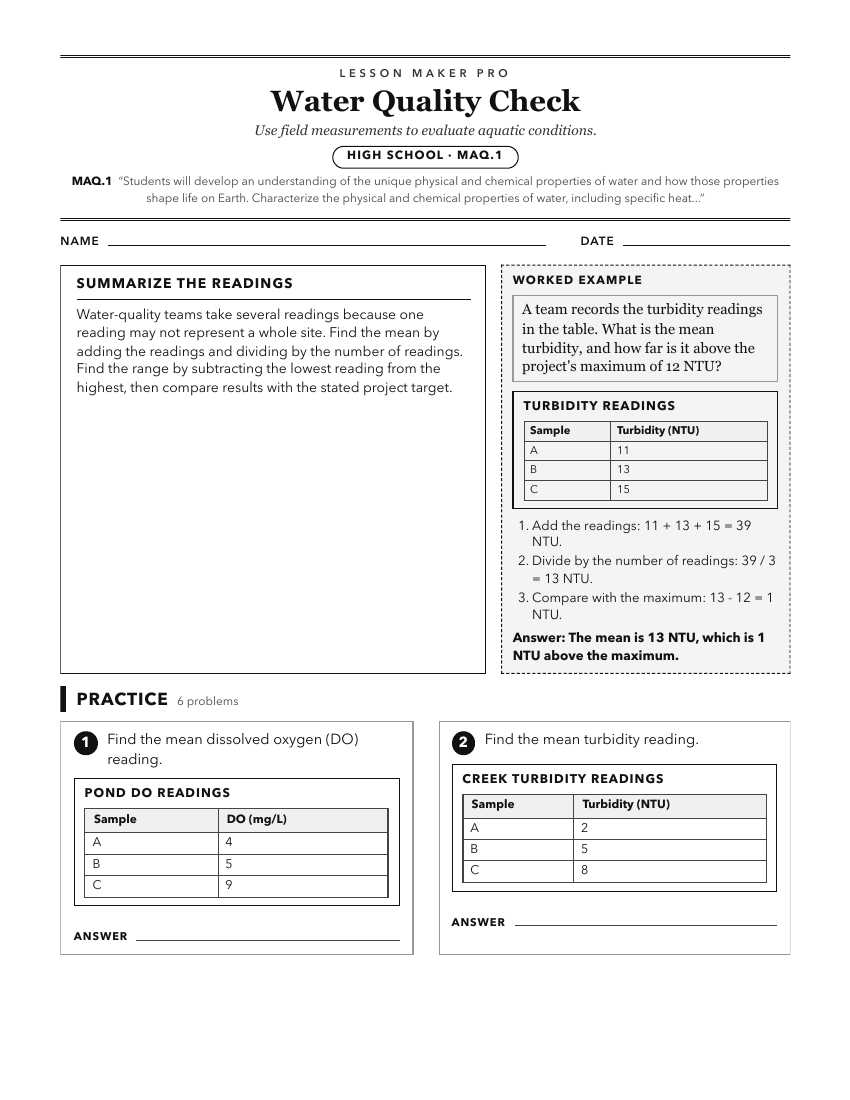
A ready-to-print activity worksheet aligned to MAQ.1, with an answer key for the teacher on its own page. No account needed.
PDF, US Letter, prints cleanly in black and white.
Download the worksheetKeep exploring
Related Standards
- ESS.2A
Students will develop an understanding of the structure and composition of Earth and its materials.
- E.1.10
Students will demonstrate an understanding of human dependence on clean and renewable water resources
- P.7.5A
Students will demonstrate an understanding of the physical and chemical properties of matter.
- P.5.5A
Students will demonstrate an understanding of the physical properties of matter.
Turn this cluster into a lesson
Grade, subject, topic, and the complete cluster are prefilled. Create one free, no account needed.
Also for this cluster:Make a WorksheetMake a QuizMake a Sub Lesson