Mississippi Science MAQ.1.4
The Standard
- MAQ.1
- Students will develop an understanding of the unique physical and chemical properties of water and how those properties shape life on Earth.
Collect, analyze, and communicate quantitative data that includes dissolved oxygen, pH, temperature, salinity, mineral content, nitrogen compounds, and turbidity from an aquatic environment (i.e., hydrometer, refractometer, Secchi disk, and chemical test kits).
2026 Mississippi College- and Career-Readiness Standards for Science · Water Properties and Quality
Teacher's field guide
What This Standard Means
What Students Need to Do
- Students use field tools and test kits to take water readings at a pond, stream, or estuary. They record oxygen, pH, temperature, salinity, hardness, ammonia, nitrate, and clarity, then explain what the numbers show.
What Mastery Looks Like
- A student chooses the right tool for each reading and records units where needed, but not for pH. They use specific readings to make a cautious claim about water conditions in a labeled table.
Common Misconceptions
- Students may give pH a unit or think a shallower Secchi disk reading means clearer water. They may combine ammonia and nitrate into one result or assume high nitrate proves where pollution came from.
How to Assess It
- Exit ticket: An estuary sample has oxygen 3 mg/L, pH 7.2, temperature 28 °C, salinity 2 ppt, hardness 90 mg/L, nitrate 4 mg/L, and Secchi depth 20 cm. Name the tools for salinity and clarity, then write one cautious claim supported by two readings.
Lesson moves
Ways to Teach It
At an estuary, teams use a Secchi disk, refractometer, thermometer, and test kits to record clarity, salinity, temperature, oxygen, pH, hardness, and nitrate.
Ask students to debate whether oxygen at 3 mg/L proves pollution, using temperature and nitrate readings as possible clues.
Give pairs tool cards and measurement cards to match Secchi depth, salinity, pH, oxygen, hardness, and nitrate to instruments.
Compare class nitrate and oxygen readings with a water agency's data for the same waterway, then write a two-sentence update for local anglers.
Free download
Printable MAQ.1.4 Worksheet
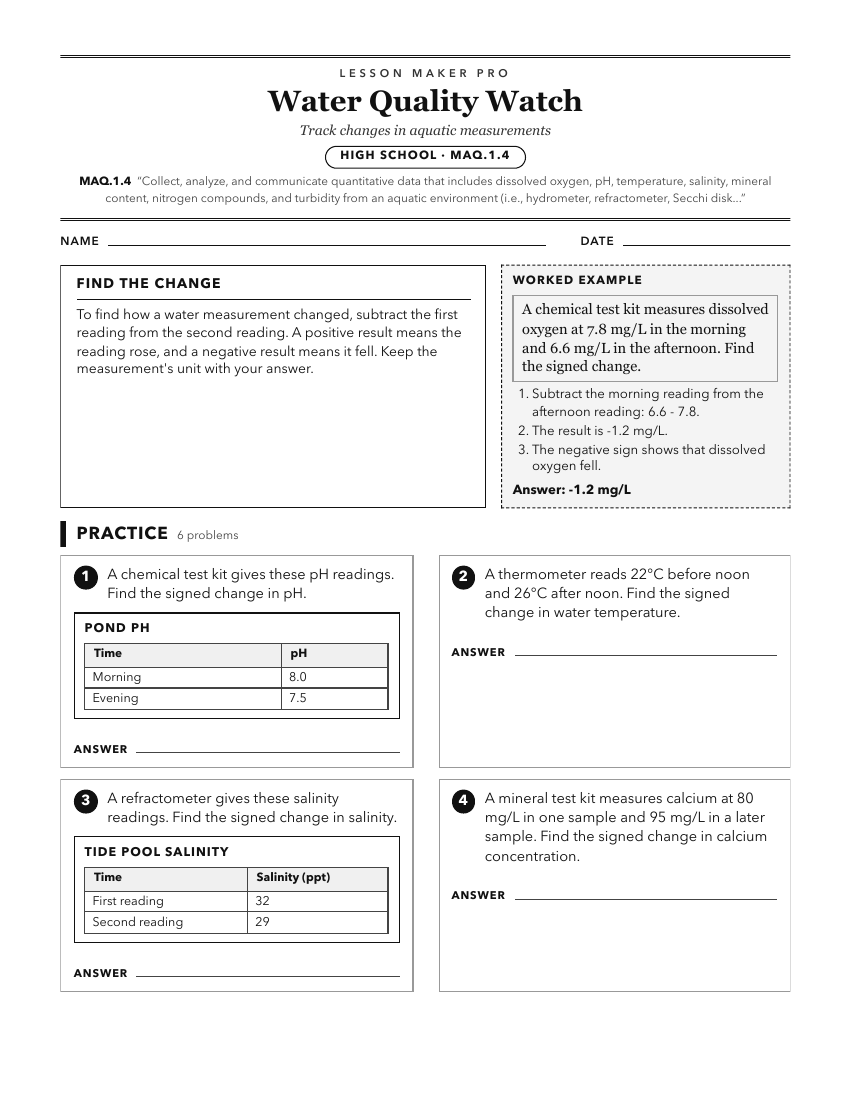
A ready-to-print activity worksheet aligned to MAQ.1.4, with an answer key for the teacher on its own page. No account needed.
PDF, US Letter, prints cleanly in black and white.
Download the worksheetKeep exploring
Related Standards
- P.5.5A.2
Collect, analyze, and interpret data from measurements of the physical properties of solids, liquids, and gases (e.g., volume, shape, movement, and spacing of p...
- MAQ.4.6
Research, analyze, and communicate the effects of natural phenomena (e.g., hurricanes, floods, drought, and sea-level rise) on the aquatic ecosystems.
- P.7.5D.3
Collect, organize, and interpret data using various tools (e.g., litmus paper, pH paper, cabbage juice) regarding neutralization of acids and bases using common...
- MAQ.1.5
Research, analyze, and communicate current technology and career opportunities available to collect this data on a global scale using CTD, buoy data, or satelli...
Turn this exact standard into a lesson
Grade, subject, topic, and the complete standard are prefilled. Create one free, no account needed.
Also for this standard:Make a WorksheetMake a QuizMake a Sub Lesson