Mississippi Science E.1.10
Standard Cluster
Students will demonstrate an understanding of human dependence on clean and renewable water resources Obtain and evaluate informational texts and other media to generate and answer questions about water sources and human uses of clean water. Communicate solutions that will reduce the impact of humans on the use and quality of water in the local environment. Create a device that will collect free water to meet a human need (e.g., household drinking water, watering plants/animals, cleaning). Use an engineering design process to define the problem, design, construct, evaluate, and improve the device. *
2026 Mississippi College- and Career-Readiness Standards for Science · Earth’s Resources
Cluster contents
Standards in This Cluster
E.1.10 is a cluster heading. These are the individual standards under it.
- E.1.10.1
Obtain and evaluate informational texts and other media to generate and answer questions about water sources and human uses of clean water.
- E.1.10.2
Communicate solutions that will reduce the impact of humans on the use and quality of water in the local environment.
- E.1.10.3
Create a device that will collect free water to meet a human need (e.g., household drinking water, watering plants/animals, cleaning). Use an engineering design...
Teacher's field guide
What This Cluster Means
What Students Need to Do
- Students use a short book or video to find where people get water and how they use it. They suggest ways to keep nearby water clean and use less of it. They build, test, and improve a device that collects rainwater for plants.
What Mastery Looks Like
- A student can name a water source and explain why people need clean water. They can show how their device catches and holds water, then change it after a test. They can name one way to keep litter out of local water.
Common Misconceptions
- Students may think clear water is always safe to drink, including rainwater collected from a roof. Some think water from a tap cannot run out. Others think litter in a storm drain stays there.
How to Assess It
- Ask students to draw a rain collector for watering a plant. Have them label where water enters and stays, name one change they would make after testing it, and tell one way to keep nearby water clean.
Lesson moves
Ways to Teach It
Give pairs a cup, paper funnel, and tape to collect water poured like rain; have them fix one leak and test again.
Read a picture book about a river, then ask, “How do people use this water, and what could make it unsafe?”
Sort picture cards into water sources, water uses, and ways to protect water; ask students to explain one choice.
From a safe spot, look at a nearby storm drain and sketch how a dropped wrapper might reach a stream.
Free download
Printable E.1.10 Worksheet
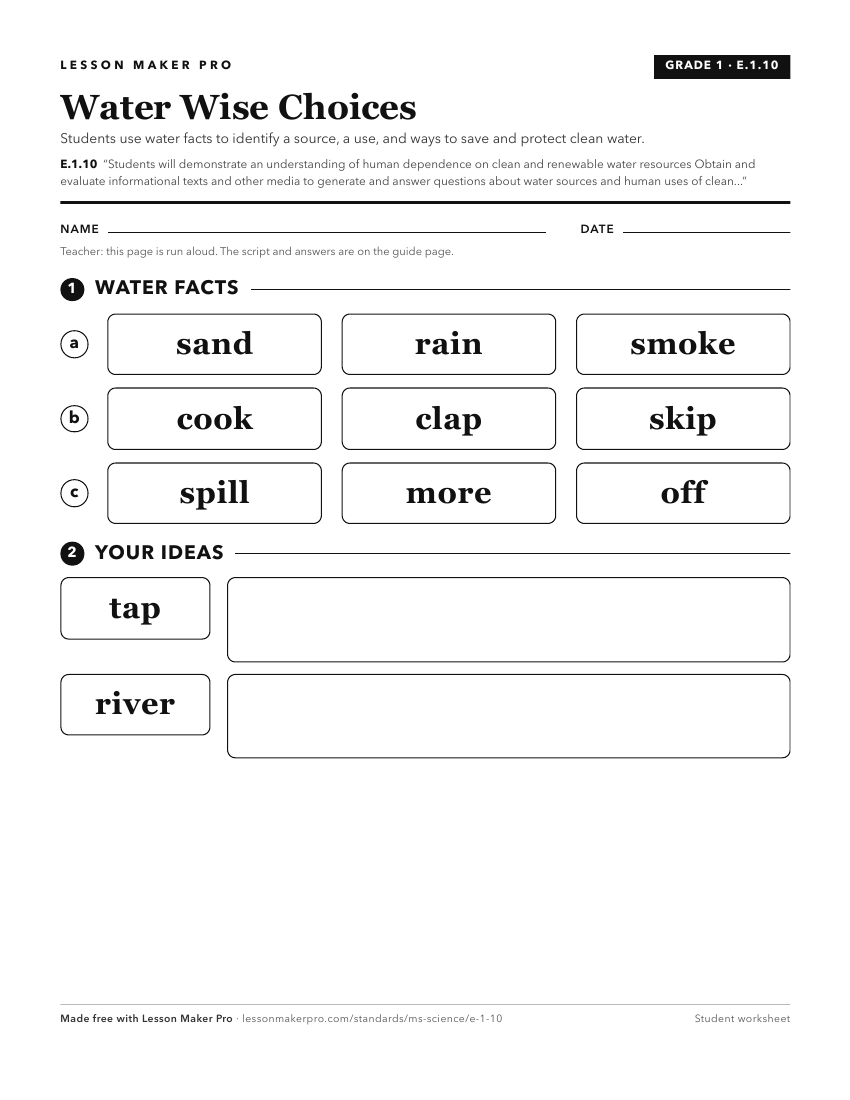
A ready-to-print activity worksheet aligned to E.1.10, with an answer key for the teacher on its own page. No account needed.
PDF, US Letter, prints cleanly in black and white.
Download the worksheetKeep exploring
Related Standards
- L.2.3A
Students will demonstrate an understanding of the interdependence of living things and the environment in which they live.
- ENV.4
Students will demonstrate an understanding of the interdependence of human sustainability and the environment.
- E.2.10
Students will demonstrate an understanding of how humans use Earth’s resources.
- E.K.10
Students will demonstrate an understanding of how humans use Earth’s resources.
Turn this cluster into a lesson
Grade, subject, topic, and the complete cluster are prefilled. Create one free, no account needed.
Also for this cluster:Make a WorksheetMake a QuizMake a Sub Lesson