Mississippi Science MAQ.1.1
The Standard
- MAQ.1
- Students will develop an understanding of the unique physical and chemical properties of water and how those properties shape life on Earth.
Characterize the physical and chemical properties of water, including specific heat, surface temperature, universal solvent, and hydrogen bonding between water molecules (i.e., cohesion/adhesion/capillary action).
2026 Mississippi College- and Career-Readiness Standards for Science · Water Properties and Quality
Teacher's field guide
What This Standard Means
What Students Need to Do
- Students explain how hydrogen bonds help water bead, cling to surfaces, and rise through narrow spaces. They use specific heat to explain why surface water warms slowly. They explain why water dissolves salt but not oil.
What Mastery Looks Like
- Given a water drop on wax paper and a wet paper towel, students identify cohesion, adhesion, and capillary action. They predict that surface water heats more slowly than sand under the same sunlight. They explain how water pulls apart salt ions.
Common Misconceptions
- Students may think water dissolves everything, including oil. They may confuse cohesion with adhesion or say capillary action comes from cohesion alone. Some think specific heat is a fixed water temperature.
How to Assess It
- Exit ticket: Explain why bay surface water heats slowly, salt dissolves in it, and water rises through a paper towel. Name the property behind each observation.
Lesson moves
Ways to Teach It
Put water drops on wax paper, then dip a paper towel edge into a cup of water and sketch the beading and climbing.
Ask: Why does salt dissolve in water while oil separates? Have students write two sentences about charged particles and oil molecules.
Have pairs match property cards to beading droplets, wet glass, a rising paper towel, a slow-warming bay, and dissolving salt.
Give students morning and afternoon temperatures for a pond's surface and nearby pavement, then ask which heats faster and how that affects pond animals.
Free download
Printable MAQ.1.1 Worksheet
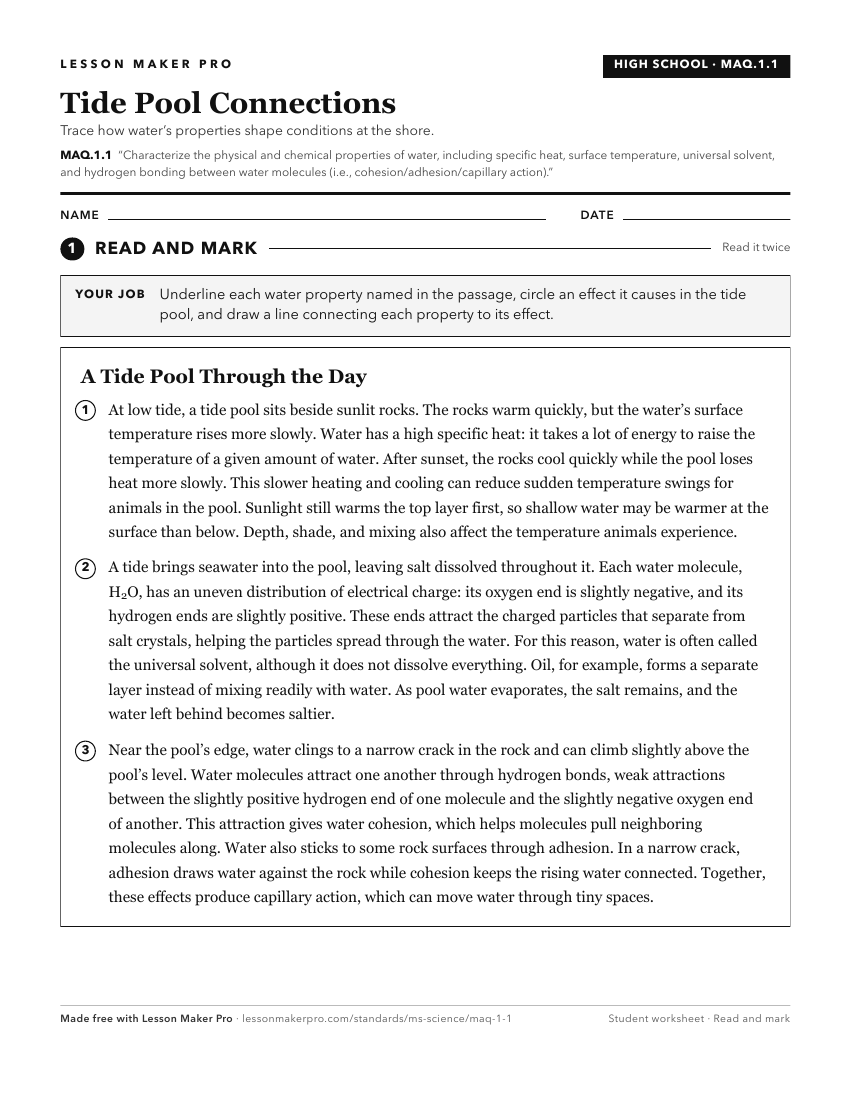
A ready-to-print activity worksheet aligned to MAQ.1.1, with an answer key for the teacher on its own page. No account needed.
PDF, US Letter, prints cleanly in black and white.
Download the worksheetKeep exploring
Related Standards
- P.7.5A.1
Collect and evaluate qualitative data to describe substances using physical properties (state, boiling/melting point, density, heat/electrical conductivity, col...
- P.7.5A.3
Compare and contrast chemical and physical properties (e.g., combustion, oxidation, pH, solubility, reaction with water).
- MAQ.1
Students will develop an understanding of the unique physical and chemical properties of water and how those properties shape life on Earth.
- FB.2.5
Investigate how the properties of water (e.g., cohesion, adhesion, heat capacity, solvent properties) contribute to the maintenance of living cells and organism...
Turn this exact standard into a lesson
Grade, subject, topic, and the complete standard are prefilled. Create one free, no account needed.
Also for this standard:Make a WorksheetMake a QuizMake a Sub Lesson