Mississippi Science HAP.11
Standard Cluster
Students will investigate the structures and functions of the lymphatic system, including the cause and effect of diseases and disorders. Analyze the functions of leukocytes, lymph, and lymphatic organs in the immune system. Compare the primary functions of the lymphatic system and its relationship to the cardiovascular system. Compare and contrast the body’s non-specific and specific lines of defense, including an analysis of the roles of various leukocytes: basophils, eosinophils, neutrophils, monocytes, and lymphocytes. Correlate the functions of the spleen, thymus, lymph nodes, and lymphocytes to the development of immunity. Differentiate the role of B-lymphocytes and T-lymphocytes in the development of humoral and cell-mediated immunity and primary and secondary immune responses. Investigate various forms of acquired and passive immunity (e.g., fetal immunity, breastfed babies, vaccinations, and plasma donations). Research and analyze the causes and effects of various pathological conditions (e.g., viral infections, auto-immune disorders, immunodeficiency disorders, and lymphomas).
2026 Mississippi College- and Career-Readiness Standards for Science · Lymphatic System
Cluster contents
Standards in This Cluster
HAP.11 is a cluster heading. These are the individual standards under it.
- HAP.11.1
Analyze the functions of leukocytes, lymph, and lymphatic organs in the immune system.
- HAP.11.2
Compare the primary functions of the lymphatic system and its relationship to the cardiovascular system.
- HAP.11.3
Compare and contrast the body’s non-specific and specific lines of defense, including an analysis of the roles of various leukocytes: basophils, eosinophils, ne...
- HAP.11.4
Correlate the functions of the spleen, thymus, lymph nodes, and lymphocytes to the development of immunity.
- HAP.11.5
Differentiate the role of B-lymphocytes and T-lymphocytes in the development of humoral and cell-mediated immunity and primary and secondary immune responses.
- HAP.11.6
Investigate various forms of acquired and passive immunity (e.g., fetal immunity, breastfed babies, vaccinations, and plasma donations).
- HAP.11.7
Research and analyze the causes and effects of various pathological conditions (e.g., viral infections, auto-immune disorders, immunodeficiency disorders, and l...
Teacher's field guide
What This Cluster Means
What Students Need to Do
- Trace tissue fluid from blood vessels into lymph vessels and back to the blood. Identify how lymph nodes, the spleen, the thymus, and white blood cells help defend the body. Use cases of infection, vaccination, and immune disease to explain different kinds of protection.
What Mastery Looks Like
- Students trace fluid through lymph nodes back to blood. They explain that the spleen filters blood and the thymus matures T cells. They match white blood cells to their jobs and distinguish B-cell antibodies from T-cell killing. They explain why a second exposure brings a faster response.
Common Misconceptions
- Students may think lymph vessels carry blood or that lymph nodes make the fluid they filter. They may confuse B-cell antibodies with T-cell killing and assume every white blood cell targets one specific germ. They may think vaccines supply ready-made antibodies or that autoimmune disease means weak immunity.
How to Assess It
- Exit ticket: A vaccinated student encounters the same virus months later, while a newborn receives antibodies through breast milk. Ask which has active immunity, which has passive immunity, and why the vaccinated student responds faster.
Lesson moves
Ways to Teach It
Lay red and blue yarn as blood and lymph vessels; move paper fluid drops from tissues through a paper node back to blood.
Ask students to write why a vaccine can protect them later, while antibodies passed through breast milk give a baby temporary protection.
Give pairs cards labeled basophil, eosinophil, neutrophil, monocyte, B cell, and T cell; have them match each to a defense clue.
Hand out brief case notes on lymphoma, lupus, and HIV; students circle the affected immune cells or organs and predict one defense problem.
Free download
Printable HAP.11 Worksheet
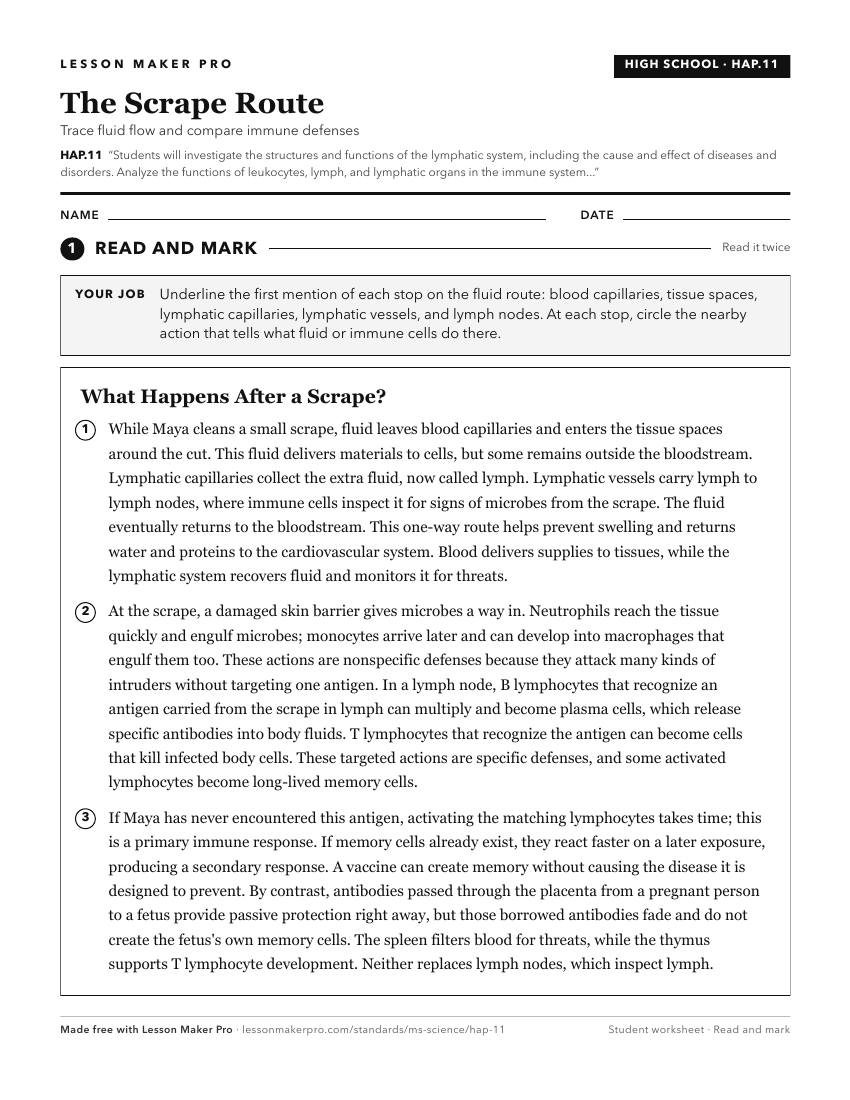
A ready-to-print activity worksheet aligned to HAP.11, with an answer key for the teacher on its own page. No account needed.
PDF, US Letter, prints cleanly in black and white.
Download the worksheetKeep exploring
Related Standards
- HAP.5
Students will investigate the structures and functions of the muscular system, including the cause and effect of diseases and disorders.
- HAP.4
Students will investigate the structures and functions of the skeletal system including the cause and effect of diseases and disorders.
- HAP.13
Students will investigate the structures and functions of the digestive system, including the cause and effect of diseases and disorders.
- HAP.10
Students will investigate the structures and functions of the cardiovascular system, including the cause and effect of diseases and disorders.
Turn this cluster into a lesson
Grade, subject, topic, and the complete cluster are prefilled. Create one free, no account needed.
Also for this cluster:Make a WorksheetMake a QuizMake a Sub Lesson