Mississippi Science HAP.11.3
The Standard
- HAP.11
- Students will investigate the structures and functions of the lymphatic system, including the cause and effect of diseases and disorders.
Compare and contrast the body’s non-specific and specific lines of defense, including an analysis of the roles of various leukocytes: basophils, eosinophils, neutrophils, monocytes, and lymphocytes.
2026 Mississippi College- and Career-Readiness Standards for Science · Lymphatic System
Teacher's field guide
What This Standard Means
What Students Need to Do
- Students compare fast, broad defenses with responses that target a particular germ and remember it. They explain the jobs of basophils, eosinophils, neutrophils, monocytes, and lymphocytes.
What Mastery Looks Like
- A student can explain how skin and inflammation protect the body before a targeted response develops. They can match basophils with histamine release, eosinophils with parasite defense, neutrophils with engulfing bacteria, and monocytes with becoming macrophages. They can explain how B and T lymphocytes target germs and form memory.
Common Misconceptions
- Students may think every white blood cell makes antibodies, when that is a job of B lymphocytes. They may also think inflammation targets one germ or that fast, broad defenses create the same lasting memory as a targeted response.
How to Assess It
- Exit ticket: Match basophils, eosinophils, neutrophils, monocytes, and B lymphocytes to histamine, parasites, engulfing bacteria, macrophages, and antibodies. Then explain why a vaccine can help months later but skin protects right away.
Lesson moves
Ways to Teach It
Give pairs cards labeled skin, swelling, neutrophils, monocytes, B cells, and T cells; have them order the defenses after a contaminated cut.
Ask: Why might a scraped knee swell before matching antibodies appear? Write two sentences using basophils and B cells.
Run a cell-role matching race with cards for the five leukocytes and their jobs; have partners explain one match they found tricky.
Show a flu shot reminder beside a scraped-knee photo; have students label targeted immune memory and fast, broad protection.
Free download
Printable HAP.11.3 Worksheet
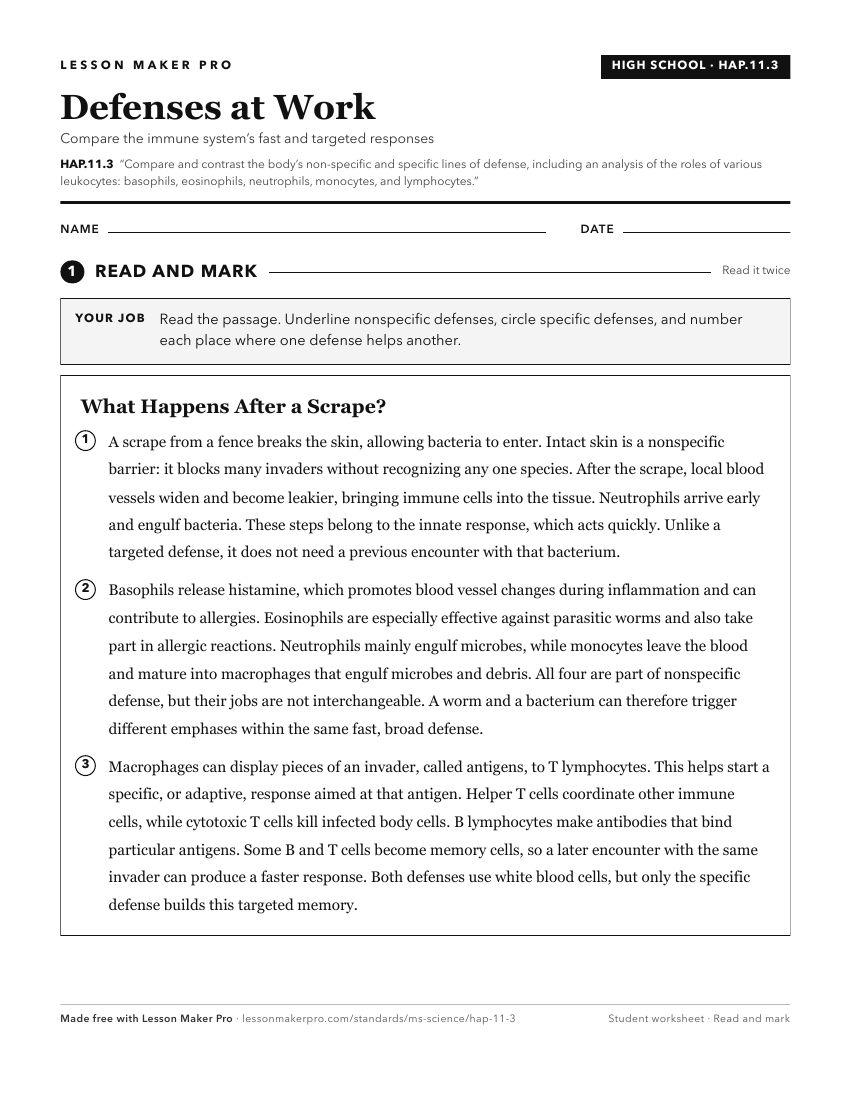
A ready-to-print activity worksheet aligned to HAP.11.3, with an answer key for the teacher on its own page. No account needed.
PDF, US Letter, prints cleanly in black and white.
Download the worksheetKeep exploring
Related Standards
- HAP.6.4
Compare and contrast the structures and functions of the central and peripheral nervous systems. Investigate how the systems interact to maintain homeostasis (e...
- MAQ.6.4
Compare and contrast major body plans (e.g., asymmetry, radial, bilateral symmetry, acoelomate, pseudocoelomate, and eucoelomate).
- HAP.11.5
Differentiate the role of B-lymphocytes and T-lymphocytes in the development of humoral and cell-mediated immunity and primary and secondary immune responses.
- HAP.11.1
Analyze the functions of leukocytes, lymph, and lymphatic organs in the immune system.
Turn this exact standard into a lesson
Grade, subject, topic, and the complete standard are prefilled. Create one free, no account needed.
Also for this standard:Make a WorksheetMake a QuizMake a Sub Lesson