Mississippi Science HAP.11.4
The Standard
- HAP.11
- Students will investigate the structures and functions of the lymphatic system, including the cause and effect of diseases and disorders.
Correlate the functions of the spleen, thymus, lymph nodes, and lymphocytes to the development of immunity.
2026 Mississippi College- and Career-Readiness Standards for Science · Lymphatic System
Teacher's field guide
What This Standard Means
What Students Need to Do
- Students explain how the spleen checks blood for pathogens, lymph nodes check lymph, and the thymus matures T cells. They describe how B and T lymphocytes fight infection and form memory after infection or vaccination.
What Mastery Looks Like
- Given a sore throat and swollen neck nodes, a student explains that lymphocytes encounter antigens and multiply in those nodes. They identify the spleen as a blood filter and the thymus as the place T cells mature. They explain that B cells make antibodies, killer T cells destroy infected cells, and memory cells help on later exposure.
Common Misconceptions
- Students often swap the spleen and lymph nodes, saying both mainly filter blood. Some think the thymus makes antibodies or that lymphocytes are organs. Others think protection ends when symptoms fade, missing the role of memory cells.
How to Assess It
- Exit ticket: One antigen travels in blood, and another drains from a cut through lymph. Name the organ that monitors each, where T cells mature, and how memory lymphocytes help on reexposure.
Lesson moves
Ways to Teach It
Have pairs move blood antigen, tissue antigen, and immature T-cell tokens across a body outline to the spleen, lymph node, and thymus.
Ask: Why might a swollen lymph node follow a sore throat, while the spleen checks blood and the thymus prepares T cells?
Play a card match: spleen filters blood, thymus matures T cells, nodes filter lymph, B cells make antibodies, killer T cells destroy infected cells.
Mark an upper-arm vaccine injection on a body outline, circle nearby lymph nodes, and explain how memory lymphocytes respond to later exposure.
Free download
Printable HAP.11.4 Worksheet
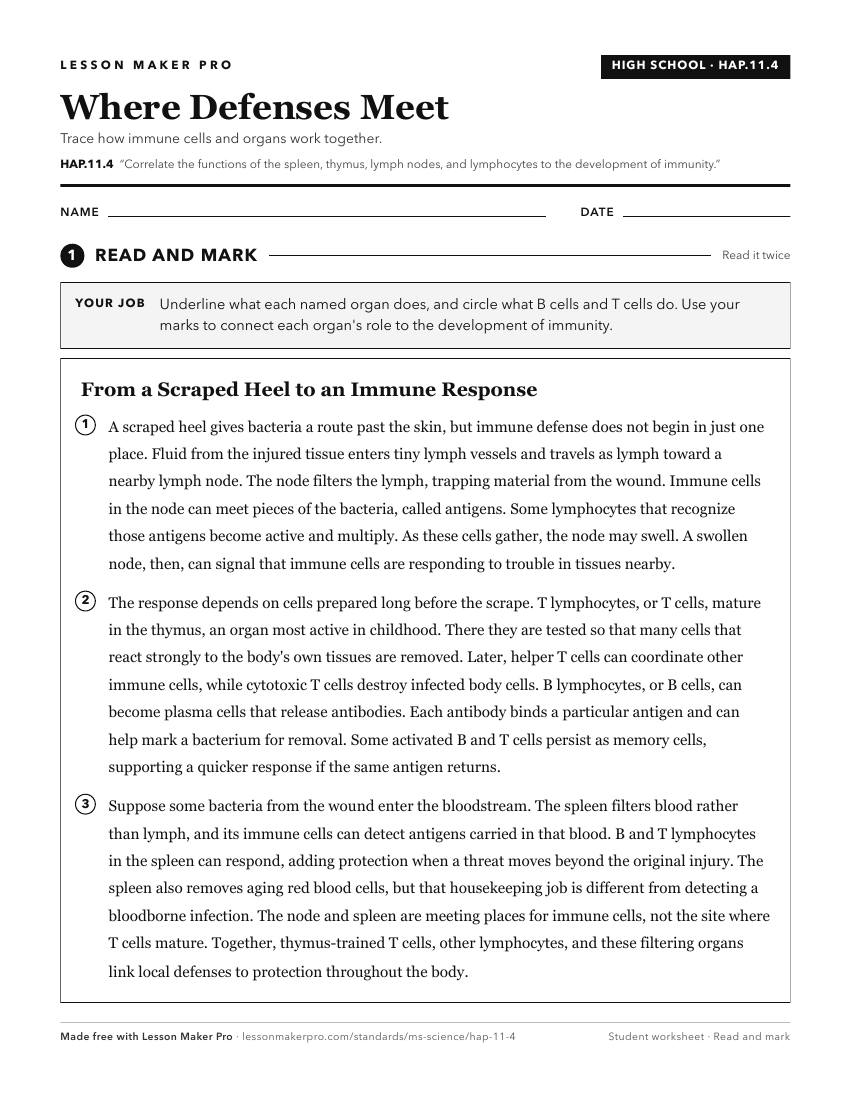
A ready-to-print activity worksheet aligned to HAP.11.4, with an answer key for the teacher on its own page. No account needed.
PDF, US Letter, prints cleanly in black and white.
Download the worksheetKeep exploring
Related Standards
- HAP.11
Students will investigate the structures and functions of the lymphatic system, including the cause and effect of diseases and disorders.
- HAP.11.7
Research and analyze the causes and effects of various pathological conditions (e.g., viral infections, auto-immune disorders, immunodeficiency disorders, and l...
- HAP.11.5
Differentiate the role of B-lymphocytes and T-lymphocytes in the development of humoral and cell-mediated immunity and primary and secondary immune responses.
- HAP.11.1
Analyze the functions of leukocytes, lymph, and lymphatic organs in the immune system.
Turn this exact standard into a lesson
Grade, subject, topic, and the complete standard are prefilled. Create one free, no account needed.
Also for this standard:Make a WorksheetMake a QuizMake a Sub Lesson