Georgia SS4E1
Georgia Standard (Element Cluster)
Use the basic economic concepts of trade, opportunity cost, specialization, voluntary exchange, productivity, and price incentives to illustrate historical events.
Georgia Standards of Excellence for Social Studies
Cluster contents
Elements in This Standard
SS4E1 is a Georgia social studies standard. These are the elements under it.
- SS4E1.a
Describe opportunity cost and its relationship to decision-making across time (e.g., decisions to settle in the west).
- SS4E1.b
Explain how price incentives affect people's behavior and choices: decisions about what crops (e.g., cotton, and tobacco) to grow and products (e.g., textiles) ...
- SS4E1.c
Describe how specialization improves standards of living (e.g., differences in the economies in the North and South).
- SS4E1.d
Explain how voluntary exchange helps both buyers and sellers (e.g., Gold Rush mining towns).
- SS4E1.e
Describe how trade promotes economic activity (e.g., trade between the U.S. and Europe).
- SS4E1.f
Give examples of technological advancements and their impact on business productivity during the development of the United States (e.g., cotton gin, steamboat, ...
Teacher's field guide
What This Cluster Means
What Students Need to Do
- Students explain how economic choices help cause or shape historical events. They connect trade, specialization, productivity, prices, and forgone choices to evidence from an event.
What Mastery Looks Like
- Students can identify the economic concept shown in a historical example and explain its effect. They support the explanation with accurate details about people, goods, work, prices, or choices.
Common Misconceptions
- Students may think trade always benefits both sides equally or that every exchange is voluntary. They may define opportunity cost as money spent, confuse productivity with total production, or treat specialization as simply being talented.
How to Assess It
- Exit ticket: During the California Gold Rush, merchants raised shovel prices, and many workers left paid jobs to search for gold. Explain one price incentive and one opportunity cost.
Lesson moves
Ways to Teach It
Give groups colonial job cards, paper goods, and tokens, then let them specialize, trade by choice, and record each rejected alternative.
Using evidence about enslaved labor, write how cotton specialization affected Southern trade and production before the Civil War.
Play a card match linking Gold Rush, railroad, and factory scenarios to opportunity cost, price incentives, productivity, or voluntary exchange.
Compare prices for one grocery item at two stores, then explain how price could influence a family's voluntary exchange.
Free download
Printable SS4E1 Worksheet
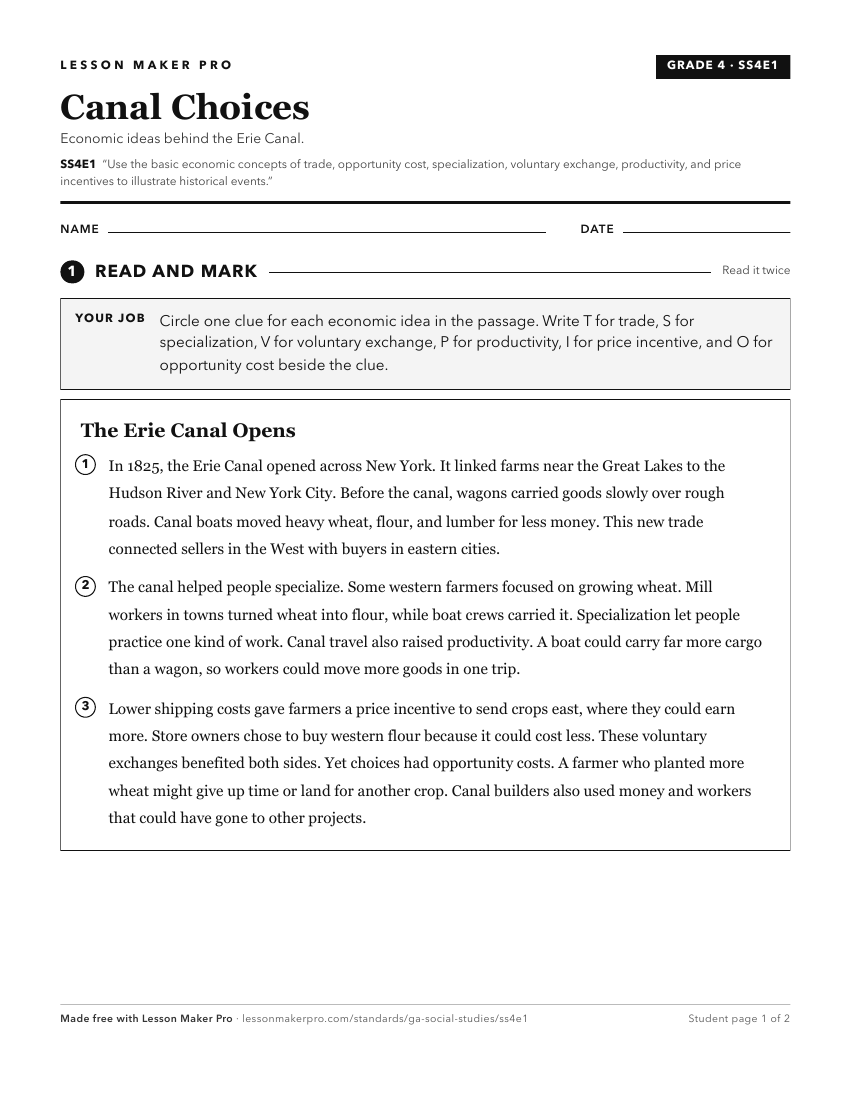
A ready-to-print activity worksheet aligned to SS4E1, with an answer key for the teacher on its own page. No account needed.
PDF, US Letter, prints cleanly in black and white.
Download the worksheetKeep exploring
Related Standards
- SS6E10.a
Compare how traditional, command, and market economies answer the economic questions of 1-what to produce, 2-how to produce, and 3-for whom to produce.
- SS6E1.a
Compare how traditional, command, and market economies answer the economic questions of 1-what to produce, 2-how to produce, and 3-for whom to produce.
- SS5E1
Use the basic economic concepts of trade, opportunity cost, specialization, productivity, and price incentives to illustrate historical events.
- SS7E4.a
Compare how traditional, command, and market economies answer the economic questions of 1-what to produce, 2-how to produce, and 3-for whom to produce.
Turn this cluster into a lesson
Grade, subject, topic, and the complete cluster are prefilled. Create one free, no account needed.
Also for this cluster:Make a WorksheetMake a QuizMake a Sub Lesson