Georgia SS5E1
Georgia Standard (Element Cluster)
Use the basic economic concepts of trade, opportunity cost, specialization, productivity, and price incentives to illustrate historical events.
Georgia Standards of Excellence for Social Studies
Cluster contents
Elements in This Standard
SS5E1 is a Georgia social studies standard. These are the elements under it.
- SS5E1.a
Describe opportunity costs and their relationship to decision-making across time (e.g., decisions by individuals in response to rationing during WWII).
- SS5E1.b
Explain how price incentives affect people's behavior and choices (e.g., decisions to participate in cattle trails because of increased beef prices).
- SS5E1.c
Describe how specialization can improve standards of living and productivity (e.g., how Henry Ford's use of the assembly line reduced the price of automobiles).
- SS5E1.d
Describe how trade and voluntary exchange promotes economic activity (e.g., how the Panama Canal increases trade among countries).
Teacher's field guide
What This Cluster Means
What Students Need to Do
- Students explain how trade, choices, worker roles, output, and prices shaped decisions during historical events. They connect each economic idea to a specific cause or result.
What Mastery Looks Like
- Given a historical situation, students identify the economic concept at work and explain its effect. They use event details to show who benefited, what was given up, or why production changed.
Common Misconceptions
- Students may confuse opportunity cost with the money paid for something. They may think specialization means being talented, or that productivity simply means working longer. They may also assume trade only happens between countries.
How to Assess It
- Use this exit ticket: “During World War II, a car factory begins making tanks. Name two economic concepts shown and explain how each affected choices or output.”
Lesson moves
Ways to Teach It
Give groups event cards and concept labels, then have them match each event and build a cause-and-effect chain with arrows.
Ask, “How did assembly-line specialization change factory output, worker roles, and prices?” Students write a claim supported by two facts.
Play Concept Detective: read historical scenarios, and teams identify the economic concept shown and explain their choice.
Have students analyze a school snack sale, naming who specializes, what is traded, what raises output, and which prices influence choices.
Free download
Printable SS5E1 Worksheet
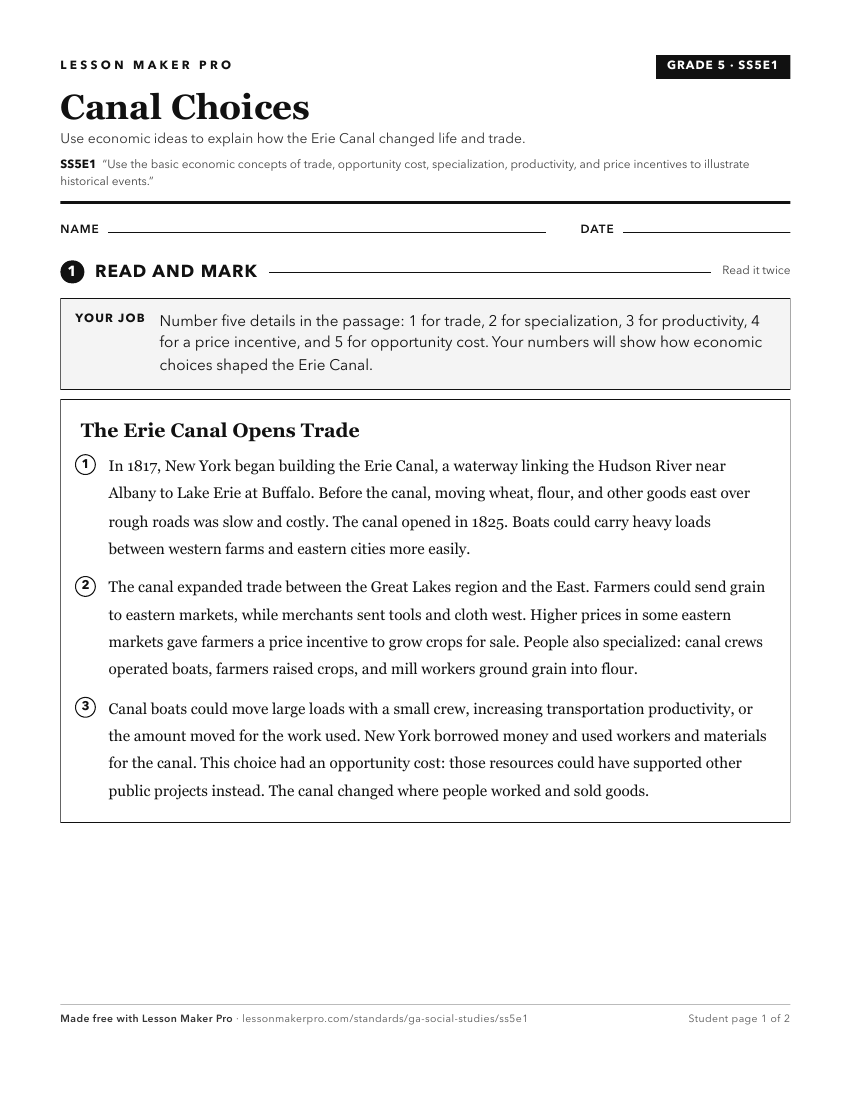
A ready-to-print activity worksheet aligned to SS5E1, with an answer key for the teacher on its own page. No account needed.
PDF, US Letter, prints cleanly in black and white.
Download the worksheetKeep exploring
Related Standards
- SS6E10.a
Compare how traditional, command, and market economies answer the economic questions of 1-what to produce, 2-how to produce, and 3-for whom to produce.
- SS4E1
Use the basic economic concepts of trade, opportunity cost, specialization, voluntary exchange, productivity, and price incentives to illustrate historical even...
- SS6E1.a
Compare how traditional, command, and market economies answer the economic questions of 1-what to produce, 2-how to produce, and 3-for whom to produce.
- SS7E4.a
Compare how traditional, command, and market economies answer the economic questions of 1-what to produce, 2-how to produce, and 3-for whom to produce.
Turn this cluster into a lesson
Grade, subject, topic, and the complete cluster are prefilled. Create one free, no account needed.
Also for this cluster:Make a WorksheetMake a QuizMake a Sub Lesson