Georgia S8P1
Georgia Standard (Element Cluster)
Obtain, evaluate, and communicate information about the structure and properties of matter.
Georgia Standards of Excellence for Science
Cluster contents
Elements in This Standard
S8P1 is a Georgia science standard. These are the elements under it.
- S8P1.a
Develop and use a model to compare and contrast pure substances (elements and compounds) and mixtures.
- S8P1.b
Develop and use models to describe the movement of particles in solids, liquids, gases, and plasma states when thermal energy is added or removed.
- S8P1.c
Plan and carry out investigations to compare and contrast chemical (i.e., reactivity, combustibility) and physical (i.e., density, melting point, boiling point)...
- S8P1.d
Construct an argument based on observational evidence to support the claim that when a change in a substance occurs, it can be classified as either chemical or ...
- S8P1.e
Develop models (e.g., atomic-level models, including drawings, and computer representations) by analyzing patterns within the periodic table that illustrate the...
- S8P1.f
Construct an explanation based on evidence to describe conservation of matter in a chemical reaction including the resulting differences between products and re...
Teacher's field guide
What This Cluster Means
What Students Need to Do
- Students use models, observations, data, and reliable sources to describe matter at the particle and atomic levels. They connect structure to measurable properties and communicate a claim supported by evidence.
What Mastery Looks Like
- A student can interpret an atomic or particle model, identify relevant properties, and use patterns to compare substances. The student explains conclusions with accurate terms, data, and a clear link between evidence and claim.
Common Misconceptions
- Students often treat atoms and molecules as the same thing, or picture particles in a liquid as having no spacing. They may confuse a property with a change and make claims from appearance alone instead of measured evidence.
How to Assess It
- Give students two particle diagrams and a table of conductivity, density, and melting point data. Ask, “Which model best matches each sample, and what evidence supports each match?”
Lesson moves
Ways to Teach It
Set up stations where students measure mass, volume, conductivity, magnetism, and solubility of four safe samples, then record patterns.
Ask students to write: “How does particle arrangement explain why a solid keeps its shape while a liquid flows?”
Play a card-matching game with particle models, property data, states of matter, and evidence-based claims.
Compare aluminum, glass, and plastic drink containers, then choose one for a product using measured properties as evidence.
Free download
Printable S8P1 Worksheet
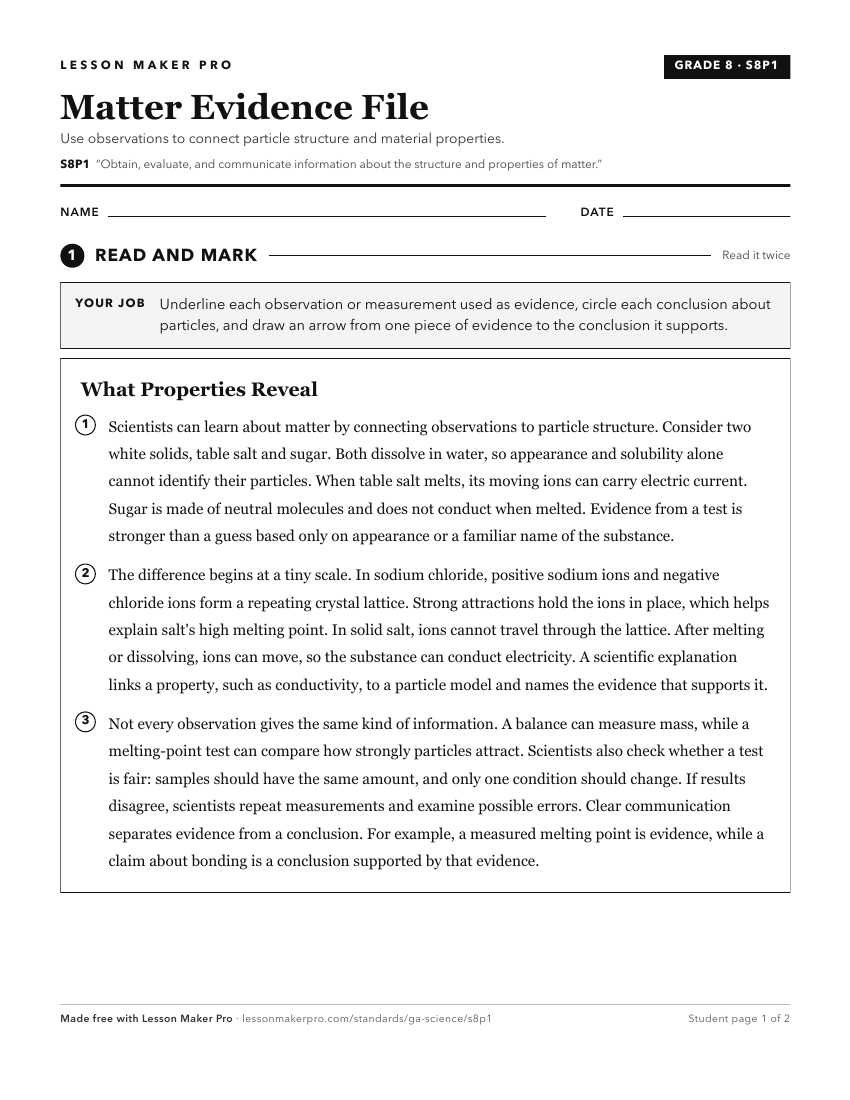
A ready-to-print activity worksheet aligned to S8P1, with an answer key for the teacher on its own page. No account needed.
PDF, US Letter, prints cleanly in black and white.
Download the worksheetKeep exploring
Related Standards
- S3E1
Obtain, evaluate, and communicate information about the physical attributes of rocks and soils.
- SKE2
Obtain, evaluate, and communicate information to describe the physical attributes of earth materials (soil, rocks, water, and air).
- S2P1
Obtain, evaluate, and communicate information about the properties of matter and changes that occur in objects.
- SKP1
Obtain, evaluate, and communicate information to describe objects in terms of the materials they are made of and their physical attributes.
Turn this cluster into a lesson
Grade, subject, topic, and the complete cluster are prefilled. Create one free, no account needed.
Also for this cluster:Make a WorksheetMake a QuizMake a Sub Lesson