Georgia S8P1.a
The Standard
- S8P1
- Obtain, evaluate, and communicate information about the structure and properties of matter.
Develop and use a model to compare and contrast pure substances (elements and compounds) and mixtures.
Georgia Standards of Excellence for Science · Obtain, evaluate, and communicate information about the structure and properties of matter.
Teacher's field guide
What This Standard Means
What Students Need to Do
- Students draw or build particle models that show atoms, bonded particles, and different particle types. They use those models to classify samples and explain similarities and differences.
What Mastery Looks Like
- Students correctly identify an element, compound, or mixture from a particle diagram. They explain that pure substances have one type of particle, while mixtures contain more than one.
Common Misconceptions
- Students may think every bonded particle is a mixture or that compounds can be separated physically. They may also classify any sample with different-colored atoms as a mixture, even when those atoms form identical molecules.
How to Assess It
- Give students three particle diagrams and ask them to label each as an element, compound, or mixture. Require one sentence of evidence for each label.
Lesson moves
Ways to Teach It
Build models with colored beads, using identical atoms for an element, bonded groups for a compound, and combined particle types for a mixture.
Write: How can two samples contain oxygen atoms but belong to different matter categories?
Sort particle-diagram cards into element, compound, or mixture, then challenge a partner to justify one disputed card.
Match particle models to an oxygen tank, distilled water, and air, then explain why each fits its category.
Free download
Printable S8P1.a Worksheet
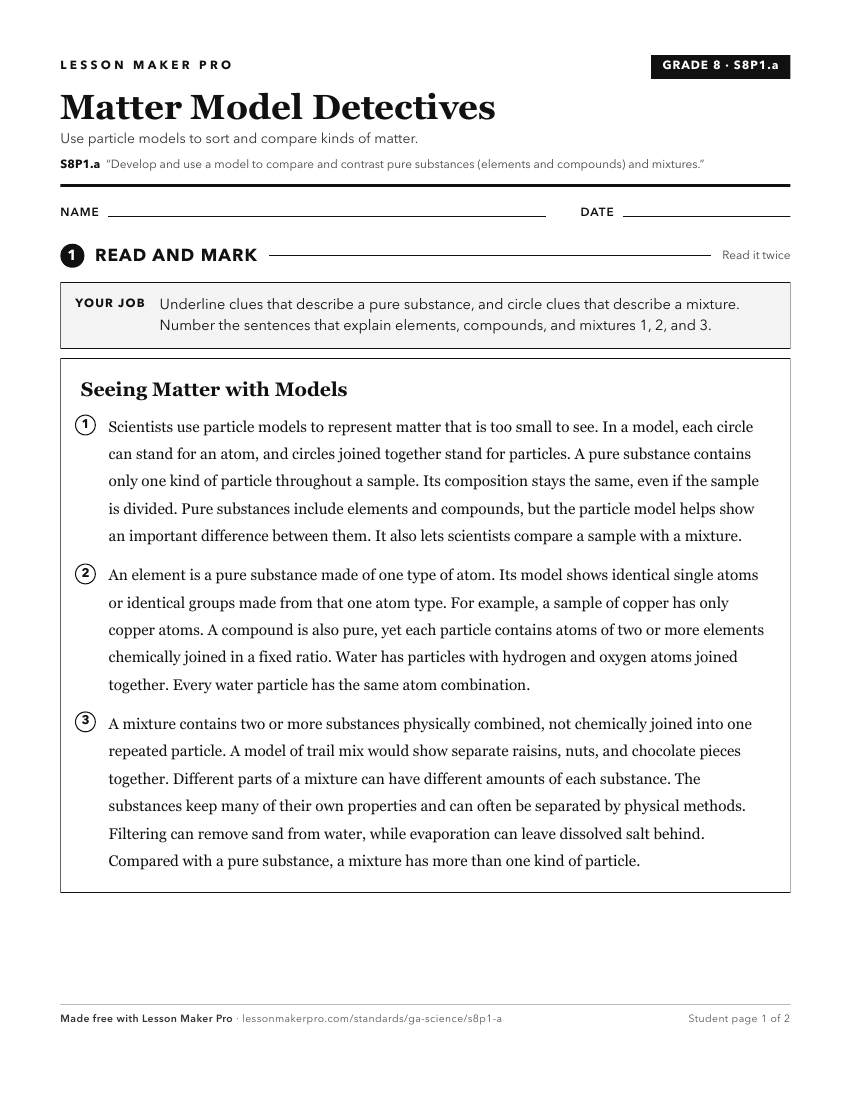
A ready-to-print activity worksheet aligned to S8P1.a, with an answer key for the teacher on its own page. No account needed.
PDF, US Letter, prints cleanly in black and white.
Download the worksheetKeep exploring
Related Standards
- S8P1.e
Develop models (e.g., atomic-level models, including drawings, and computer representations) by analyzing patterns within the periodic table that illustrate the...
- S8P1.b
Develop and use models to describe the movement of particles in solids, liquids, gases, and plasma states when thermal energy is added or removed.
- S8P1.c
Plan and carry out investigations to compare and contrast chemical (i.e., reactivity, combustibility) and physical (i.e., density, melting point, boiling point)...
- SKP1.a
Ask questions to compare and sort objects made of different materials. (Common materials include clay, cloth, plastic, wood, paper, and metal.)
Turn this exact standard into a lesson
Grade, subject, topic, and the complete standard are prefilled. Create one free, no account needed.
Also for this standard:Make a WorksheetMake a QuizMake a Sub Lesson