Georgia S8P1.e
The Standard
- S8P1
- Obtain, evaluate, and communicate information about the structure and properties of matter.
Develop models (e.g., atomic-level models, including drawings, and computer representations) by analyzing patterns within the periodic table that illustrate the structure, composition, and characteristics of atoms (protons, neutrons, and electrons) and simple molecules.
Georgia Standards of Excellence for Science · Obtain, evaluate, and communicate information about the structure and properties of matter.
Teacher's field guide
What This Standard Means
What Students Need to Do
- Students use periodic table data to determine the numbers of protons, neutrons, and electrons in an atom. They draw or build atomic models and combine atom models to represent simple molecules. They explain how table patterns support their models.
What Mastery Looks Like
- Given an element, students identify its atomic number, estimate its neutrons, and model its electron arrangement. They label each particle correctly and represent the number and type of atoms in a simple molecule.
Common Misconceptions
- Students often confuse atomic number with atomic mass or treat decimal atomic mass as an exact neutron count. They may place electrons in the nucleus or assume every atom is neutral. Subscripts in formulas are often mistaken for charges.
How to Assess It
- Give students a periodic table square for oxygen and the formula H2O. Ask them to model one oxygen atom, then draw a water molecule and label each atom.
Lesson moves
Ways to Teach It
Use colored beads and pipe cleaners to build atoms, then connect selected atoms to make models of water, oxygen, and carbon dioxide.
Ask students to explain in writing how an element's periodic table square provides evidence for each part of their atomic model.
Play a matching game with element cards, particle counts, atomic diagrams, and molecule formulas, requiring students to justify each match.
Examine water, aluminum foil, and helium balloons, then model the particles that make up each familiar material.
Free download
Printable S8P1.e Worksheet
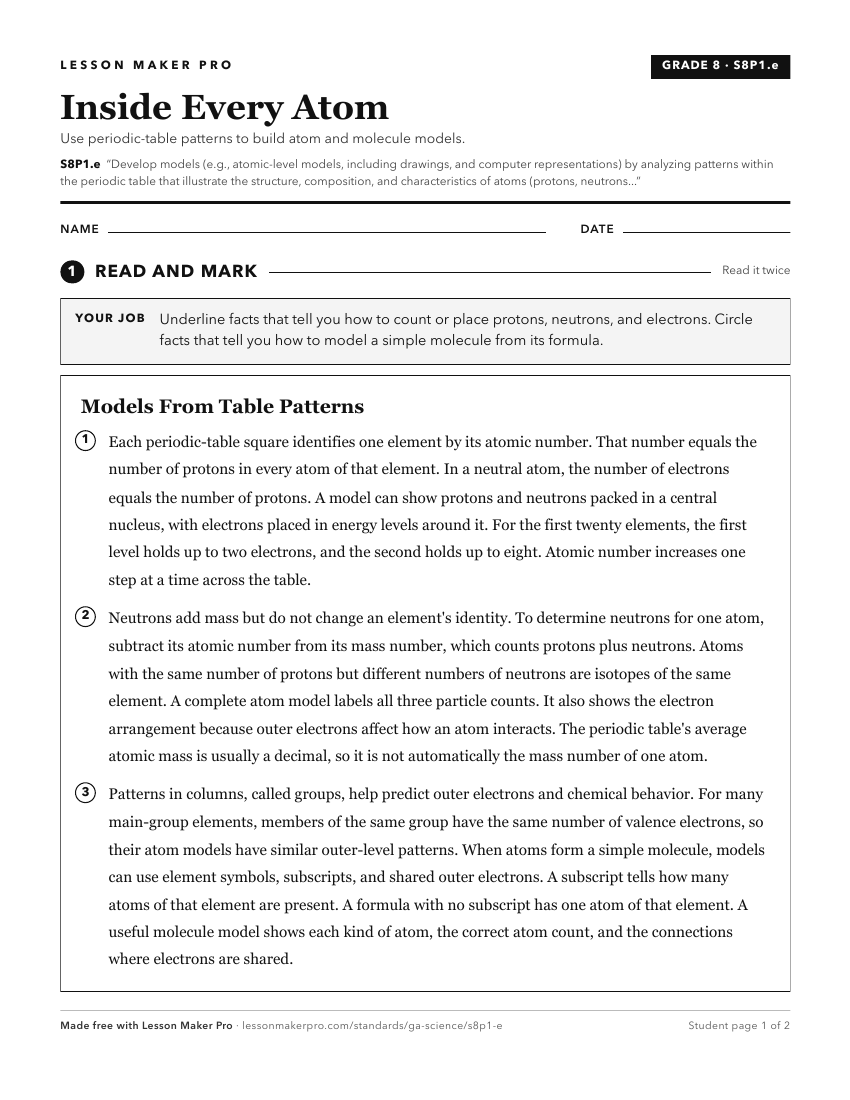
A ready-to-print activity worksheet aligned to S8P1.e, with an answer key for the teacher on its own page. No account needed.
PDF, US Letter, prints cleanly in black and white.
Download the worksheetKeep exploring
Related Standards
- S8P1.a
Develop and use a model to compare and contrast pure substances (elements and compounds) and mixtures.
- S7L2.a
Develop a model and construct an explanation of how cell structures (specifically the nucleus, cytoplasm, cell membrane, cell wall, chloroplasts, lysosome, and ...
- S1L1.a
Develop models to identify the parts of a plant—root, stem, leaf, and flower.
- S8P1.b
Develop and use models to describe the movement of particles in solids, liquids, gases, and plasma states when thermal energy is added or removed.
Turn this exact standard into a lesson
Grade, subject, topic, and the complete standard are prefilled. Create one free, no account needed.
Also for this standard:Make a WorksheetMake a QuizMake a Sub Lesson