Georgia S8P1.b
The Standard
- S8P1
- Obtain, evaluate, and communicate information about the structure and properties of matter.
Develop and use models to describe the movement of particles in solids, liquids, gases, and plasma states when thermal energy is added or removed.
Georgia Standards of Excellence for Science · Obtain, evaluate, and communicate information about the structure and properties of matter.
Teacher's field guide
What This Standard Means
What Students Need to Do
- Students create particle diagrams that show spacing, arrangement, motion, and charge in each state of matter. They use the diagrams to explain how heating speeds particles up and cooling slows them down.
What Mastery Looks Like
- Given a state and an energy change, a student can draw an accurate before-and-after model. The student can predict changes in particle motion, spacing, arrangement, and charge.
Common Misconceptions
- Students may think particles grow when heated or that solid particles do not move. They may draw gases as empty space with no particles. They may also treat plasma as ordinary gas rather than charged particles.
How to Assess It
- Exit ticket: Draw four panels showing a solid heated into a liquid and plasma cooled into a gas. Add motion arrows and label spacing, arrangement, charge, and energy transfer.
Lesson moves
Ways to Teach It
Give pairs beads, trays, and colored counters to build and move models of solid, liquid, gas, and plasma particles.
Ask students to explain why a sealed balloon expands when warmed even though each gas particle stays the same size.
Play Model Match by pairing state cards, particle diagrams, motion descriptions, and heating or cooling arrows, then justify each match.
Compare an ice cube, liquid water, water vapor, and a neon sign, then sketch particle motion and energy in each.
Free download
Printable S8P1.b Worksheet
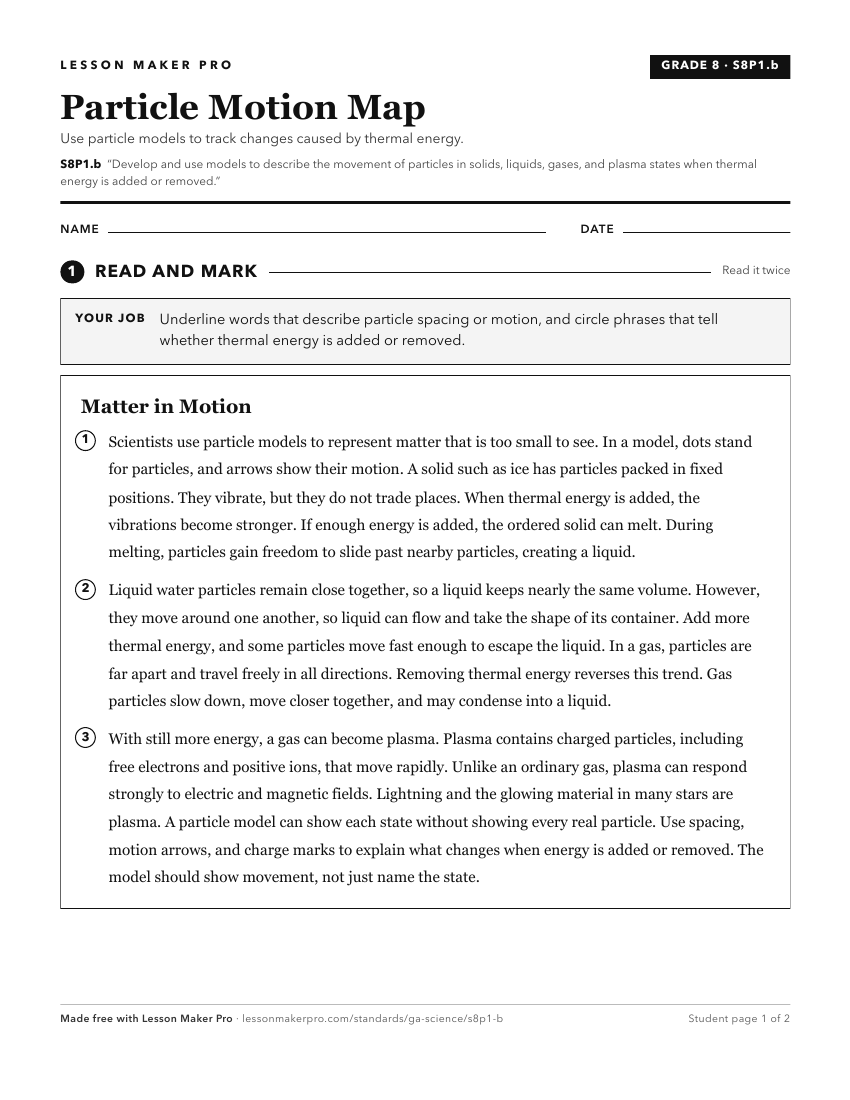
A ready-to-print activity worksheet aligned to S8P1.b, with an answer key for the teacher on its own page. No account needed.
PDF, US Letter, prints cleanly in black and white.
Download the worksheetKeep exploring
Related Standards
- S8P1.a
Develop and use a model to compare and contrast pure substances (elements and compounds) and mixtures.
- S8P4.f
Develop and use a model (e.g., simulations, graphs, illustrations) to predict and describe the relationships between wave properties (e.g., frequency, amplitude...
- S4E3.a
Plan and carry out investigations to observe the flow of energy in water as it changes states from solid (ice) to liquid (water) to gas (water vapor) and change...
- S8P2.d
Plan and carry out investigations on the effects of heat transfer on molecular motion as it relates to the collision of atoms (conduction), through space (radia...
Turn this exact standard into a lesson
Grade, subject, topic, and the complete standard are prefilled. Create one free, no account needed.
Also for this standard:Make a WorksheetMake a QuizMake a Sub Lesson