Georgia S4E3.a
The Standard
- S4E3
- Obtain, evaluate, and communicate information to demonstrate the water cycle.
Plan and carry out investigations to observe the flow of energy in water as it changes states from solid (ice) to liquid (water) to gas (water vapor) and changes from gas to liquid to solid.
Georgia Standards of Excellence for Science · Obtain, evaluate, and communicate information to demonstrate the water cycle.
Teacher's field guide
What This Standard Means
What Students Need to Do
- Students plan a fair test that heats or cools water, then record the state changes they observe. They explain whether water gains or loses thermal energy during each change.
What Mastery Looks Like
- Students can use observations to identify melting, freezing, evaporation, and condensation. They correctly connect melting and evaporation with energy gained, and freezing and condensation with energy lost.
Common Misconceptions
- Students may think evaporated water disappears or that visible mist is water vapor. They may also think condensation comes through a cup or that only boiling causes evaporation.
How to Assess It
- Give students four changes: ice melting, a puddle drying, droplets forming on a cold cup, and water freezing. Ask them to label each change and state whether water gains or loses energy.
Lesson moves
Ways to Teach It
Freeze marked cups of water, melt the ice under a lamp, then cover the warm cups with chilled plastic wrap and record observations.
Ask students to explain where droplets on a cold drink come from and whether the water gained or lost energy.
Run a card-sort relay matching melting, freezing, evaporation, and condensation with starting state, ending state, and energy gained or lost.
Outline a playground puddle with chalk, check it during the day, and connect its shrinking size to sunlight and evaporation.
Free download
Printable S4E3.a Worksheet
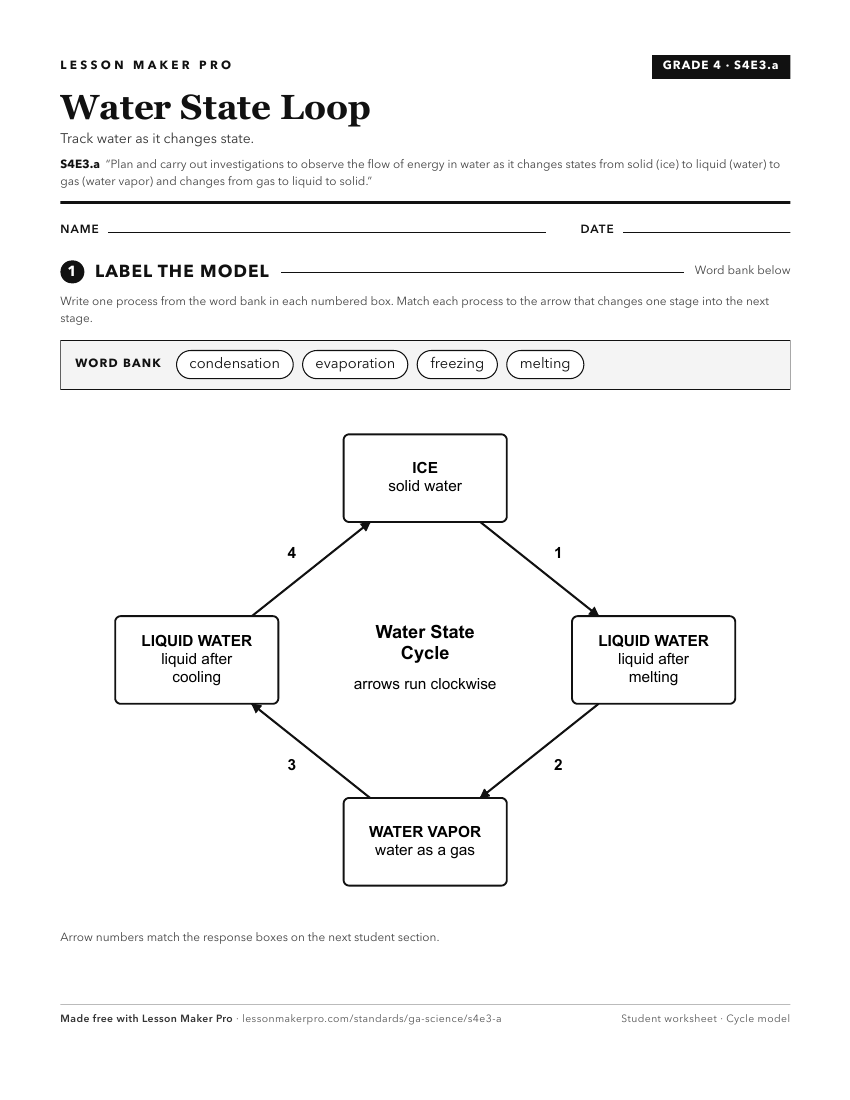
A ready-to-print activity worksheet aligned to S4E3.a, with an answer key for the teacher on its own page. No account needed.
PDF, US Letter, prints cleanly in black and white.
Download the worksheetKeep exploring
Related Standards
- S6E4.b
Plan and carry out an investigation to demonstrate how energy from the sun transfers heat to air, land and water at different rates.
- S6E3.b
Plan and carry out an investigation to illustrate the role of the sun's energy in atmospheric conditions that lead to the cycling of water.
- S5P1.a
Plan and carry out investigations of physical changes by manipulating, separating and mixing dry and liquid materials.
- S8P2.d
Plan and carry out investigations on the effects of heat transfer on molecular motion as it relates to the collision of atoms (conduction), through space (radia...
Turn this exact standard into a lesson
Grade, subject, topic, and the complete standard are prefilled. Create one free, no account needed.
Also for this standard:Make a WorksheetMake a QuizMake a Sub Lesson