Georgia S8P2.d
The Standard
- S8P2
- Obtain, evaluate, and communicate information about the law of conservation of energy to develop arguments that energy can transform from one form to another within a system.
Plan and carry out investigations on the effects of heat transfer on molecular motion as it relates to the collision of atoms (conduction), through space (radiation), or in currents in a liquid or a gas (convection).
Georgia Standards of Excellence for Science · Obtain, evaluate, and communicate information about the law of conservation of energy to develop arguments that energy can transform from one form to another within a system.
Teacher's field guide
What This Standard Means
What Students Need to Do
- Students plan and run fair tests that track temperature changes during conduction, convection, and radiation. They use particle motion and collisions to explain the evidence they collect.
What Mastery Looks Like
- Students control variables, record temperature data, and identify the heat transfer method shown. They explain that conduction uses particle collisions, convection moves warmer fluids, and radiation transfers energy through electromagnetic waves.
Common Misconceptions
- Students may say cold moves into an object or that heat always rises. They may think particles travel through a solid during conduction, or that radiation needs matter to travel.
How to Assess It
- Exit ticket: A metal spoon sits in hot soup under a heat lamp. Identify two heat transfer methods and explain each using particles or waves.
Lesson moves
Ways to Teach It
Rotate through stations using metal and wood spoons, a heat lamp, and food coloring in warm water to observe each transfer method.
Write an explanation answering, “Why does a metal spoon heat faster than a wooden spoon in hot water?”
Sort scenario cards into conduction, convection, or radiation, then defend one disputed card using particle motion or waves.
Map how conduction, convection, and radiation each transfer energy while a pot of soup cooks on a stove.
Free download
Printable S8P2.d Worksheet
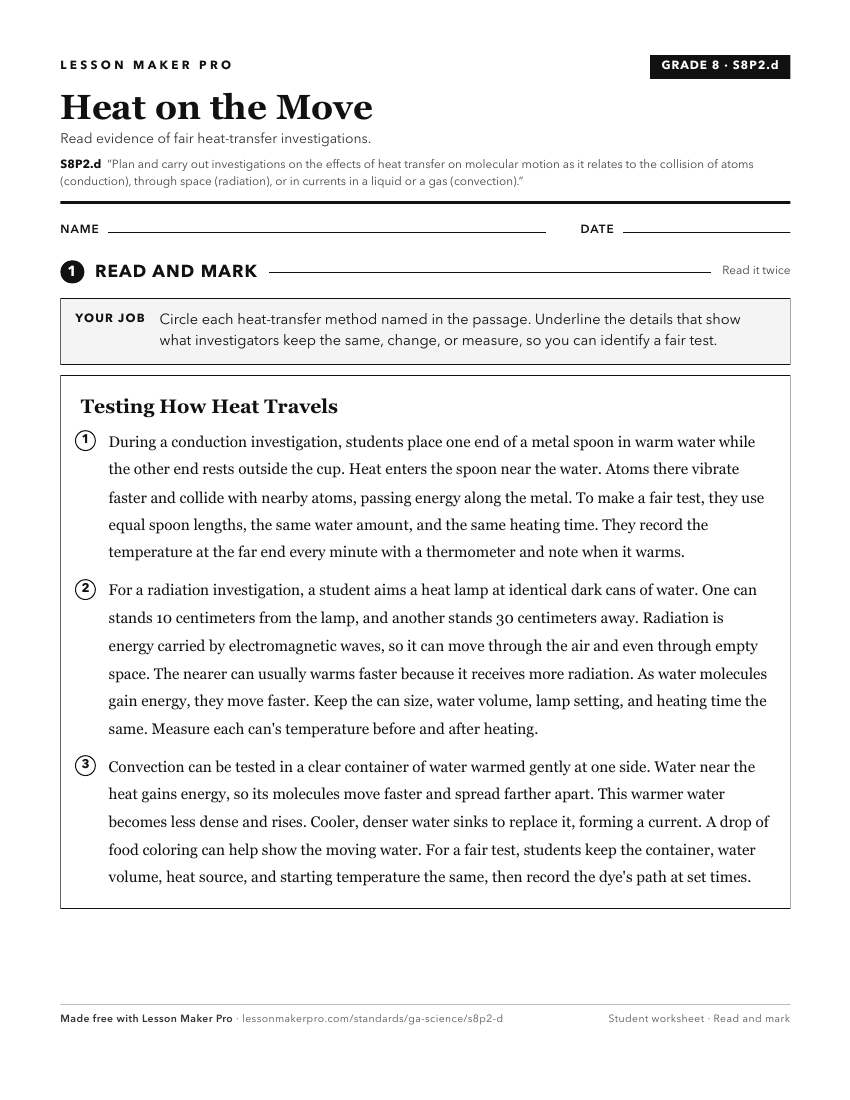
A ready-to-print activity worksheet aligned to S8P2.d, with an answer key for the teacher on its own page. No account needed.
PDF, US Letter, prints cleanly in black and white.
Download the worksheetKeep exploring
Related Standards
- S3P1
Obtain, evaluate, and communicate information about the ways heat energy is transferred and measured.
- S8P1.b
Develop and use models to describe the movement of particles in solids, liquids, gases, and plasma states when thermal energy is added or removed.
- S6E4.b
Plan and carry out an investigation to demonstrate how energy from the sun transfers heat to air, land and water at different rates.
- S4E3.a
Plan and carry out investigations to observe the flow of energy in water as it changes states from solid (ice) to liquid (water) to gas (water vapor) and change...
Turn this exact standard into a lesson
Grade, subject, topic, and the complete standard are prefilled. Create one free, no account needed.
Also for this standard:Make a WorksheetMake a QuizMake a Sub Lesson