Georgia S6E3.b
The Standard
- S6E3
- Obtain, evaluate, and communicate information to recognize the significant role of water in Earth processes.
Plan and carry out an investigation to illustrate the role of the sun's energy in atmospheric conditions that lead to the cycling of water.
Georgia Standards of Excellence for Science · Obtain, evaluate, and communicate information to recognize the significant role of water in Earth processes.
Teacher's field guide
What This Standard Means
What Students Need to Do
- Students plan and run a fair test showing how light or heat affects evaporation. They measure changes and connect solar energy, atmospheric conditions, and water cycling.
What Mastery Looks Like
- Students identify the variable they change, what they measure, and what stays the same. They use recorded evidence to explain how solar heating causes evaporation and supports condensation and precipitation.
Common Misconceptions
- Students may think the sun pulls water upward or that clouds are made of water vapor. They may also confuse evaporation with boiling or think the water cycle stops at night.
How to Assess It
- Exit ticket: Two identical cups contain equal water, but one sits under a lamp and one sits in shade. Predict the results and explain why using evidence you would collect.
Lesson moves
Ways to Teach It
Place equal amounts of water in identical cups under a lamp and in shade, then measure mass loss and observe condensation.
Write a claim explaining how solar heating of a puddle can eventually contribute to cloud formation and rain.
Sort process cards for evaporation, condensation, precipitation, and collection, then match each process to its energy change.
Compare drying times for two wet paper towels placed in sunny and shaded school locations, then connect the results to weather conditions.
Free download
Printable S6E3.b Worksheet
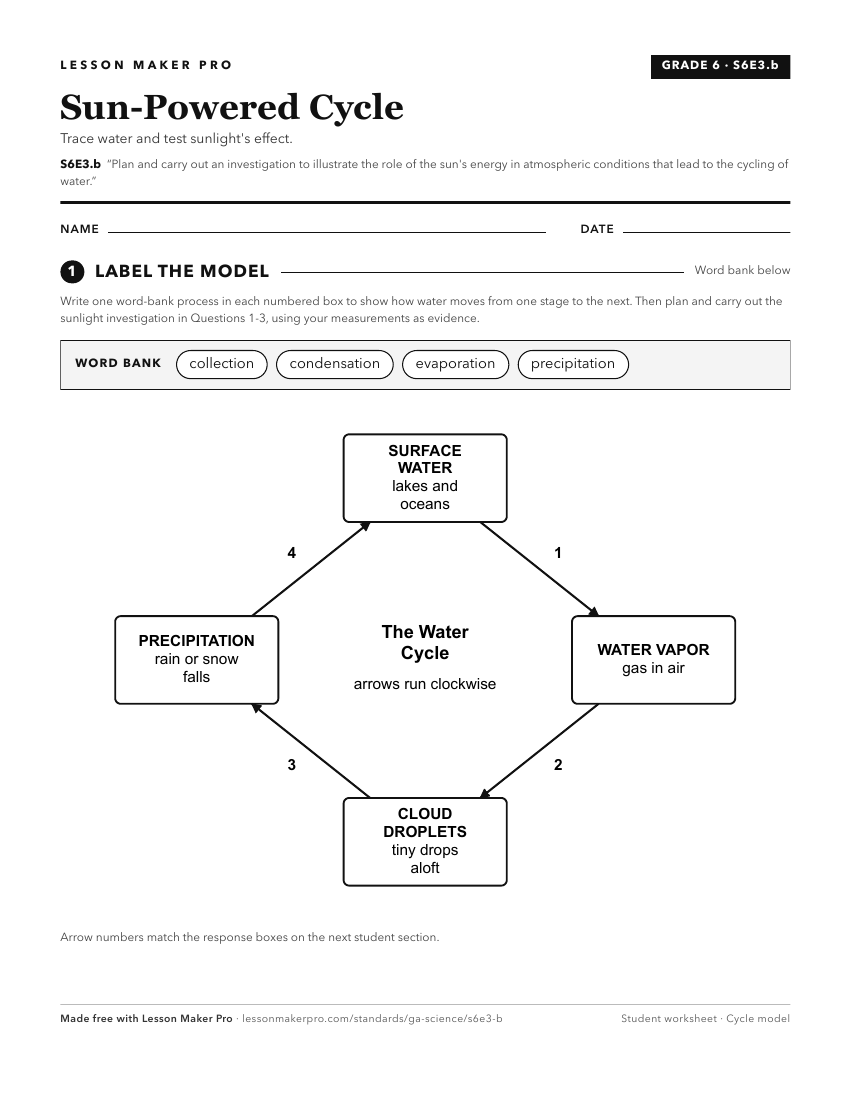
A ready-to-print activity worksheet aligned to S6E3.b, with an answer key for the teacher on its own page. No account needed.
PDF, US Letter, prints cleanly in black and white.
Download the worksheetKeep exploring
Related Standards
- S3P1.b
Plan and carry out an investigation to gather data using thermometers to produce tables and charts that illustrate the effect of sunlight on various objects.
- S6E4.b
Plan and carry out an investigation to demonstrate how energy from the sun transfers heat to air, land and water at different rates.
- S2E2.a
Plan and carry out an investigation to determine the effect of the position of the sun in relation to a fixed object on Earth at various times of the day.
- S4E3.a
Plan and carry out investigations to observe the flow of energy in water as it changes states from solid (ice) to liquid (water) to gas (water vapor) and change...
Turn this exact standard into a lesson
Grade, subject, topic, and the complete standard are prefilled. Create one free, no account needed.
Also for this standard:Make a WorksheetMake a QuizMake a Sub Lesson