Georgia S3P1.b
The Standard
- S3P1
- Obtain, evaluate, and communicate information about the ways heat energy is transferred and measured.
Plan and carry out an investigation to gather data using thermometers to produce tables and charts that illustrate the effect of sunlight on various objects.
Georgia Standards of Excellence for Science · Obtain, evaluate, and communicate information about the ways heat energy is transferred and measured.
Teacher's field guide
What This Standard Means
What Students Need to Do
- Students plan a fair test to compare how sunlight changes the temperature of different objects. They read thermometers, record measurements in a table, and turn the data into a labeled chart.
What Mastery Looks Like
- Students keep exposure time and measurement steps the same for each object. They read the thermometer scale accurately and use chart data to explain which object warmed most or least.
Common Misconceptions
- Students may think sunlight heats every object by the same amount or that color and material do not matter. They may read the thermometer before it settles, confuse temperature with heat, or create charts with missing labels.
How to Assess It
- Give students temperature data for soil, water, and gravel before and after 15 minutes in sunlight. Ask them to make a bar chart and identify which material warmed most, using numbers as evidence.
Lesson moves
Ways to Teach It
Place cups of soil, water, and gravel in sunlight, measure starting and ending temperatures, then graph each change.
Write: Which material warmed most in sunlight, and what numbers from your table support your claim?
Play Data Match by pairing thermometer-reading cards with table entries and the correct bars on a class graph.
Use temperature data from sunny grass, mulch, and blacktop to recommend a cooler place for an outdoor class reading area.
Free download
Printable S3P1.b Worksheet
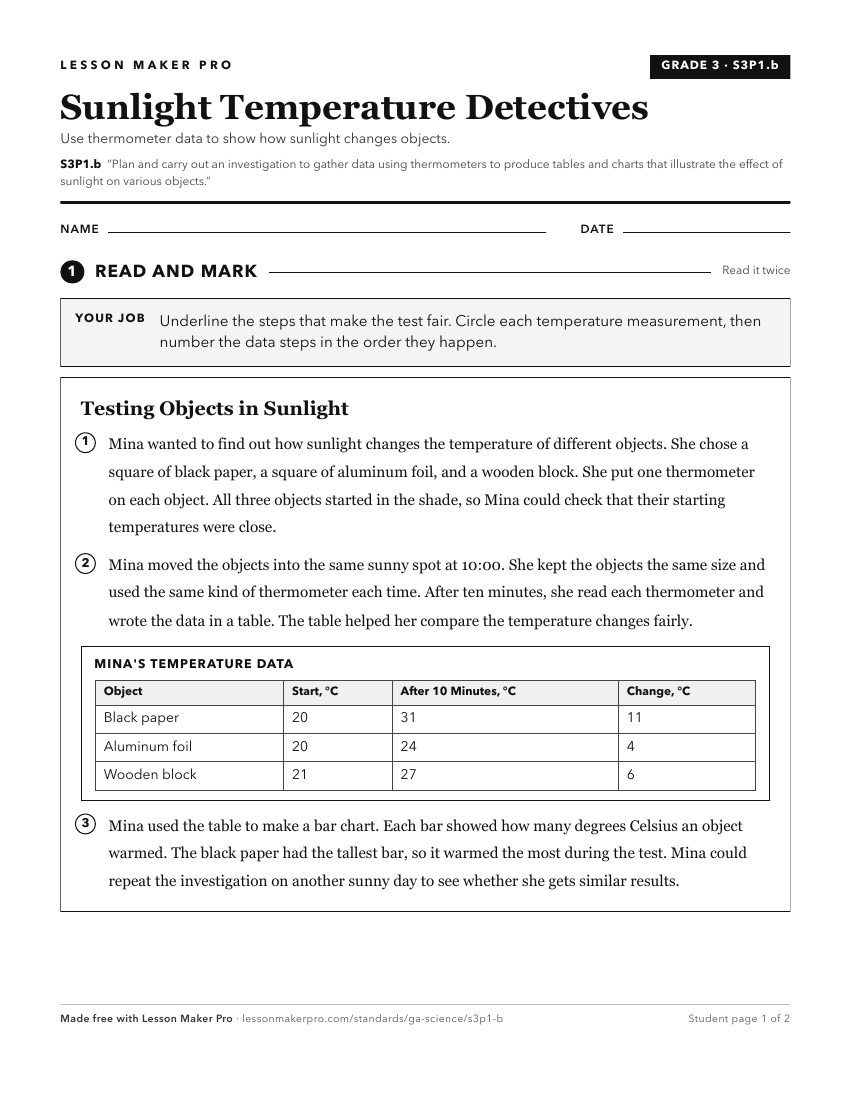
A ready-to-print activity worksheet aligned to S3P1.b, with an answer key for the teacher on its own page. No account needed.
PDF, US Letter, prints cleanly in black and white.
Download the worksheetKeep exploring
Related Standards
- S6E4.b
Plan and carry out an investigation to demonstrate how energy from the sun transfers heat to air, land and water at different rates.
- S2E2.a
Plan and carry out an investigation to determine the effect of the position of the sun in relation to a fixed object on Earth at various times of the day.
- S6E3.b
Plan and carry out an investigation to illustrate the role of the sun's energy in atmospheric conditions that lead to the cycling of water.
- S1E1.c
Plan and carry out investigations on current weather conditions by observing, measuring with simple weather instruments (thermometer, wind vane, rain gauge), an...
Turn this exact standard into a lesson
Grade, subject, topic, and the complete standard are prefilled. Create one free, no account needed.
Also for this standard:Make a WorksheetMake a QuizMake a Sub Lesson