Georgia S1L1.a
The Standard
- S1L1
- Obtain, evaluate, and communicate information about the basic needs of plants and animals.
Develop models to identify the parts of a plant—root, stem, leaf, and flower.
Georgia Standards of Excellence for Science · Obtain, evaluate, and communicate information about the basic needs of plants and animals.
Teacher's field guide
What This Standard Means
What Students Need to Do
- Students build or draw a simple plant model showing roots, a stem, leaves, and a flower. They name and label each part in its correct place.
What Mastery Looks Like
- Students can locate and name each part on a real plant, picture, or model. Their own model includes all four parts arranged accurately.
Common Misconceptions
- Students may call the whole plant a flower or confuse leaves with petals. They may place roots above the soil or leave them out because they are hidden.
How to Assess It
- Give students a blank sheet and ask them to draw a plant model, then label its roots, stem, leaves, and flower.
Lesson moves
Ways to Teach It
Build a plant model with yarn roots, a craft-stick stem, paper leaves, and a cupcake-liner flower, then add labels.
Ask students to explain in writing how their model shows each plant part clearly.
Play Plant Part Match by pairing picture cards, word cards, and locations on a large plant poster.
Visit the schoolyard, find a flowering plant, and sketch the visible parts while adding roots below the soil line.
Free download
Printable S1L1.a Worksheet
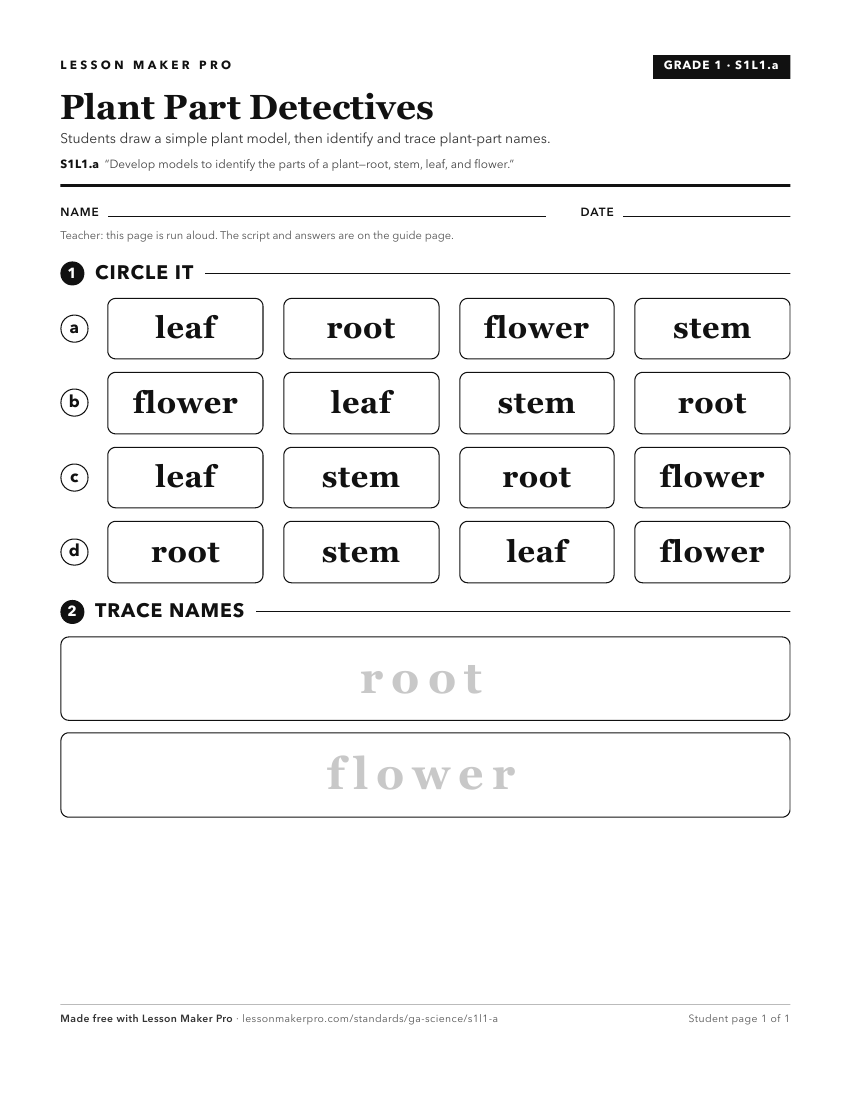
A ready-to-print activity worksheet aligned to S1L1.a, with an answer key for the teacher on its own page. No account needed.
PDF, US Letter, prints cleanly in black and white.
Download the worksheetKeep exploring
Related Standards
- S7L1.a
Develop and defend a model that categorizes organisms based on common characteristics.
- S5L3.b
Develop a model to identify and label parts of a plant cell (membrane, wall, cytoplasm, nucleus, chloroplasts) and of an animal cell (membrane, cytoplasm, and n...
- S5L1.b
Develop a model that illustrates how plants are sorted into groups (seed producers, non-seed producers) using data from multiple sources.
- S2L1.d
Develop models to illustrate the unique and diverse life cycles of organisms other than humans.
Turn this exact standard into a lesson
Grade, subject, topic, and the complete standard are prefilled. Create one free, no account needed.
Also for this standard:Make a WorksheetMake a QuizMake a Sub Lesson