Georgia S7L1.a
The Standard
- S7L1
- Obtain, evaluate, and communicate information to investigate the diversity of living organisms and how they can be compared scientifically.
Develop and defend a model that categorizes organisms based on common characteristics.
Georgia Standards of Excellence for Science · Obtain, evaluate, and communicate information to investigate the diversity of living organisms and how they can be compared scientifically.
Teacher's field guide
What This Standard Means
What Students Need to Do
- Students choose shared traits and use them to sort organisms into clear groups. They create a chart, branching diagram, or other model, then defend each grouping with evidence.
What Mastery Looks Like
- Students apply the same criteria consistently and place unfamiliar organisms using evidence. They explain their choices, compare possible models, and revise categories when new traits are introduced.
Common Misconceptions
- Students may group organisms only by habitat, size, color, or whether they seem alike. They may assume there is one correct model or change criteria between groups without explaining why.
How to Assess It
- Give students pictures and trait cards for six organisms. Ask them to group the organisms, label each criterion, and defend one placement in two sentences.
Lesson moves
Ways to Teach It
Give teams organism cards and yarn, then have them build a branching floor model using shared traits at each split.
Ask students to write which traits make a classification model useful, then defend one grouping choice with evidence from two organisms.
Play Classification Challenge, where teams sort mystery organism cards and earn points for consistent criteria and evidence-based revisions.
Compare produce sections at a grocery store, then redesign one section using scientific traits rather than cooking use or store labels.
Free download
Printable S7L1.a Worksheet
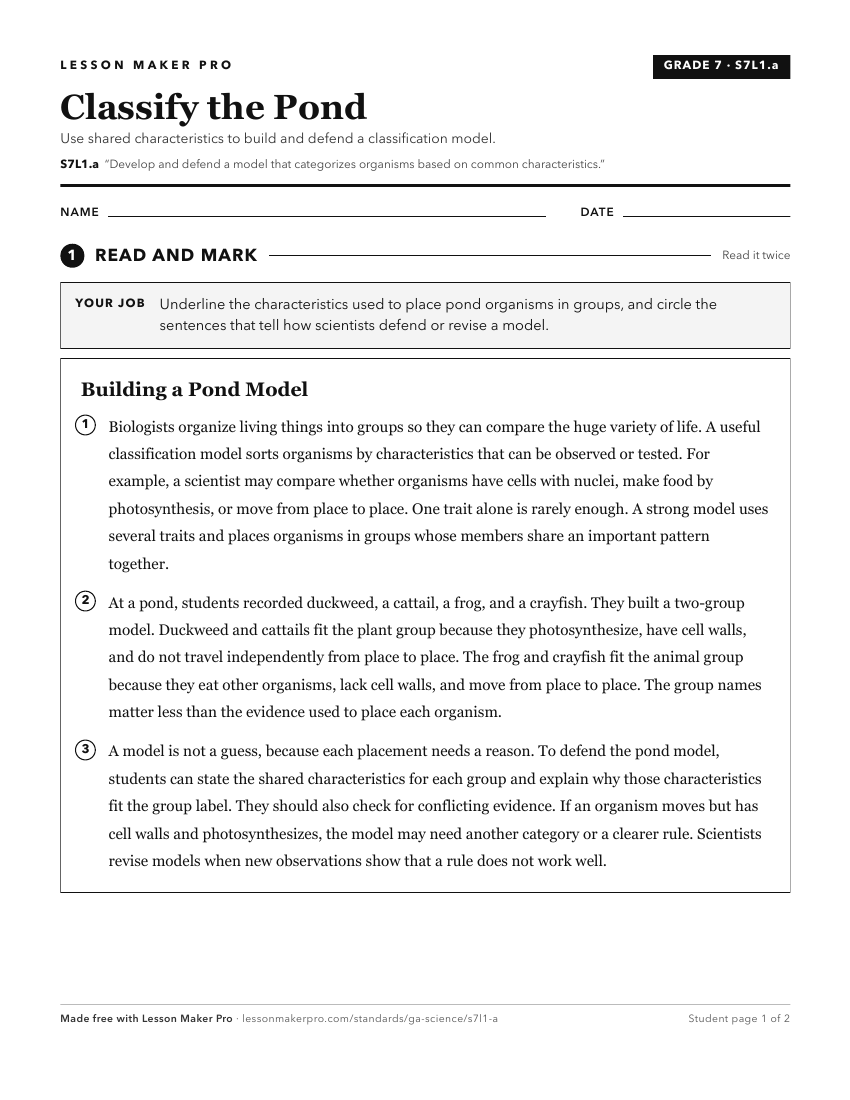
A ready-to-print activity worksheet aligned to S7L1.a, with an answer key for the teacher on its own page. No account needed.
PDF, US Letter, prints cleanly in black and white.
Download the worksheetKeep exploring
Related Standards
- S5L1
Obtain, evaluate, and communicate information to group organisms using scientific classification procedures.
- SKL1.b
Develop a model to represent how a set of organisms and non-living objects are sorted into groups based on their attributes.
- S5L1.a
Develop a model that illustrates how animals are sorted into groups (vertebrate and invertebrate) and how vertebrates are sorted into groups (fish, amphibian, r...
- S7L1.b
Evaluate historical models of how organisms were classified based on physical characteristics and how that led to the six kingdom system (currently archaea, bac...
Turn this exact standard into a lesson
Grade, subject, topic, and the complete standard are prefilled. Create one free, no account needed.
Also for this standard:Make a WorksheetMake a QuizMake a Sub Lesson