Georgia S5L1.a
The Standard
- S5L1
- Obtain, evaluate, and communicate information to group organisms using scientific classification procedures.
Develop a model that illustrates how animals are sorted into groups (vertebrate and invertebrate) and how vertebrates are sorted into groups (fish, amphibian, reptile, bird, and mammal) using data from multiple sources.
Georgia Standards of Excellence for Science · Obtain, evaluate, and communicate information to group organisms using scientific classification procedures.
Teacher's field guide
What This Standard Means
What Students Need to Do
- Students build a branching model that first separates animals by the presence of a backbone. They then sort vertebrates into five groups using traits gathered from more than one source.
What Mastery Looks Like
- A student places unfamiliar animals correctly and labels each branch with supporting traits. The student explains choices using evidence such as body covering, breathing structures, reproduction, and body temperature.
Common Misconceptions
- Students may group animals by habitat, movement, or appearance instead of body traits. They may call whales fish, bats birds, or penguins mammals because of where they live or how they move.
How to Assess It
- Give students pictures of a trout, frog, snake, owl, dog, and spider. Ask them to create a labeled sorting model and justify two placements with evidence.
Lesson moves
Ways to Teach It
Give pairs animal cards and yarn, then have them build a branching floor model and label each split with evidence from two reference sheets.
Ask, "Should a whale be grouped with fish or mammals?" Students write a claim and support it with three observable traits.
Play Classification Relay: teams place animal cards under headings, then challenge one placement by naming a trait-based reason.
Use zoo or wildlife center pages to classify five local animals and compare how public exhibits organize animal information.
Free download
Printable S5L1.a Worksheet
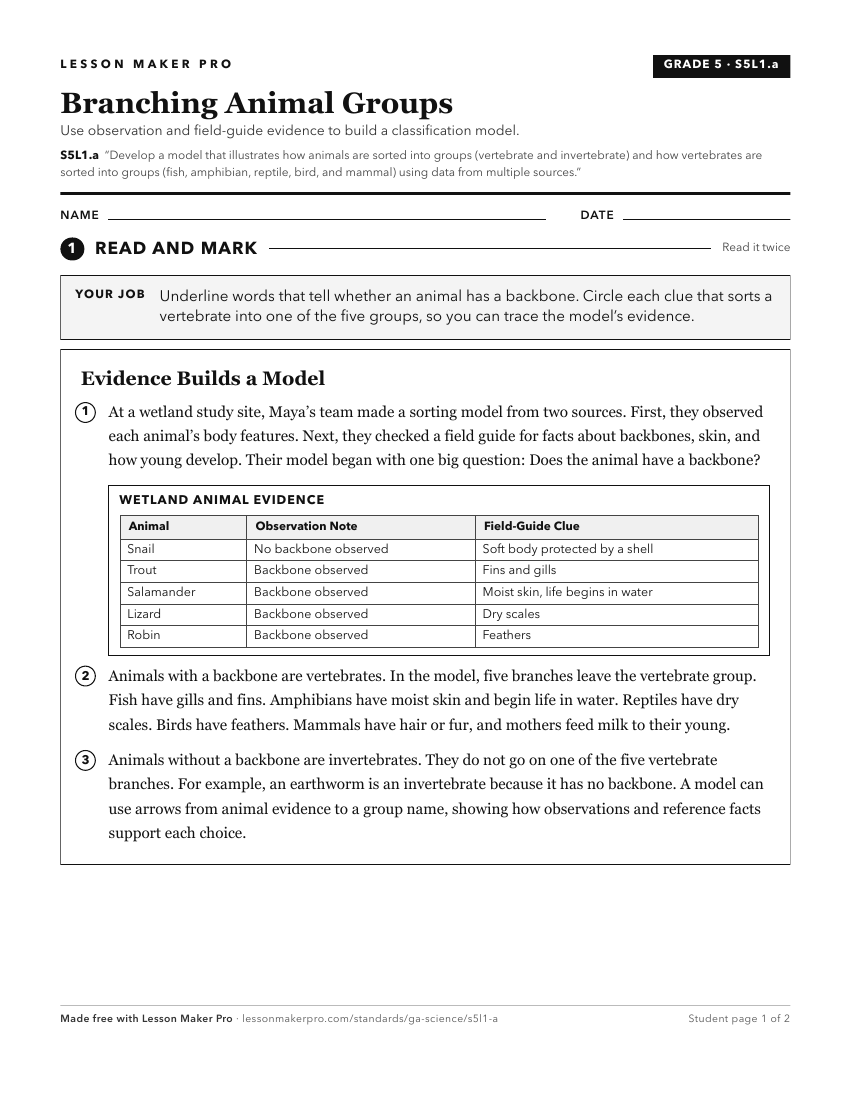
A ready-to-print activity worksheet aligned to S5L1.a, with an answer key for the teacher on its own page. No account needed.
PDF, US Letter, prints cleanly in black and white.
Download the worksheetKeep exploring
Related Standards
- S7L1.a
Develop and defend a model that categorizes organisms based on common characteristics.
- SKL2.a
Construct an argument supported by evidence for how animals can be grouped according to their features.
- SKL1.b
Develop a model to represent how a set of organisms and non-living objects are sorted into groups based on their attributes.
- S5L1.b
Develop a model that illustrates how plants are sorted into groups (seed producers, non-seed producers) using data from multiple sources.
Turn this exact standard into a lesson
Grade, subject, topic, and the complete standard are prefilled. Create one free, no account needed.
Also for this standard:Make a WorksheetMake a QuizMake a Sub Lesson