Georgia SKL2.a
The Standard
- SKL2
- Obtain, evaluate, and communicate information to compare the similarities and differences in groups of organisms.
Construct an argument supported by evidence for how animals can be grouped according to their features.
Georgia Standards of Excellence for Science · Obtain, evaluate, and communicate information to compare the similarities and differences in groups of organisms.
Teacher's field guide
What This Standard Means
What Students Need to Do
- Students sort animals using visible features such as fur, feathers, scales, wings, or number of legs. They explain each grouping rule and point to evidence from the animals.
What Mastery Looks Like
- A student places animals into groups that follow a clear feature rule. The student names the shared feature and uses it to explain each choice.
Common Misconceptions
- Students may group animals by observable features, including color or size, but give personal preference instead of evidence for their rule. They may group animals by habitat without pointing to a shared animal feature. They may think an animal can belong to only one group.
How to Assess It
- Show pictures of a duck, eagle, dog, and cat. Ask students to make two groups, name the rule, and point to supporting features.
Lesson moves
Ways to Teach It
Give pairs plastic animal figures to sort by fur, feathers, scales, wings, or legs, then have them explain their sorting rule.
Show a bat, bird, and butterfly, then ask, “Which two belong together, and what body feature supports your choice?”
Play Animal Sort Relay, where students place picture cards under feature labels and explain one placement before earning a point.
Use zoo signs or animal shelter photos to identify shared body features that could help organize animals for visitors.
Free download
Printable SKL2.a Worksheet
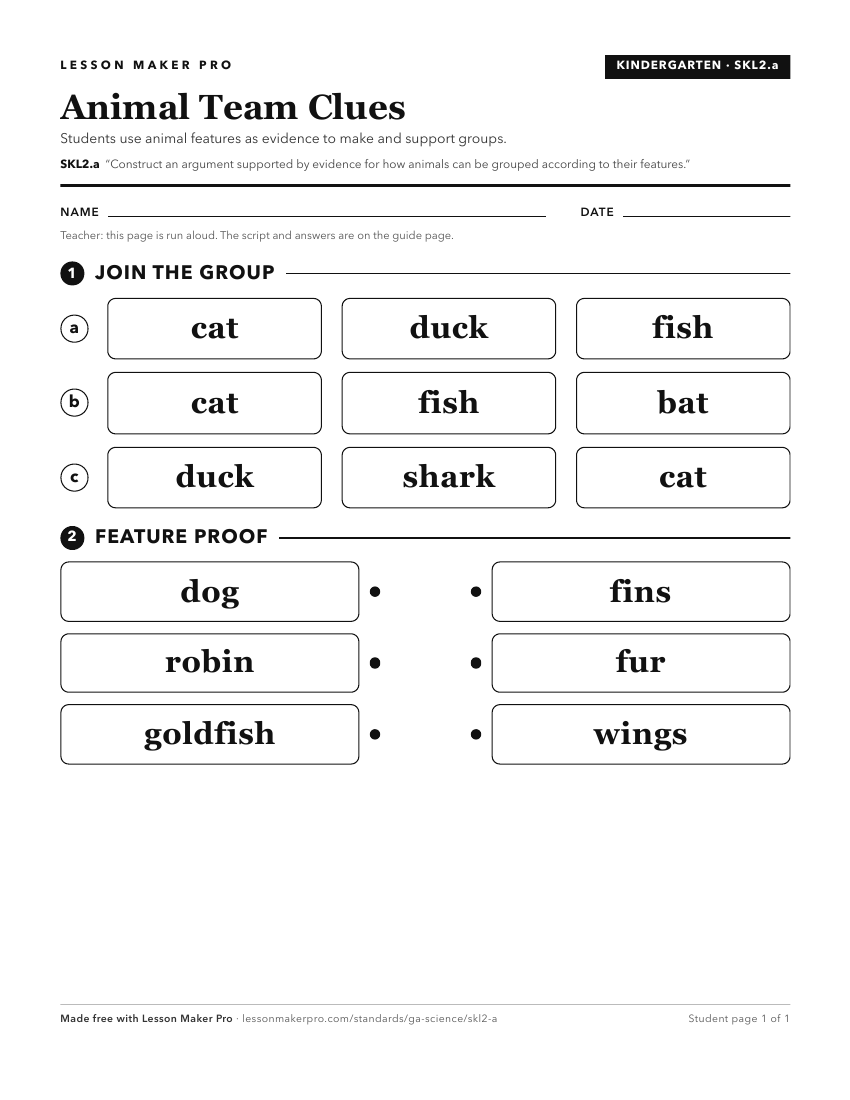
A ready-to-print activity worksheet aligned to SKL2.a, with an answer key for the teacher on its own page. No account needed.
PDF, US Letter, prints cleanly in black and white.
Download the worksheetKeep exploring
Related Standards
- SKL2.b
Construct an argument supported by evidence for how plants can be grouped according to their features.
- S5L1.a
Develop a model that illustrates how animals are sorted into groups (vertebrate and invertebrate) and how vertebrates are sorted into groups (fish, amphibian, r...
- SKE2.b
Construct an argument supported by evidence for how rocks can be grouped by physical attributes (size, weight, texture, color).
- S3E2.a
Construct an argument from observations of fossils (authentic or reproductions) to communicate how they serve as evidence of past organisms and the environments...
Turn this exact standard into a lesson
Grade, subject, topic, and the complete standard are prefilled. Create one free, no account needed.
Also for this standard:Make a WorksheetMake a QuizMake a Sub Lesson