Georgia S5L1.b
The Standard
- S5L1
- Obtain, evaluate, and communicate information to group organisms using scientific classification procedures.
Develop a model that illustrates how plants are sorted into groups (seed producers, non-seed producers) using data from multiple sources.
Georgia Standards of Excellence for Science · Obtain, evaluate, and communicate information to group organisms using scientific classification procedures.
Teacher's field guide
What This Standard Means
What Students Need to Do
- Students use observations, images, and short texts to decide whether plants produce seeds. They build a labeled model that sorts plants into seed producers and non-seed producers, with evidence for each choice.
What Mastery Looks Like
- Students correctly place flowering plants and cone-bearing plants with seed producers, and ferns and mosses with non-seed producers. Their model shows two clear groups and uses facts from more than one source.
Common Misconceptions
- Students may think only flowering plants make seeds, so they misclassify cone-bearing plants. They may also call spores tiny seeds or assume every plant reproduces in the same way.
How to Assess It
- Give students fact cards for a pine tree, fern, sunflower, and moss. Ask them to draw a sorting model and cite two facts supporting their groups.
Lesson moves
Ways to Teach It
Give groups plant photos, seed samples, cones, and fern fronds to sort, then have them build a two-branch classification chart.
Ask students to explain why a pine tree and sunflower belong together, while a fern belongs in another group.
Play Classification Relay with plant cards, where teams place each card under seed producer or non-seed producer and defend one choice.
Examine plants around the school, record visible cones, flowers, fruits, or spores, then compare observations with a field guide.
Free download
Printable S5L1.b Worksheet
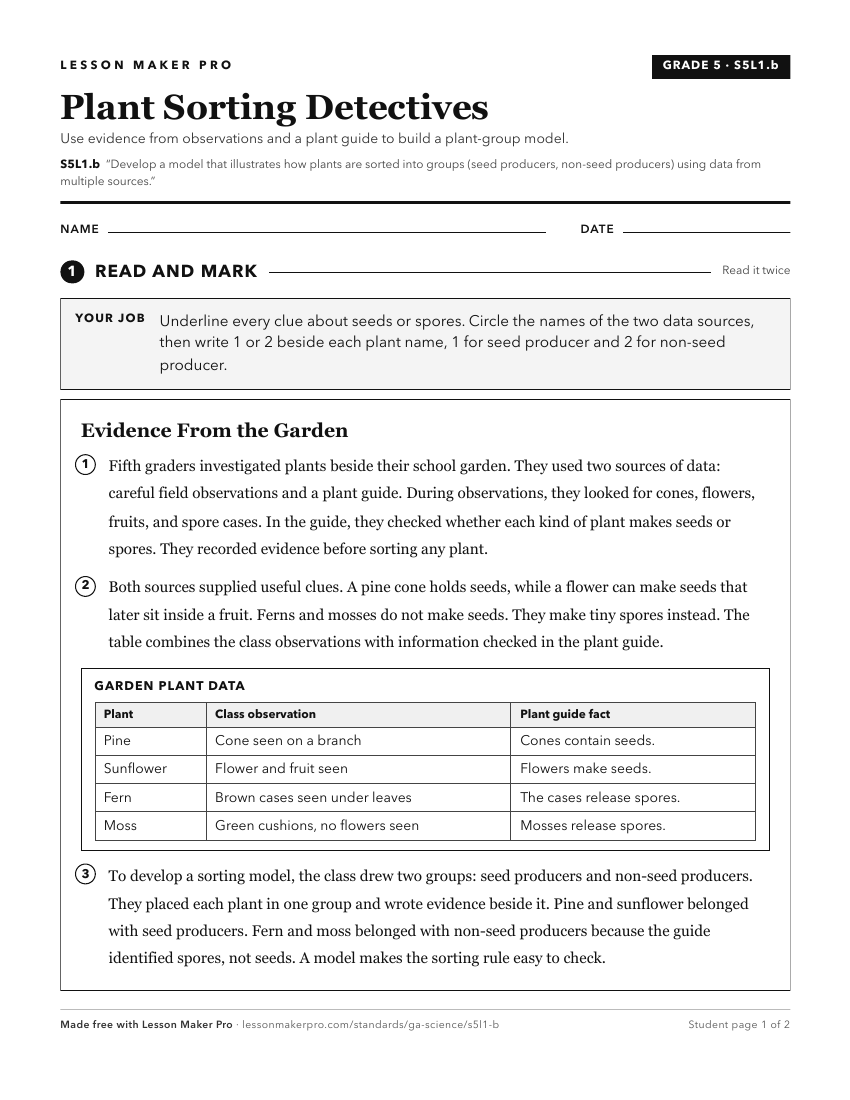
A ready-to-print activity worksheet aligned to S5L1.b, with an answer key for the teacher on its own page. No account needed.
PDF, US Letter, prints cleanly in black and white.
Download the worksheetKeep exploring
Related Standards
- S1L1.a
Develop models to identify the parts of a plant—root, stem, leaf, and flower.
- SKL2.b
Construct an argument supported by evidence for how plants can be grouped according to their features.
- SKL1.b
Develop a model to represent how a set of organisms and non-living objects are sorted into groups based on their attributes.
- S5L1.a
Develop a model that illustrates how animals are sorted into groups (vertebrate and invertebrate) and how vertebrates are sorted into groups (fish, amphibian, r...
Turn this exact standard into a lesson
Grade, subject, topic, and the complete standard are prefilled. Create one free, no account needed.
Also for this standard:Make a WorksheetMake a QuizMake a Sub Lesson