Georgia SKL1.b
The Standard
- SKL1
- Obtain, evaluate, and communicate information about how organisms (alive and not alive) and non-living objects are grouped.
Develop a model to represent how a set of organisms and non-living objects are sorted into groups based on their attributes.
Georgia Standards of Excellence for Science · Obtain, evaluate, and communicate information about how organisms (alive and not alive) and non-living objects are grouped.
Teacher's field guide
What This Standard Means
What Students Need to Do
- Students compare plants, animals, and objects by features such as color, shape, body covering, or whether they are living. They show their grouping with a drawing, hoop diagram, or picture chart and explain the rule they used.
What Mastery Looks Like
- Given a mixed collection, a student chooses a clear rule and places every item consistently. The student creates an understandable visual, explains each choice, and suggests another valid way to group the items.
Common Misconceptions
- Students may assume every group must be living or nonliving, even when another rule fits. They may call plants nonliving, treat moving toys as alive, or switch sorting rules halfway through. They may also think an item can fit only one possible group.
How to Assess It
- Give each student pictures of a dog, tree, bird, rock, spoon, and ball. Ask them to draw two labeled groups, place every picture, and explain their rule.
Lesson moves
Ways to Teach It
Place plant and animal cards, rocks, blocks, and buttons in hoops; students choose one feature, sort them, and sketch the result.
Ask, “Could a bird and a ball belong in the same group?” Students name a shared feature and defend their choice.
Play Rule Detective: sort four picture cards secretly, reveal the groups, and have students infer the rule before placing a new card.
Tour the playground, sketch six things, then group the sketches by a chosen feature such as living, color, shape, or movement.
Free download
Printable SKL1.b Worksheet
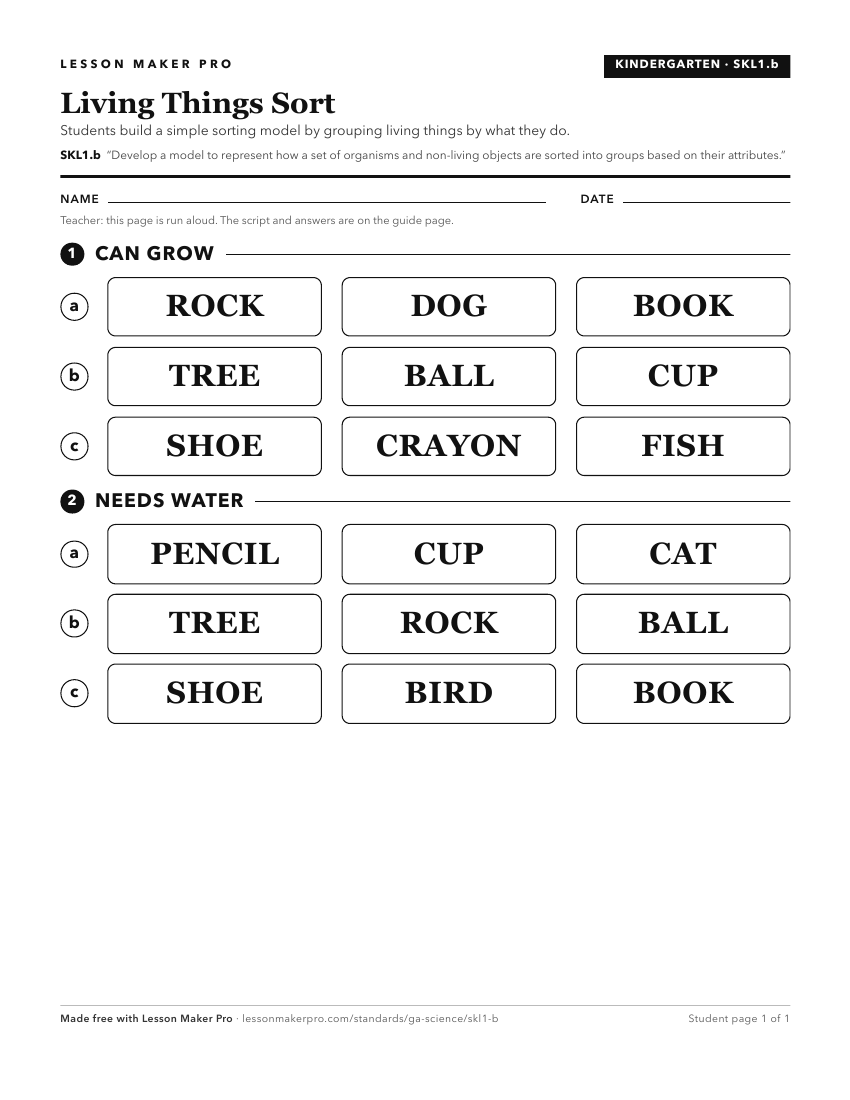
A ready-to-print activity worksheet aligned to SKL1.b, with an answer key for the teacher on its own page. No account needed.
PDF, US Letter, prints cleanly in black and white.
Download the worksheetKeep exploring
Related Standards
- S7L1.a
Develop and defend a model that categorizes organisms based on common characteristics.
- S5L1.a
Develop a model that illustrates how animals are sorted into groups (vertebrate and invertebrate) and how vertebrates are sorted into groups (fish, amphibian, r...
- S5L1.b
Develop a model that illustrates how plants are sorted into groups (seed producers, non-seed producers) using data from multiple sources.
- SKL1
Obtain, evaluate, and communicate information about how organisms (alive and not alive) and non-living objects are grouped.
Turn this exact standard into a lesson
Grade, subject, topic, and the complete standard are prefilled. Create one free, no account needed.
Also for this standard:Make a WorksheetMake a QuizMake a Sub Lesson