Georgia S7L2.a
The Standard
- S7L2
- Obtain, evaluate, and communicate information to describe how cell structures, cells, tissues, organs, and organ systems interact to maintain the basic needs of organisms.
Develop a model and construct an explanation of how cell structures (specifically the nucleus, cytoplasm, cell membrane, cell wall, chloroplasts, lysosome, and mitochondria) contribute to the function of the cell as a system in obtaining nutrients in order to grow, reproduce, make needed materials, and process waste.
Georgia Standards of Excellence for Science · Obtain, evaluate, and communicate information to describe how cell structures, cells, tissues, organs, and organ systems interact to maintain the basic needs of organisms.
Teacher's field guide
What This Standard Means
What Students Need to Do
- Students build a labeled model that shows how cell parts work together. They explain nutrient entry, sugar production, energy release, cell control, support, growth, reproduction, and waste processing.
What Mastery Looks Like
- Students can trace nutrients through a cell and connect each step to the correct structure. They distinguish plant and animal cell structures. They can predict how the cell would be affected if one structure stopped working.
Common Misconceptions
- Students often treat organelles as isolated parts instead of a connected system. They may put cell walls and chloroplasts in animal cells or say plants get food from soil. They also confuse cell walls with membranes and describe lysosomes as simple trash cans.
How to Assess It
- Give students blank plant and animal cell diagrams and ask them to label the seven structures, with lysosomes in the animal cell and cell walls and chloroplasts in the plant cell. Have them add arrows and captions showing how nutrient entry, sugar production, energy release, cell control, support, and waste processing help the cells function.
Lesson moves
Ways to Teach It
Build a cell pathway model with organelle cards and yarn, then move nutrient and waste tokens through each step.
Write: What would happen to a cell if its membrane worked but its mitochondria stopped, and why?
Play an organelle relay where teams match nutrient entry, sugar production, energy release, and waste cleanup cards to structures, then justify each match.
Trace glucose from a snack into a muscle cell, showing how the membrane, cytoplasm, and mitochondria help the cell use it.
Free download
Printable S7L2.a Worksheet
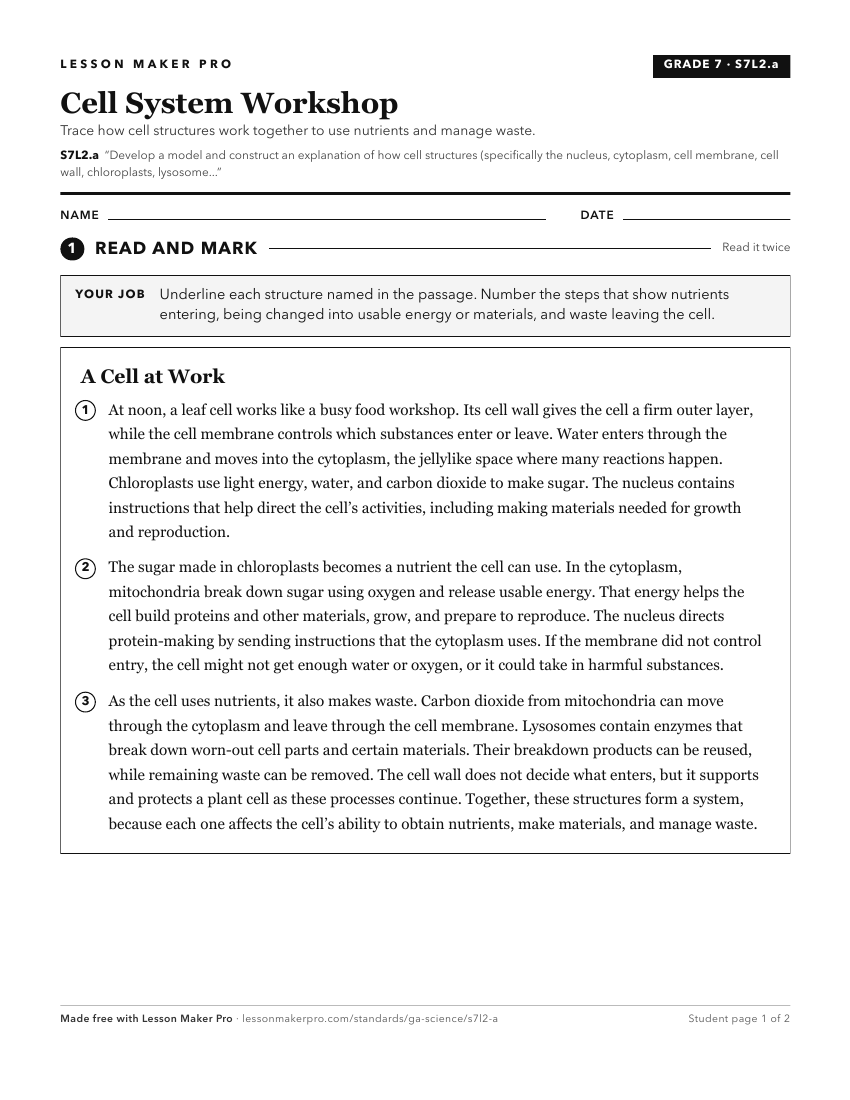
A ready-to-print activity worksheet aligned to S7L2.a, with an answer key for the teacher on its own page. No account needed.
PDF, US Letter, prints cleanly in black and white.
Download the worksheetKeep exploring
Related Standards
- S7L2.b
Develop and use a conceptual model of how cells are organized into tissues, tissues into organs, organs into systems, and systems into organisms.
- S5L3.b
Develop a model to identify and label parts of a plant cell (membrane, wall, cytoplasm, nucleus, chloroplasts) and of an animal cell (membrane, cytoplasm, and n...
- S7L2
Obtain, evaluate, and communicate information to describe how cell structures, cells, tissues, organs, and organ systems interact to maintain the basic needs of...
- S5L3.c
Construct an explanation that differentiates between the structure of plant and animal cells.
Turn this exact standard into a lesson
Grade, subject, topic, and the complete standard are prefilled. Create one free, no account needed.
Also for this standard:Make a WorksheetMake a QuizMake a Sub Lesson