Georgia S7L2.b
The Standard
- S7L2
- Obtain, evaluate, and communicate information to describe how cell structures, cells, tissues, organs, and organ systems interact to maintain the basic needs of organisms.
Develop and use a conceptual model of how cells are organized into tissues, tissues into organs, organs into systems, and systems into organisms.
Georgia Standards of Excellence for Science · Obtain, evaluate, and communicate information to describe how cell structures, cells, tissues, organs, and organ systems interact to maintain the basic needs of organisms.
Teacher's field guide
What This Standard Means
What Students Need to Do
- Students build and use a diagram or nested model to show levels of organization within one organism. They explain how parts at each level work together and predict how a change at one level affects higher levels.
What Mastery Looks Like
- Students can correctly arrange examples such as cardiac muscle cells, heart tissue, the heart, and the circulatory system. They can use their model to explain how damage to one part may affect the whole organism.
Common Misconceptions
- Students may confuse tissues with organs or treat an organ system as a single organ. They may also think each level works alone instead of depending on interactions with other levels.
How to Assess It
- Give students these terms: human, stomach, digestive system, muscle cell, and muscle tissue. Ask them to order the terms, draw labeled arrows, and explain what each arrow means.
Lesson moves
Ways to Teach It
Give pairs nested cups labeled cardiac muscle cell, heart tissue, heart, circulatory system, and human, then have them justify the nesting.
Ask students to write: How could damage to cardiac muscle cells affect the whole organism? Require links across every organization level.
Play a card sort relay in which teams order example cards and remove any card that does not belong in the sequence.
Present a skin burn case, then have students trace effects through skin cells, tissue, the skin organ, the integumentary system, and the person.
Free download
Printable S7L2.b Worksheet
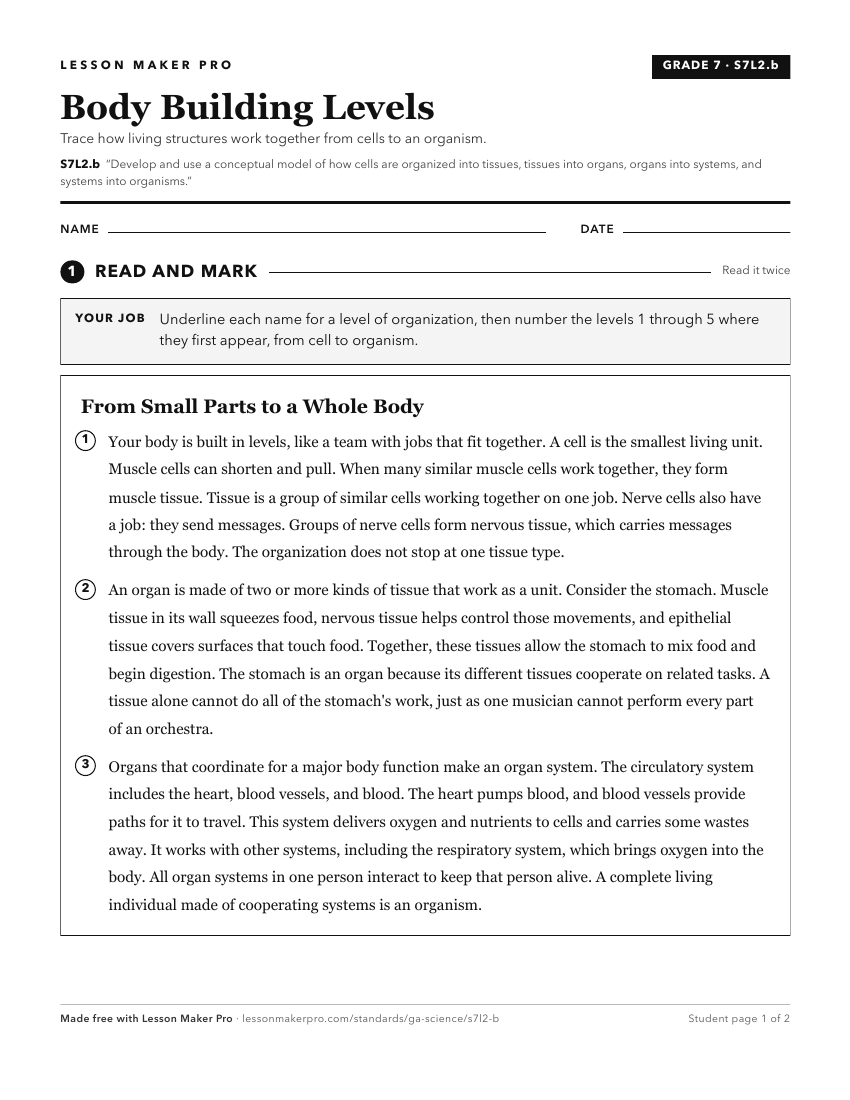
A ready-to-print activity worksheet aligned to S7L2.b, with an answer key for the teacher on its own page. No account needed.
PDF, US Letter, prints cleanly in black and white.
Download the worksheetKeep exploring
Related Standards
- S7L2.a
Develop a model and construct an explanation of how cell structures (specifically the nucleus, cytoplasm, cell membrane, cell wall, chloroplasts, lysosome, and ...
- S7L1.a
Develop and defend a model that categorizes organisms based on common characteristics.
- S7L2
Obtain, evaluate, and communicate information to describe how cell structures, cells, tissues, organs, and organ systems interact to maintain the basic needs of...
- SKL1.b
Develop a model to represent how a set of organisms and non-living objects are sorted into groups based on their attributes.
Turn this exact standard into a lesson
Grade, subject, topic, and the complete standard are prefilled. Create one free, no account needed.
Also for this standard:Make a WorksheetMake a QuizMake a Sub Lesson